
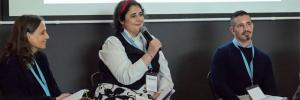
SU Department of Journalism Chair Dr Marenet Jordaan (centre) presents at an ICA preconference, titled “Journalistic Roles in Context: Global Views and Local Realities”.
Department of Journalism leaves its mark on historic first African ICA Conference
- The Department of Journalism participated in the International Communication Association (ICA) conference
- The Department hosted two preconferences
- Several academics presented at the conference
A strong Stellenbosch University (SU) Department of Journalism presence helped shape the first-ever African edition of the International Communication Association (ICA) conference, held in Cape Town from 4 to 8 June.
ICA is the leading global academic association for scholars interested in the study, teaching and application of all aspects of human and mediated communication. This year's conference attracted more than 3 000 delegates to the Cape Town International Convention Centre for five days of panel discussions, research presentations, plenary sessions and networking events.
The theme for the 2026 conference was “Communication and Inequalities in Context”. The conference invited critical reflection on the dynamics between communication and inequality across different social, cultural and geographical contexts. The aim was to encourage engagement with research exploring the deep divisions and existing interpersonal, institutional and structural inequalities in societies across the globe.
Prof Herman Wasserman, Professor in the Department of Journalism and Director of the Centre for Information Integrity in Africa (CINIA), says, “By hosting this conference in Cape Town, the ICA is demonstrating a meaningful commitment not only to expanding its global reach, but also to enriching the field of communication scholarship. Inclusion, diversity and access must go beyond symbolism to recognising that knowledge shaped primarily by scholars in well-resourced countries offers only a partial understanding of our world. We are delighted that this conference helped broaden the range of voices and perspectives shaping our discipline.”
Staff and students from the Department of Journalism played key roles in the build-up to and during the conference. Wasserman, together with Department Chair Dr Marenet Jordaan and PhD Programme Convener Dr Meli Ncube, served on the local organising committee for ICA 2026.
The Department also organised two preconferences ahead of the main event. These independently organised gatherings provided opportunities for more focused and in-depth discussions on themes related to the broader conference programme.
On 3 June, CINIA, which is part of the Department of Journalism, co-hosted a preconference titled “Global Disruptions: Platforms, Power and Contested Communication” at Lanzerac Wine Estate in Stellenbosch. The preconference brought together scholars to examine the role of media and communication in disrupting states and societies around the world.
The second preconference, organised by Jordaan, was titled “Journalistic Roles in Context: Global Views and Local Realities”. Discussions explored how universal journalistic ideals intersect with local cultural norms, political structures, media platforms and contextual realities. Nadine Christians and Landi Slatter, doctoral students in the Department, as well as alumnus Dr Andre Gouws supported organising the event.
Conference
Staff and students from the Department were also actively involved in the main conference programme, chairing sessions and presenting research across a wide range of topics.
Prof Mehita Iqani, Director of the Centre for Science and Technology Mass Communication (CENSCOM) and Chair of the DST-NRF South African Research Chair in Science Communication, which sits within the Department of Journalism, together with postdoctoral fellow Dr Christel Antonites, presented a paper, titled “Messy Baboons, Angry Humans: Waste as Multispecies Mediator in a Neighbourhood in South Africa's Noordhoek Valley”.
Iqani also participated in a South African Communications Association panel discussion on “Waste and Luxury as Lenses for Inequality in African Contexts” and presented a second paper, “From Zibi to Bingo: South African Anti-littering Adverts and the Discourse of Personal Responsibility”.
Wasserman and Yossabel Chetty, a researcher at CINIA and PhD candidate in the Department, co-presented a paper, titled “Hate Speech and Intersectionality in Africa” as part of a panel on global hate speech research.
In addition, Wasserman chaired a session, titled “Who Makes Crisis Visible? Platforms, NGOs and News Media”, participated in a panel on political influence in 2026, and contributed to a session examining the democratic implications of the global rise of political influencers. He also launched the book Media on the Margins in South Africa, co-edited by Prof Franz Krüger and Prof Sarah Chiumbu, which explores the role of community and local media.
The conference also provided an invaluable opportunity for staff and students to learn from and engage with leading international scholars conducting research in the communications space.
Jordaan says, “The Department of Journalism at SU had a wide footprint at the event, with staff and students presenting at, and attending, the main conference, as well as several preconferences. The event offered our Department the opportunity to showcase our research and ideas on a global stage. The wide-ranging involvement of the Department in the conference and related events, was indicative of its continued standing in the broader academic community. We are proud of our representatives for the hard work they put in to ensure that the Department of Journalism, and SU made its mark at the first ICA conference in Africa.”
Related stories

Education
Scholars reflect on the transformative legacy of Prof Lis Lange
Colleagues, friends, and students of the late Prof Lis Lange recently assembled in the Library Auditorium at Stellenbosch University (SU) for a memorial...
Campus life
Health and wellbeing workshop charts a humanising path forward for SU
Stellenbosch University (SU) has taken a decisive step towards strengthening a more human-centred institutional culture with a two-day Health & Wellbeing...
Events
Prof Lis Lange remembered for her integrity, intellect and indomitable spirit
A profound sense of sadness and gratitude suffused the Old Main Building of Stellenbosch University’s (SU) Faculty of Law on 5 November, as colleagues, friends...