
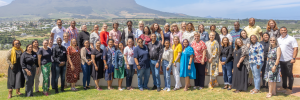
SU staff gathered for a two-day strategic workshop hosted by the Institutional Committee of Staff Health and Wellbeing to co-create a more integrated, multi-dimensional, compassionate approach to health and wellbeing.
Health and wellbeing workshop charts a humanising path forward for SU
- SU staff gathered for a two-day strategic workshop hosted by the Institutional Committee of Staff Health and Wellbeing to co-create a more integrated, multi-dimensional, compassionate approach to health and wellbeing.
- Participants drawn from the Wellbeing Ambassador Programme and other environments engaged deeply, raising both concerns and solutions, while praising an inspiring case study.
- The workshop marked a significant step in shaping a values-based wellbeing strategy grounded in modern wellbeing science, collaboration, honesty and shared purpose.
Stellenbosch University (SU) has taken a decisive step towards strengthening a more human-centred institutional culture with a two-day Health & Wellbeing Strategic Workshop held recently at the Protea Hotel in Technopark. Staff members from across the institution came together not to listen passively, but to engage in learning conversations, to reflect and to co-create.
In his welcoming address Prof Nico Koopman, Deputy Vice-Chancellor: Social Impact, Transformation and Personnel, acknowledged the immense pressures facing individuals and communities. He emphasised that the quest for wellbeing is universal and calls for depth, honesty and a collective willingness to rethink conventional approaches. “As human beings we share a trait: vulnerability,” Koopman said. “It is not about showing weakness, but the courage to embrace authenticity.”
Koopman linked wellbeing directly to SU’s vision of a flourishing academic community grounded in purpose, partnership and care. His call for a more deeply embedded culture of wellbeing set the tone for the deliberations that followed, which moved beyond broad concepts into practical questions about how SU can support healthier, more connected ways of working that include the staff’s full authenticity as humans.
Dr Kathryn Grammer, Senior Director of Campus Health and organiser of the event, provided an overview of the University’s wellbeing journey, tracing the collaborative efforts that shaped the workshop. Grammer said although there have been “wonderful efforts” at SU, there is a need for alignment and integration of health and wellbeing initiatives.
“How we aspire to approach wellbeing for the next five years is why we are gathered here today,” she explained. A new approach should be ecosystemic, integrated and embedded requiring not just more coordination, but synthesis in practice, she stressed. Global thinking in workplace wellbeing practices was outlined to build a better shared understanding of key occupational wellbeing drivers, noting its multi-disciplinary approach.
Grammer’s reflections highlighted what many participants would echo over the next two days: staff health and wellbeing are not peripheral concerns, but central to a thriving, values-driven University that places people at the centre.
Interventions that ignite insight – and honest reflection
Presentations on the second day brought the lived realities shaping staff wellbeing into sharp focus. The morning session opened with Prof Gina Gorgens from the Department of Industrial Psychology shedding light on how burn-out, depression and anxiety can affect work culture and how, in turn, toxic environments can breed toxic behaviours.
Gorgens argued that wellbeing is inseparable from institutional performance. She also shared research on how technostress and anxiety about artificial intelligence in the workplace can contribute to exhaustion, thus impacting overall digital wellbeing.
She referred to the Conservation of Resources theory, which provides a framework for understanding how resources, including personal traits like resilience, grit and self-efficacy, shape wellbeing. “Those with strong personal resources are better equipped to access further support, forming positive cycles of resilience,” she observed. “Conversely, a lack of resources can drive spirals of stress and disengagement downward.”
Dr Alten du Plessis from the Division for Institutional Strategy, Research and Analytics presented insights from the Flourish4Life initiative. By drawing on evidence-based practices used in clinical psychology, the programme supports students and staff in building resilience, cultivating emotional skills and integrating wellbeing practices into daily life. “Thriving is achievable when individuals have access to tools and support,” Du Plessis said, stressing that wellbeing cannot be treated as separate from academic and institutional work.
Case study of the four-day work week
Participants were especially energised by the insights shared by Dr Charl Davids, Director at the Centre for Student Counselling and Development (CSCD), who offered a candid account of his Division’s journey towards a four-day work week – an initiative that has yielded significant positive outcomes for staff wellbeing, productivity and resource management over the past two years.
The pilot, launched in February 2024, arose from urgent challenges facing the CSCD. “We were seeing mounting pressure in our environment,” Davids recounted. “Staff were experiencing burnout and health issues, compounded by long student waiting lists and high workloads. With salary increases out of reach, we knew we needed a different solution.”
After extensive consultation, the CSCD leadership opted to pilot a four-day work week, introducing a dedicated “wellness day” each week. This was guided by the principle that productivity should be measured by outcomes, not just hours at a desk. “It’s not about working less. It’s about working smarter and putting our health first,” Davids emphasised.
The effects were marked: “Sick leave dropped significantly, consulting fees declined and staff reported better mental health, greater job satisfaction and improved work-life balance,” Davids noted.
He acknowledged the challenges of implementing such a model across different departments, particularly where outputs are less quantifiable and environments not as contained. However, he emphasised the importance of leadership that prioritises staff wellbeing: “If we are to foster a truly humanising culture, we must be creative and flexible, tailoring solutions to the realities of each environment,” Davids cautioned.
The four-day week case study showed that bold experimentation can lead to healthier teams and improved productivity, one participant noted. Another described it as a “game-changer” that shifted how she thought about trust, autonomy and the future of work at SU.
The discussions also brought to the surface challenges that cannot be solved overnight. Staff voiced concerns about systemic challenges, workloads, remuneration, a lack of collective bargaining opportunities, resources and the emotional demands placed on teams. Upcoming policy implementation, such as the Performance Advancement Framework, will address recognition and reward systems once implemented in 2026 to tackle some of these concerns.
Workshop ‘a turning point’
What set this workshop apart, attendees agreed, was the spirit of participation. The sessions were highly interactive, with facilitators Drs Lianne Keiller and Lesedi Makhurane creating spaces for open dialogue and creative problem-solving. The room often hummed with the energy of staff sharing candid stories, mapping systemic challenges and brainstorming a wellbeing vision for the future. Over tea and lunch staff could be seen revisiting ideas and sharing experiences so that a distillation of five critical elements that will underpin SU’s wellbeing strategy was agreed by consensus.
“The fact that concerns were not brushed aside but engaged with openly is what made the workshop feel real and hopeful,” one participant noted. “You could feel the excitement. People genuinely wanted to rethink how we do things at SU. The workshop acknowledged the difficulties, but it also gave us a sense of possibility.”
By the close of the second day, themes had begun to crystallise: the need for institutional consistency; the importance of compassionate leadership; the value of emotional intelligence in navigating modern academic life; and the urgency of addressing structural pressures that undermine wellbeing. These insights will directly inform SU’s evolving wellbeing strategy, Grammer confirmed in her closing remarks.
“We are going to move together with purpose because you have generated massive ideas and rich conversations about your lived experiences,” she said. The workshop marked a turning point for SU’s wellbeing strategy, she added, noting that months of groundwork had now gained “real momentum”.
The ideas generated at the workshop will be carried forward through a clear governance process, feeding into the Institutional Committee for Staff Health and Wellbeing. The renewed collaboration and shared purpose across SU signal a promising foundation for implementing the new wellbeing framework, Grammer concluded. Further rounds of consultation and comment will take place in the new year once the draft framework is written up and circulated.
While challenges remain, participants overwhelmingly described the workshop as a positive and necessary step forward. As one attendee put it: “I believe it has sparked a wellness movement – one I’m proud to be part of and eager to help carry forward.”
Related stories

Events
Department of Journalism leaves its mark on historic first African ICA Conference
A strong Stellenbosch University (SU) Department of Journalism presence helped shape the first-ever African edition of the International Communication...

Education
Scholars reflect on the transformative legacy of Prof Lis Lange
Colleagues, friends, and students of the late Prof Lis Lange recently assembled in the Library Auditorium at Stellenbosch University (SU) for a memorial...
Events
Prof Lis Lange remembered for her integrity, intellect and indomitable spirit
A profound sense of sadness and gratitude suffused the Old Main Building of Stellenbosch University’s (SU) Faculty of Law on 5 November, as colleagues, friends...