
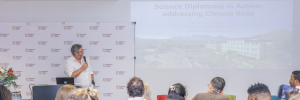
Who owns the narrative? Science diplomacy sparks conversations at SIAN 2026
- As part of the SIAN 2026 programme, the workshop explored the tension between scientific empiricism and diplomatic storytelling. While science speaks through data, diplomacy is driven by how issues are framed, raising the critical question: "Who owns the narrative?
- A major point of discussion was the exclusion of the Global South from the tools that shape global policy. Because most climate and sustainability models are developed in the Global North, the specific needs and strategic potential of Africa are often overlooked in international negotiations.
- Beyond generating knowledge, universities were highlighted as essential diplomatic actors that build cross-border networks. Science diplomacy was framed as a way to sustain relationships of trust and mutual respect that outlast political cycles and drive long-term change.
When it comes to climate change, sustainability, and development, influence comes from two sides. Those who provide the evidence (the data) and those who tell the stories. Both play key roles.
That was one of the central messages at the Stellenbosch International Academic Network (SIAN) Workshop 2026. Stellenbosch University International (SUI) hosted the event from 8 to 14 March. Delegates from around the world came together to discuss why science diplomacy matters more than ever in today’s complex world.
On the second day of the workshop, which focused on science diplomacy, Professor Guy Midgley, Director of the School for Climate Studies at Stellenbosch University (SU), encouraged delegates to consider how evidence, influence, and power interact.
“Who owns the narrative?” Midgley asked. “Climate change, population growth, and sustainability are arenas where competing stories of crisis, opportunity, responsibility, and blame influence political decisions long before evidence is fully considered.”
In his keynote, he discussed the main challenge in science diplomacy: science relies on evidence and proof, while diplomacy often relies on framing, persuasion, and storytelling. “Science speaks through empiricism and attribution; diplomacy speaks through framing and story,” he said.
To illustrate the point, Midgley turned to an unexpected example: the Pirahã people of the Amazon rainforest. “Their language”, he explained, “requires that every statement be attributed to its source. A claim cannot be made in isolation; it must be supported by evidence or testimony”.
What makes this even more striking is that the Pirahã have no grammatical concept of past or future as they live almost entirely in the present. Their communication is grounded in direct experience, where only what has been seen, heard, or reliably told can be trusted.
For Midgley, this contrast mirrors scientific practice, where knowledge must be verifiable and evidence-based, versus diplomacy, which is shaped more by how issues are framed, interpreted, and communicated than by proof.
Midgley said this is similar to science, where every conclusion needs support from data, models, or peer-reviewed research. However, in diplomacy, arguments often centre on how problems are described, whose interests are highlighted, and what futures are imagined, rather than strictly on data.
He argued that this difference is central to science diplomacy.
Climate change as a diplomatic struggle
Midgley described climate change as both an environmental crisis and a geopolitical struggle over limited resources. “It’s a fight over the remaining carbon space in the atmosphere for economic activity,” he said.
In other words, each country’s development depends on how much carbon it can still emit while keeping the climate safe. Decisions about this carbon budget are influenced by scientific models, politics, negotiation, and access to information.
Midgley, who has participated in international climate negotiations and contributed to the Intergovernmental Panel on Climate Change (IPCC), drew on his own experience to show how these global decisions are made. “You don’t just raise your hand in a ministerial meeting,” he explained. “You lobby, you have corridor conversations, you understand the process, and sometimes you see your own text appear in the final decision a few days later.”
In this environment, science is important, but so are relationships, trust, strategy, and timing. This conversation about influence naturally led to questions of scientific modelling and representation in climate policy.
Midgley raised a major concern about the uneven distribution of scientific resources worldwide, especially regarding the models that guide climate and sustainability policy.
Most integrated assessment models, which help predict future emissions and guide climate talks, are still mainly developed in the Global North. As a result, the science that shapes global policy often comes from outside the areas most affected by climate change.“We are excluded from the table because we don’t have the tools,” Midgley said.
This imbalance has real effects, he argues. When models and scenarios are created elsewhere, the needs and priorities of Africa and the Global South can be overlooked.
At the same time, Midgley emphasised Africa’s central and active role in sustainability. He pointed out that Africa is not just affected by climate change—it is central in developing future global strategies.
He highlighted Africa’s urban growth, large population, and environmental significance. The Southern Ocean absorbs much of the world’s carbon dioxide. Southern Africa is among the most climate-sensitive regions globally.
If high emissions continue, some parts of southern Africa could warm by more than 5°C to 6°C above pre-industrial levels. This would have serious effects on ecosystems, agriculture, water resources, and people’s well-being.
For Midgley, this situation brings up tough questions for Africa. “Do we develop and adapt, or do we mitigate? That is a diplomatic question.”
Rethinking the global story
Midgley also challenged some widely repeated global narratives, including the idea that the world is racing uncontrollably towards a population precipice.
While the global population is still growing, he argued that growth is slowing. Many parts of the world now face a different problem: aging populations and declining fertility.
“We need to be careful of strategic dissonance,” he said, referring to situations where policy is built on outdated or misleading assumptions. “Our strategies can become dissonant with reality because the narrative is fooling us.”
This is very important for Africa. While people often talk about the continent’s future as a crisis, Midgley suggested we should also see its growing population, development potential, and the opportunity to shape new paths toward sustainability.
He argued that this is exactly why science diplomacy is important. It’s not just about sharing evidence, but also about deciding whose evidence matters and whose story shapes the future.
Universities as science diplomacy actors
Before Midgley’s talk, Dr. Heide Hackmann, Chair in Science Futures at SU’s Centre for Research on Evaluation, Science and Technology (CREST), gave an overview of how science diplomacy has developed as both a practice and a key strategic field.
Hackmann has worked for many years in international science policy and global research, including serving as chair of international science councils. She pointed out that although the term “science diplomacy” is fairly new, the practice has been around much longer.
She mentioned Cold War-era efforts like the Pugwash Conferences and the International Institute for Applied Systems Analysis as examples of how science has helped keep dialogue open across political divides.
Today, though, the situation is even more challenging.
Hackmann described a world facing many overlapping crises, including climate instability, war, weak international cooperation, diminished trust in science, disinformation, AI disruptions, and increased geopolitical competition.
“We sit today not only with unmet goals,” she said, referring to frameworks such as the Sustainable Development Goals and the Paris Climate Agreement, “but also with a world of converging risks, existential threats and increasingly limited space for diplomacy.”
She argued that in this situation, science diplomacy should go beyond just supporting scientific teamwork. It should help build trust, encourage public discussion, and ensure that knowledge from around the world shapes decisions.
“We need to ensure that scientific knowledge from the majority world is part of the narratives that shape global policy,” Hackmann said. She also said that universities have an important role to play as Universities don’t just create knowledge. They also build networks, bring people together, and provide the foundation that connects evidence to policy and diplomacy.
Hackmann suggested that science diplomacy shouldn’t be left to just a few experts. It’s becoming more important for international offices, researchers, university leaders, and the whole academic community.
Beyond rhetoric towards equity
A strong thread in both talks was the need for more equitable scientific collaboration. Midgley said progress slowed after a major German-funded research program in southern Africa ended. That program had built local Earth systems science networks and expertise. He emphasized that steady resources and teamwork enabled this progress, but much was lost when funding stopped.
“What an unbelievable missed opportunity,” he said. Both speakers agreed that the challenge now is to make science diplomacy stronger in practice. It must also be practical, fair, and responsive to the needs of different regions.
This means building stronger modelling skills, strengthening networks in Africa and the Global South, supporting science diplomacy, and ensuring cooperation leads to real change—not just symbolism.
Hackmann captured this in her closing reflection on what science diplomacy should ultimately seek to do.
“The collaborations we forge through science diplomacy have to build and sustain relationships of trust, mutual understanding and respect that outlast political cycles,” she said. “And we need to direct those relationships towards change.”
A conversation that goes beyond climate
Although climate change was a big focus, the session went beyond just climate science.
The discussion raised broader questions about power and who gets heard in global knowledge systems. Who decides what evidence is credible? Who has the resources to predict future risks? Whose priorities guide international policies? And how can universities in Africa and the Global South help create solutions instead of just reacting to them?
At SIAN 2026, science diplomacy was shown to be an urgent practice connecting research, policy, international cooperation, and justice.
And at the centre of it remains Midgley’s question:
Who owns the narrative?