
From mobility to meaning: SIAN 2026 explores new ways to put internationalisation into practice
- Discussions at SIAN 2026 emphasized that internationalisation is no longer just about mobility, but about creating inclusive communities where every student feels seen and heard.
- A key focus of the program was empowering staff across all levels to become practitioners who carry global and intercultural perspectives into their daily work.
- Shifting Toward Intentional Partnerships: The network explored a move away from broad agreements toward focused, reciprocal relationships that prioritize trust and strategic alignment over high volumes of activity.
People often think of internationalisation in higher education as student exchanges, travel, or partnership agreements. On the third day of Stellenbosch University International’s (SUI) Stellenbosch International Academic Network (SIAN) 2026, however, the conversation turned practical. What does internationalisation actually look like in the daily life of a university?
Sarah van der Westhuizen, Director of the Centre for Global Collaboration and programme director for the day, said: “Internationalisation needs to be intentional. It’s not just about activity, but about where and why we engage.”
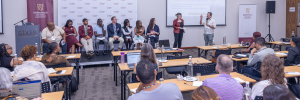
Held from 8 to 14 March at Stellenbosch University (SU), SIAN 2026 brought together delegates from around the world to discuss how internationalisation is evolving. Led by Van der Westhuizen, the day’s discussions focused on three practical areas: student integration, staff development, and partnership strategy.
All three panels agreed that internationalisation is no longer just about mobility. It now means building inclusive campus communities. It also means helping staff develop global and intercultural skills and creating purposeful, reciprocal, and strategically aligned partnerships.
Student integration: Belonging starts with being seen
The first panel, led by colleagues from SUI’s Unit for Global Learning, focused on student voices and the real experiences of international students in campus integration.
One key point from the discussion was that international students are not all the same. Full-degree students, semester students, refugee and displaced students, and those in short-term mobility programmes each have different experiences. They need different types of support.
Students talked about how orientation, residence communities, mentoring, student societies, and peer networks help them find their way on campus. They also shared that feeling like they belong often starts with being noticed. Simple things make a big difference, like having their names pronounced correctly, seeing their culture represented at events, or finding a community that understands their background.
As one student noted, “International students are not just part of a programme — they are people with their own aspirations, challenges and stories.”
The panel also brought up some real concerns. Some students said that while support and opportunities are available, they are not always easy to find or access. Others, especially refugee and displaced students, mentioned extra challenges. These include paperwork, funding issues, and uncertainty about their rights and opportunities.
The discussion showed that effective integration is more than just offering programmes. It means creating student-focused support systems that address complex needs. These systems should close information gaps and give students real chances to connect.
Staff internationalisation: building global capacity across the institution
The second panel focused on staff, saying that internationalisation is not just the job of academics or international offices.
Speakers gave examples of staff development projects supported by bilateral, trilateral, and Erasmus+ partnerships with universities like Lund University, the University of Hamburg, and Northwestern University. They also discussed programmes like the EQUiiP Summer School. This programme focuses on inclusive teaching and learning.
A key takeaway was that staff internationalisation is more than just mobility. Lidia du Plessis, Programme Manager for Staff Internationalisation at SUI, said: “These exchanges are not just about travel. They are about building people who can carry internationalisation into their everyday work.” These initiatives offer professional development. They help staff become what speakers called “internationalisation practitioners”—staff who can bring global, intercultural, and inclusive perspectives into their daily work.
This applies to academic, professional, administrative, and support staff. Participants said these programmes help build intercultural skills, confidence, and peer networks. They also help form communities of practice that last beyond the exchange.
The panel also pointed out the value these initiatives bring to the university. By investing in staff development and recognising the international side of staff roles, universities can build stronger teams. They can deepen partnerships and become more attractive employers in a competitive global environment.
Partnerships with purpose: from broad networks to strategic focus
The third panel examined how universities are approaching partnership development more intentionally.
Speakers from Germany, Colombia, and Brazil talked about the opportunities and challenges of creating global and regional partnership strategies. While each university has its own approach, many are moving away from numerous loosely connected agreements and instead building more focused, purposeful relationships.
Panelists said that regional priorities usually come from the university’s overall strategy, not as separate goals. Sometimes, focusing on certain regions helps balance out partnerships. In other cases, it’s a response to funding, research needs, or the desire to work more closely in specific parts of the world.
One important topic was collaboration within the Global South. Participants agreed that these partnerships are often overlooked, even though they can offer great opportunities. These include shared learning, fair exchange, and research that fits local contexts.
The panel also stressed that reciprocity does not mean each partner gives the same thing. It is about fairness. Each institution brings its own strengths, resources, and value to the partnership.
Overall, the discussion showed that successful partnerships need more than just a good strategy. They also rely on data, trust, flexibility, and a real commitment to working together, not just signing agreements.
A shared responsibility
One clear message from all three panels was that internationalisation is no longer just a special task for mobility offices or formal agreements. It is now a shared responsibility across the whole university. It is co-created by people, practices, and purpose.
For students, this means making sure they feel they belong. For staff, it’s about building skills, confidence, and opportunities throughout the university. For partnerships, it’s about choosing where and how to work together for the most impact.
SIAN 2026 showed that internationalisation is not just about crossing borders. It’s about what universities do with those connections once they are made.