
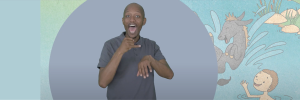
A scene from one of the videos where a Deaf storyteller interprets a children’s storybook published by Book Dash in South African Sign Language.
SU’s Handlab and Book Dash open new worlds for Deaf children
- A landmark partnership brings the full Book Dash library of more than 200 African children’s books to life in South African Sign Language (SASL).
- Deaf storytellers from across the country join the project to create expressive, culturally diverse SASL story videos.
- With more than half the stories already recorded in SASL, the collaboration signals a major shift toward inclusive early literacy in South Africa.
A quiet revolution underway in early childhood literacy didn’t begin in a classroom, but in a studio where Deaf storytellers rehearse, sign and retell African stories in the expressive rhythms of South African Sign Language (SASL). Here, a collaboration between Stellenbosch University’s (SU) Handlab and social impact publisher Book Dash is reshaping access to stories for Deaf children across the country.
For the first time, the entire Book Dash library – 221 picture books created by volunteer writers, illustrators and designers – is being translated and recorded in SASL, ensuring that Deaf children can encounter stories in their own language from their earliest years. It is a project grounded in linguistic rights, community representation and the belief that every child deserves a story that speaks to them.
Expanding access through language
Handlab, a curriculum material development project within SU’s Department of General Linguistics, has long worked to develop learning and teaching support material for the school subject SASL Home Language. For years, their team of Deaf and hearing individuals have been producing video texts and teaching resources for the more than 40 schools for the Deaf and Hard of Hearing across the country. Their partnership with Book Dash began modestly, with the translation of a handful of stories.
The recognition as South Africa’s 12th official language of SASL in 2023 turbocharged this earlier work. “The translation of the full Book Dash library into SASL is a milestone because it tackles one of the most persistent barriers facing Deaf children: access to early language and literacy,” says Vanessa Reyneke, Handlab’s Project Coordinator. Many Deaf children enter school with a limited language foundation, she explains, often because their families do not (yet) sign. Early exposure to engaging stories in SASL can shift the entire trajectory of their learning.
Book Dash, founded on the principle that every child should own a hundred books by the age of five, saw natural alignment in expanding its library into SASL. Publishing Manager Zanri Kritzinger says the collaboration reflects their core mission: “Book Dash works towards a world where every child, regardless of their abilities or economic situation, has access to books – and preferably in their home language.”
Years of partnership meant the organisations were ready when the policy landscape changed. As former Book Dash Executive Director Julia Norrish wrote in a post celebrating the initiative, long-term collaboration and shared values made it possible to move swiftly once SASL gained official recognition. Suddenly, it was feasible to fund the translation of the full collection.
Diversity of the deaf community represented
Handlab’s team knew that representation mattered. Filling the project with a single signing style or region would narrow children’s exposure to the language’s richness. They wanted Deaf storytellers from different provinces, with different identities and signing styles, to help bring the stories to life.
To achieve this, they advertised widely and hosted four recording camps in Cape Town, Johannesburg and Durban. Eighteen Deaf adults were selected to participate. What followed was both rewarding and challenging.
“One of the biggest breakthroughs has been bringing storytellers together from across the country,” Reyneke says. “We now have a collection of rich, expressive videos that showcase the diversity of the Deaf community.”
But the process required far more time than expected. Handlab initially estimated that each story might take one or two hours to record. In practice, some storytellers needed up to six hours to prepare, rehearse and film a single story. The team persisted, offering guidance and continuous support. The result: 115 stories have already been filmed.
The same event marked a historic first for Book Dash: a story created in SASL as its original language, crafted by Deaf volunteers who joined the fast-paced 12-hour bookmaking challenge. For Kritzinger, this represented a turning point in inclusive storytelling.
A foundation for future readers
Early feedback from educators and partners suggests growing enthusiasm for the SASL library. While the project is still underway, Kritzinger says responses from Book Dash’s Open Content Partner Sharing Session highlighted how audiences valued the inclusive approach and the insight into sign language translation.
Reyneke believes the impact will be far-reaching. “We hope this initiative helps shift the literacy landscape by ensuring that Deaf children are not excluded from the joyful, story-rich childhood that hearing children often take for granted,” she says. The SASL videos also offer a bridge for families: Caregivers who are not fluent in SASL can still share stories with their children.
The work is supported by donor funding and an ethos of open access. All finished videos – 59 so far – are freely available at www.bookdash.org, alongside audiobooks, wordless books and multilingual editions. Both organisations see this openness as essential to widening access, especially in communities with limited reading materials.
Long term, Handlab plans to continue working with Book Dash until the full collection is complete. Beyond that, Reyneke hopes the project will contribute to an education system where Deaf children have equitable access to early literacy and where SASL is fully integrated into early childhood development.
The partnership signals a shift in what is possible when Deaf expertise, university research and social impact publishing come together. In studios across South Africa, as storytellers sign gentle beginnings and dramatic turns of beloved African tales, a new generation of readers is discovering not just the pleasure of stories, but the power of seeing their language reflected back at them.
- Here is the link to all the Book Dash books already available in SASL.
Related stories
Arts, languages and social sciences
Dr Sishuwa appointed as a visiting scholar at Harvard
Dr Sishuwa Sishuwa, a Senior Lecturer in History at Stellenbosch University’s (SU) Faculty of Arts and Social Sciences, has been appointed visiting scholar at...
Media release
Learning leadership from horses at SU
Leadership lessons at Stellenbosch University (SU) sometimes happen beyond lecture halls and meeting rooms.
Instead, they unfold in the university’s paddocks...
Media release
Council appoints Prof Liezl van Dyk to advance academic coherence, innovation and student success at SU
The Council of Stellenbosch University (SU) has appointed Prof Liezl van Dyk as Deputy Vice-Chancellor: Academic, effective 1 July 2026.
The appointment follows...