
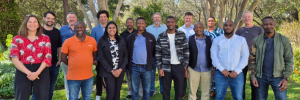
Some of the participants in the first South African Ocean and Land Carbon Dioxide Removal (CDR) Science-Policy Workshop at STIAS in September 2025. Picture: Skyla Thornton
SU leads South Africa’s preparations for carbon removal to curb global warming
- Stellenbosch University (SU) has stepped up to guide one of the most contested yet vital responses to global warming: Carbon Dioxide Removal (CDR).
- SU hosted a first-of-its-kind national science-policy workshop at the Stellenbosch Institute for Advanced Study (STIAS)
As the dust settles on COP30 in Brazil, the urgency for climate action has never been greater. It is in this critical context that Stellenbosch University (SU) has stepped up to guide one of the most contested yet vital responses to global warming: Carbon Dioxide Removal (CDR).
While United Nations (UN) Secretary-General António Guterres warned last month that the failure to limit warming is “deadly negligence,” countries are realising that emission cuts alone are not enough. They are turning to CDR – approaches that actively remove CO₂ from the atmosphere and store it on land, underground or in the ocean.
To lay the groundwork for this in South Africa, SU hosted a first-of-its-kind national science-policy workshop at the Stellenbosch Institute for Advanced Study (STIAS) in September. The event brought together leading researchers and government partners to build the foundations for responsible, evidence-based carbon removal.
The event was organised by SU’s School for Climate Studies (SCS), in collaboration with the University of the Witwatersrand, the South African Environmental Observation Network, the Department of Forestry, Fisheries and the Environment (DFFE), and the Presidential Climate Commission.
It started a process to ensure that South Africa develops its own frameworks for evaluating CDR options – before global pressures and the private sector set the terms.
Scientific foundations
The workshop built on a 2023 South African Journal of Science paper by SU’s Profs Pedro Monteiro and Guy Midgley, which called for a national science-policy partnership to guide South Africa’s approach to CDR. Their analysis warned that global investment and commercial interest are accelerating far faster than the scientific evidence base or regulatory systems.
Monteiro, a former lead author of the IPCC’s Sixth Assessment Report, now heads CDR research at SU’s SCS. And Midgley, the founding Director of the School, is recognised internationally as one of the world’s most influential climate-change scientists.
Opening the workshop, Monteiro warned that CDR is already attracting major investment from technology companies seeking offsets for their emissions. Without clear scientific standards and governance, he said, the field risks becoming a “Wild West”.
He noted: “Societal trust is vital. CDR can only succeed if it is transparent, science-based and aligned with genuine emissions cuts.”
Participants heard that CDR could in future contribute perhaps 10% of the global journey to net-zero – but this will only be meaningful if it is accompanied by deep, sustained reductions in fossil-fuel emissions.
“Nothing will save us” if emissions are not reduced by around 90% at the same time, Prof David Ho of the University of Hawai‘i at Mānoa said via a live video link.
Land, ocean and avoiding ‘mal-mitigation’
Much of the workshop centred on ecological realities that must guide responsible CDR.
Midgley highlighted that roughly 90% of South Africa’s terrestrial biological carbon is stored underground in soils, with grasslands – not forests – holding the largest share. Planting trees in fire-adapted ecosystems, he warned, can deplete these soil carbon reserves and even raise local surface temperatures.
“We must avoid mal-mitigation – doing the wrong things for the right reasons,” he said.
Ocean-based schemes received similar scrutiny. In a recorded input, Prof Catriona Hurd of the University of Tasmania warned that large-scale “ocean afforestation” using free-floating seaweeds is scientifically unsupported and poses significant ecological risks. While nearshore seaweed mariculture can provide real co-benefits, attempts to scale it into the open ocean ignore fundamental oceanography and plant physiology.
Other international specialists cautioned that several engineered CDR technologies are not yet net-negative once full energy and material inputs are included – reinforcing the need for robust measurement, reporting and verification (MRV) before any deployment.
Governance: moving quickly but wisely
A recurring theme was that South Africa cannot allow enthusiasm for new technologies to outpace regulation. With growing private-sector interest in carbon markets and offsets, clear national principles and cross-sector coordination are essential.
Dr Brian Mantlana, who heads climate change at the Council for Scientific and Industrial Research, stressed the importance of a shared national vision. “We see the next few years as critical for the country to define its pathways – bringing together scientists, business, technology and government,” he said.
Barney Kgope, Director of Biodiversity Risk Management at the DFFE and South Africa’s lead negotiator at the UN Convention on Biological Diversity, noted that private interest is rising rapidly. “We must proceed with caution,” he warned. “We need clear principles and engagement with political decision-makers to give context and guidance.”
Monteiro added that long-term commitment and decadal funding will be needed for research, monitoring and policy alignment. “Policy needs insight into how science is thinking – and science needs policy to be its ambassador to global funders,” he said.
New skills needed
The workshop highlighted that CDR will require a new generation of researchers able to work across disciplines – from biodiversity and oceanography to engineering, modelling and data science. South Africa’s combination of Southern Ocean observatories, terrestrial biodiversity expertise and long-term monitoring networks gives the country a strong base from which to build.
The SCS is doing its bit to strengthen capacity. In January 2026, it will launch new MPhil and Postgraduate Diploma programmes in Climate Risk and Disaster Reduction, adding to its existing interdisciplinary networks in atmospheric science, hydrology, data analytics and policy studies.
“We need graduates who not only understand climate science, but who can act on it – in government, business and communities adapting to a changing climate,” Midgley said.
A coordinated path forward
By the end of the workshop, participants had identified several next steps to guide South Africa’s early approach to CDR. These include establishing a national CDR Working Group, producing a joint science paper and a policy checklist, and planning a national CDR conference in 2026. Integrating CDR considerations into national climate-change and biodiversity strategies will also be critical.
Monteiro described the work ahead as “a long-term trajectory for our great-grandchildren”. The foundations – scientific, institutional and educational – are now being laid. If the country moves quickly and collaboratively, participants agreed, South Africa could model credible, transparent and well-governed carbon-removal approaches that serve national needs while contributing to global climate solutions.
CAPTION:
Some of the participants in the first South African Ocean and Land Carbon Dioxide Removal (CDR) Science-Policy Workshop at STIAS in September 2025. Picture: Skyla Thornton
* Additional reporting by Skyla Thornton, media intern at SU’s School for Climate Studies.
* Desmond Thompson is a freelance journalist.
Related stories
Conservation and forestry
Matie part of record-breaking ‘helihack’ to clear invasive pines
A Matie alumnus is helping to take the fight against invasive vegetation to new heights. In November 2025, Leon Visser (64) took part in an initiative in which...