
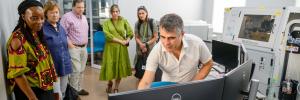
A buzz of anticipation filled the Chamber of Mines Building at Stellenbosch University’s Department of Earth Sciences as students, academics and industry delegates recently gathered for the launch of a powerful new scientific instrument – one that promises to transform research across the physical and earth sciences.
A new era for isotope science as SU celebrates installation of advanced instrument
- State-of-the-art research technology positions SU at the forefront of high-precision isotope analysis in Africa.
- The new instrument will drive opportunities for South African students and researchers to gain key skills in analytical science.
- University and industry leaders hailed the installation as a milestone, opening doors to world-class research and collaboration.
A buzz of anticipation filled the Chamber of Mines Building at Stellenbosch University’s (SU) Department of Earth Sciences as students, academics and industry delegates recently gathered for the launch of a powerful new scientific instrument – one that promises to transform research across the physical and earth sciences.
With the ceremonial unveiling of the Neoma Multi-Collector, Inductively Coupled Plasma, Mass Spectrometer (MC-ICP-MS), a state-of-the-art instrument that is part of the BIOGRIP node for soil and water analysis and hosted in the Elemental and Isotope Analysis Laboratory, SU has formally joined the ranks of leading global research institutions in high-precision isotope analysis.
“Isotopes tell stories that stretch from the birth of the universe to the future of our planet,” explained Prof Gary Stevens, Director: Central Analytical Facilities at SU, as he opened the event. “They connect us to the biggest questions in science, from understanding the evolution of our landscapes to exploring the processes shaping minerals, water systems and the atmosphere.”
In essence, Stevens pointed out, the MC-ICP-MS allows researchers to look “deep inside” rocks, water and biological samples – helping to trace processes such as pollution, mineral formation or ancient climate change with a level of detail previously unattainable on African soil.
World-class analytical technology
Other speakers unpacked the far-reaching impact of the new MC-ICP-MS, the first of its kind in Africa, and emphasised that its acquisition was made possible with support from the Biogeochemistry Research Infrastructure Platform (BIOGRIP), a national research initiative. Funded by the Department of Science and Innovation, BIOGRIP focuses on advancing the study of how biological, geological and chemical processes interact to shape the environment.
The director of BIOGRIP, Dr Roger Diamond, explained the platform’s aim to build world-class analytical facilities, develop technical capacity and provide scientific leadership.
“A platform such as BIOGRIP shows how collaboration allows us to access new infrastructure that we would not normally be able to obtain alone,” said Prof Sibusiso Moyo, SU’s Deputy Vice-Chancellor for Research, Innovation and Postgraduate Studies. “With continued investment from science councils, universities and industry, we are on the right track to position our University at the cutting edge of scientific research – on the continent, and globally,” Moyo said.
The MC-ICP-MS was described as a game changer for the measurement of isotopes in geological, environmental and even archaeological materials. Its capacity to analyse multiple isotopes simultaneously at unprecedented levels of accuracy will empower scientists to unlock new knowledge, not just about the geology of Africa, but about the shared history of planet earth.
“Having this equipment ensures that the research we produce is globally competitive. More importantly, it means that our postgraduate fellows, early-career researchers and collaborators across Africa can access technology that is usually out of reach,” Moyo said. “We have already seen strong interest from neighbouring countries in our training courses and workshops.”
Building on partnerships
Collaboration was a recurring theme, with multiple speakers pausing to recognise the constellation of individuals and organisations needed to bring the project to life. Diamond placed SU’s achievement within a global context, noting that modern research infrastructures hinge on long-term planning, extensive resources and a spirit of cooperation.
“Internationally competitive laboratories require more than equipment – they need visionary thinking, expert staff and the collective will to push boundaries,” Diamond said. “This launch demonstrates what’s possible when government, universities and industry come together with a shared purpose.”
Several contributors received heartfelt thanks during the launch event: Elemental & Isotope Analysis Laboratory Manager Riana Rossouw and the Department of Earth Sciences’ Prof Cristiano Lana for their vision and commitment to advancing geochemical research; and David Visser of Anatech and Daniele Recenti from Thermo Scientific for their technical support in installation and commissioning the new technology.
Lana captivated the audience with his detailed demonstration of the workings and functionalities of the MC-ICP-MS. He explained that the instrument’s extraordinary sensitivity allows researchers to analyse everything from the chemical composition of ancient rocks to the structure of dinosaur eggs. The technology can uncover the stories hidden inside fossils, such as determining the age of dinosaur eggshells and examining their chemical makeup, which reveals clues about prehistoric environments and the life that once thrived here, he said. Lana also described how the instrument is already being used for groundbreaking work in geochronology, helping to piece together the complex history of minerals and the evolution of the earth’s crust.
Industry leaders noted the instrument’s broader significance. With more accurate data, mining and environmental sectors stand to benefit from cutting-edge solutions and sustainable practices. University-industry partnerships, fostered through shared access to this facility, are now poised to expand.
- Watch a video of the ground-breaking method a team of scientists at SU developed to age-date fossilised dinosaur eggs using the MC-ICP-MS.
Related stories
Natural and mathematical sciences
Former leaders in microbiology honoured in leading academic journal
The journal is recognised as a key publication for the global yeast research community, focusing on both fundamental and applied research, and is published by...