
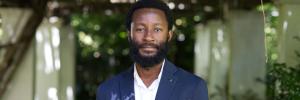
Dr Sishuwa Sishuwa, a Senior Lecturer in History at Stellenbosch University’s (SU) Faculty of Arts and Social Sciences, has been appointed visiting scholar at Harvard University.
Dr Sishuwa appointed as a visiting scholar at Harvard
- Dr Sishuwa is based in the Faculty of Arts and Social Sciences.
- He will spend a semester as a visiting scholar at Harvard.
- He has authored over 20 peer-reviewed publications.
Dr Sishuwa Sishuwa, a Senior Lecturer in History at Stellenbosch University’s (SU) Faculty of Arts and Social Sciences, has been appointed visiting scholar at Harvard University.
This appointment results from collaboration between Harvard University and the Stellenbosch Institute for Advanced Study (STIAS), where Sishuwa holds the prestigious Iso Lomso Fellowship. The fellowship provides a three-year attachment to STIAS to enable fellows to develop and conduct a long-term research programme of their preference.
From January to June 2026, Sishuwa will spend his time at the Harvard University Center for African Studies, working on his research project that examines the political role of the military in securing democratic gains in southern Africa since the transition to multiparty politics in the early 1990s.
“The eventual output will be a scholarly monograph tentatively titled Gunning for Democracy: Why the Military Upholds Democracy in Malawi. A central argument of the book is that despite the reverse trend in some parts of West Africa over the past couple of years, the army continues to be a positive force in the process of democratisation elsewhere, contrary to academic studies that only stress the institution’s largely hostile role,” says Sishuwa
Prof Sandra Swart, Chairperson of the Department of History, described the appointment of Sishuwa as an “exceptional opportunity”.
“Dr Sishuwa’s scholarly contributions to African political and intellectual history have already marked him as one of the most original and rigorous voices of his generation. His research productivity and public scholarship have strengthened our department’s academic profile, and his work has attracted significant international attention. The invitation from Harvard represents not only an important recognition of his achievements but will also meaningfully advance his (and our department’s) long-term research trajectory.”
While at Harvard, Sishuwa is expected to contribute to the intellectual life of the Center by attending and participating in academic events, especially the African Studies Workshop; sharing his ongoing research and latest work; helping to shape, steward and promote the Center for African Studies across the university and throughout regional and international networks; and by serving as an occasional resource or subject matter expert to students and colleagues.
Prof Zoe Marks, Faculty Director of Harvard’s Center for African Studies and Lecturer in Public Policy at the Harvard Kennedy School, said the university was delighted to host Sishuwa. “It is a great honour to have Dr Sishuwa at Harvard. We count ourselves lucky to be an institutional host for his book project. I am certain that he will have a productive and rewarding experience here,” says Marks.
More about Sishuwa:
Sishuwa joined SU in 2023. He received his DPhil in Modern History from the University of Oxford where he studied as a Rhodes Scholar. He researches the political history of southern Africa since the twentieth century, focusing primarily on elections, leadership, ethnicity, historical biography, populism, civil society, racial nationalism, and the challenges of state sovereignty and political sustainability in national and regional contexts. He has edited three special issues of academic journals and authored over 20 peer-reviewed publications. His books include Party Politics and Populism in Zambia (James Currey, 2024) and the Cambridge History of Democracy in Africa (Cambridge University Press, forthcoming), co-edited with Nic Cheeseman, Maame Gyekye-Jandoh and Edalina Rodrigues Sanches. In addition to Gunning for Democracy, he is writing another monograph, Why Leaders Fail: Presidential Decision-Making in Zambia, 2015-2021.
Related stories

Media release
SU’s Handlab and Book Dash open new worlds for Deaf children
A quiet revolution underway in early childhood literacy didn’t begin in a classroom, but in a studio where Deaf storytellers rehearse, sign and retell African...