
More Than a Grade: How International Students Turned Learning into Community Impact Through "Jackets on Trees"
- As part of the Global Education Module at Stellenbosch University International, a cohort of 35 international students organised the "Jackets on Trees," a winter warmth initiative that collected and distributed over 200 items of clothing to vulnerable local communities through trusted partners.
- The students ran the campaign like a professional organisation — splitting into specialised teams for logistics, marketing, and distribution — and gained attention by symbolically hanging jackets on campus trees to represent unexpected support for those in need.
- Prompted by severe winter storms in the Western Cape, the project pushed students out of their comfort zones, challenging their cultural assumptions about community service and transforming a graded assignment into a deeper lesson on empathy and personal growth.
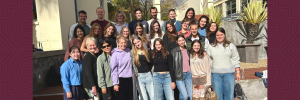
Beyond the classroom, studying abroad reshapes how students engage with different cultures and academic expectations in real time. For a group of 35 international students at Stellenbosch University (SU), that experience went a step further — becoming an opportunity to leave a meaningful mark on the community around them.
Through Stellenbosch University International's (SU International) Global Education Programme (GEP), students from France, Germany, Italy, Japan, the Netherlands, Spain, the United Kingdom and the United States came together to lead "Jackets on Trees", a winter warmth initiative aimed at supporting vulnerable communities in and around Stellenbosch.
The initiative formed part of a GEP module, Sustainable Agriculture & Community Gardening, coordinated by Ms Thanja Allison, Departmental Manager in SU's Department of Genetics. Through years of refining the module's experiential learning approach, Allison has created opportunities for international students to collaborate across cultures while engaging directly with local communities. As she explains, the winter warmth drive was designed to ensure that donations reached people who genuinely needed them through trusted community partners, with “dignity, responsibility and measurable impact” at the heart of the initiative.
For the students involved, however, the project quickly became about far more than collecting winter clothing. It became an opportunity to navigate cultural differences, build relationships, challenge assumptions and develop a deeper understanding of community engagement in a South African context.
From Cultivating Gardens to Engineering Warmth
The project itself reflects the evolution of a module that has long sought to connect learning with meaningful community engagement. For many years, students participating in the programme established vegetable gardens at schools, farms and community sites around Stellenbosch.
As Allison explains, the challenge has always been finding ways to create impactful experiences within the realities of a semester abroad.
“As background, I can mention that I have been presenting the programme every semester for quite a few years now, and in the early years we established a vegetable garden somewhere on campus or in the surrounding area every semester,” she says.
“The problem is that the students have little time between their other classes and commitments, and if the idea is that we all work together — and that participation forms part of their assessment — I must make it possible for everyone to participate.”
The shift from creating gardens to coordinating a large-scale winter clothing drive allowed students to engage in a project that could be completed within a short timeframe while still delivering meaningful impact. Yet, for Allison, the true value of the project extends beyond the practical outcome.
“The project is actually a side issue,” she says. “The working together and the friendships we build while they do something outside of their comfort zone is the asset.”
Learning Through Leadership
To bring the project to life, the students organised themselves much like a professional organisation, taking ownership of every stage of the campaign.
The cohort was divided into four specialised teams: Awareness and Campaign, Collection and Logistics, Sorting and Quality Control, and Distribution and Partnerships. Each group was responsible for a critical component of the initiative, requiring students to collaborate across cultures while applying project management principles in a real-world setting.
Together, they mobilised the broader university community, encouraging students and staff to donate jackets, shoes and other winter essentials. Collection points were established at Maties Gym, The Tapas Deli at Academia Residence, academic departments across campus and local gathering spaces such as DORP Bar.
Their efforts resulted in more than 200 donated items of winter clothing.
For many students, however, the most significant lessons came through building relationships with local organisations.
“To target communities that are in need, we had to identify various organisations whose mission is already to reach out to these communities,” explained a student from Japan studying at Sophia University.
The team connected with organisations including Stellcare, Donations on Wheels, the Ukukhanya Project, local shelters, soup kitchens and churches in and around Stellenbosch.
“In the part where we had to reach out, we were overwhelmed by how interested and thankful their organisations were that we wanted to bring our project to them,” the student reflected.
“We experienced that personal communication was much more effective than simply sending emails. They could see our excitement for the project, and that made them even more interested in becoming involved.”
In the process, many students discovered that meaningful community partnerships are built through relationships rather than transactions.
The Meaning Behind the Trees
One of the most distinctive elements of the initiative was the visual campaign that inspired its name.
Jackets were temporarily hung on trees across campus as a symbolic representation of warmth, generosity and unexpected support.
For a student from the University of Padua in Italy, the concept carried a deeper meaning.
“We hang jackets on trees to signify that you find something unexpected on your way in a spontaneous manner,” she explained. “Sometimes when you are in need of something, it may not always be in plain sight, or you do not always feel comfortable asking for it.”
While the installations were not intended as direct collection points, the students hoped to capture the idea that support often arrives in unexpected ways, particularly for those who may be hesitant to ask for help.
The displays quickly attracted attention from passers-by, sparking conversations about the initiative and encouraging additional donations. What began as a creative marketing strategy became a powerful symbol of community care.
Challenging Assumptions Through Experience
A central goal of the GEP is to encourage students to critically examine their own perspectives and assumptions. For many participants, that learning took place not only through the project itself, but also through the broader realities of life in South Africa.
That opportunity emerged unexpectedly when severe winter storms struck the Western Cape on 12 May 2026, forcing school closures and disrupting communities across the region.
For an environmental biology student from Saint John’s University in the United States, the experience highlighted realities they had never previously considered.
“I have never participated in a module where we delve into various communities and cultural dimensions such as this,” the student said. “Back home in Minnesota, school closures due to severe weather are rather common, but I have noticed that it is not the same here. I have experienced this new-found knowledge that, back home, we should perhaps not just target visible communities who are in need but seek out those who are struggling silently.”
Similar reflections emerged among students from the Netherlands, whose experiences challenged what they had previously considered normal.
“We have realised the cultural differences in approaching community service in different countries,” they explained.
“In the Netherlands, there is no urgent need for warm clothes, but more focus is placed on serving a mental need. Through our engagements with local organisations, and now seeing the impact of the current need through this past week's intense weather, we have been challenged to rethink those ‘Oh, that's normal’ thoughts.”
The experience prompted them to reconsider assumptions they had long taken for granted.
“What is normal for me — always having access to three or more jackets during the colder months as we live in a place with extremely cold winters — is not the same here. The need here may simply be to stay dry while being kept warm, and to be prepared for unexpected weather changes.”
Through these encounters, students developed what the programme describes as a more global and reflective perspective, recognising that needs, challenges and solutions often look very different depending on context.
More Than a Grade
By the end of the initiative, the students had collected and distributed hundreds of winter clothing items, but the project's greatest impact may have been on the students themselves.
What started as a project management assignment evolved into an opportunity to build relationships, challenge perspectives and develop a deeper understanding of the communities around them.
A student from Helmut Schmidt University in Germany perhaps captured the experience best.
“This module has given us the opportunity to pour as much of ourselves into this project. This module has not only taught us more about project management, but in the end, it blossomed into personal development.”
“This experience pushed us to do more than earn a grade. We learned more about Stellenbosch, how we can reach communities here, and how to work as a diverse team. Most importantly, we learned to challenge our current knowledge, rethink how we approach community service and understand the value of engaging with people whose experiences differ from our own.”
For these international students, "Jackets on Trees" became far more than a winter clothing drive. It became a lesson in empathy, collaboration and intercultural understanding — a reminder that some of the most meaningful learning happens not in a classroom, but through the connections we build and the communities we serve.
Related stories
Impact
Connecting Globally, Growing Locally: Why Supporting Staff Internationalisation Matters for SU
Stellenbosch University (SU) actively supports staff internationalisation as a core pillar of its institutional growth. Far from being a mere travel opportunity...
Impact
From research to communication: Stellenbosch researchers at the VIU Spring School
Arriving on San Servolo Island, a short boat ride from the busy waterways of Venice, Italy, it is clear that this is not a typical academic setting. Removed...

Education
Redefining the Playbook: Internationalising Sport Education through Cross-Cultural Exchange
For three weeks in January 2026, a group of undergraduate Sport Science students from Stellenbosch University (SU) traded the South African summer for the crisp...