

From research to communication: Stellenbosch researchers at the VIU Spring School
- Three Stellenbosch University researchers joined an international cohort and expert faculty at Venice International University (VIU), Italy, to master the strategies and confidence needed for effective science communication.
- Through intensive workshops in storytelling and public speaking, participants practiced translating complex research into accessible narratives, receiving immediate feedback from global peers.
- The program helped researchers shift their mindset, viewing communication not as an afterthought, but as an essential, integrated part of the scientific research process.
Arriving on San Servolo Island, a short boat ride from the busy waterways of Venice, Italy, it is clear that this is not a typical academic setting. Removed from the crowds but still connected to the city, the island offers a setting that feels both calm and reflective, well-suited to a week centred on how and why we communicate science.
From 23 to 27 March 2026, Stellenbosch University PhD candidates Zainab Kashim-Bello and Dannielle Kenny, together with Postdoctoral Researcher Dr Tahnee Otto, joined participants from across the world at the Venice International University (VIU) Spring School, Equipping Researchers with Skills, Strategies and Confidence for Science Communication. Zainab and Tahnee attended with the generous support of Erasmus+ funding, combined with support from the Stellenbosch University International Office.
The programme brought together an international faculty from institutions including the Munich Science Communication Lab at Ludwig Maximilian University, the University of Padua, the University of Bordeaux, and VIU’s Science Communication Unit, alongside Stellenbosch University’s Professor Marina Joubert.
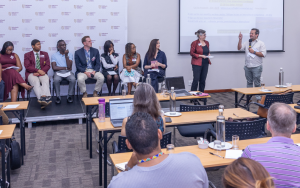
Over the course of the week, participants were expected to engage actively with their own work. The programme began with short, three-minute research presentations, immediately highlighting the challenge of translating complex research into something clear and accessible. Building on this, the various sessions explored how communication functions in practice, from identifying audiences and considering impact, to reflecting on communication in digital and socio-political contexts. Practical sessions on public speaking, storytelling, and writing created space to test these ideas, always with immediate feedback from both peers and faculty. Working within an interdisciplinary and international group highlighted how differently communication is approached across fields, whilst also showing that many of the underlying challenges are shared. Together, these elements encouraged a shift from simply presenting research to engaging more critically with science communication as a field of research and practice in its own right.
Stepping away from the classroom formed an important part of the experience. On the second day of the course, a social dinner in Venice offered a chance to connect more informally. Discussions from the day carried into the evening, blending with shared experiences as conversations continued in a relaxed setting. Later in the week, a visit to the UNESCO SEA BEYOND Ocean Literacy Centre provided a practical example of science communication in action. Interactive exhibits focused on ocean processes, climate influences, and the diversity of marine and coastal ecosystems, offering a clear link between scientific concepts and public engagement.
Participants presented again at the end of the week, either individually or in groups, applying what they had learned. The contrast between the initial and final presentations made the progression particularly clear, with participants demonstrating increased confidence in structuring, framing, and delivering their research, as well as a greater willingness to experiment with different ways of communicating their work.
For Tahnee, this meant stepping outside of familiar presentation approaches. ‘Coming from a physical sciences background, I’m used to fairly traditional ways of presenting research,’ she explains. ‘This experience pushed me to explore a new format, and it showed me that there is real value in communicating science in ways beyond what we are typically used to in an academic setting.’
Zainab reflected on the impact of the programme: ‘As the saying goes, science is not complete until it is communicated. This course has provided me with a strong foundation in science communication, strengthening me to present my research with greater confidence, clarity, and relevance. I look forward to engaging broader audiences more effectively as a result of my experience at Venice International University Spring School 2026’.
For the Stellenbosch participants, the course offered more than a set of practical skills. It provided a framework for thinking about science communication as part of the research process itself, rather than something separate from it. The experience is expected to inform ongoing work in science communication and engagement at Stellenbosch University, whilst also shaping how participants approach their own research going forward. As expectations on researchers to engage beyond academia continue to grow, opportunities such as the VIU Spring School play an important role in building both confidence and capability in this space.
Related stories

Education
More Than a Grade: How International Students Turned Learning into Community Impact Through "Jackets on Trees"
Beyond the classroom, studying abroad reshapes how students engage with different cultures and academic expectations in real time. For a group of 35...
Events
From mobility to meaning: SIAN 2026 explores new ways to put internationalisation into practice
People often think of internationalisation in higher education as student exchanges, travel, or partnership agreements. On the third day of Stellenbosch...
Impact
Strengthening Rural Sustainability Through Strategic African Partnerships: SU Engages in MASSTER Consortium Meeting in Senegal
From 23–26 February 2026, Henk Stander from the Aquaculture Unit in the Department of Animal Science at Stellenbosch University (SU) participated in a workshop...