
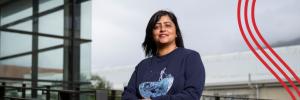
Dr Chevarra Hansraj
SU mathematician headed for 75th Lindau Nobel Laureate Meeting
- Dr Chevarra Hansraj is one of six South African scientists chosen by the Academy of Science of South Africa to attend the 75th Lindau Nobel Laureate meeting in Germany.
- Her research sits at the intersection of mathematics and physics, specialising in relativistic astrophysics.
Dr Chevarra Hansraj is one of six South African scientists chosen by the Academy of Science of South Africa, with the support from the Department of Science, Technology and Innovation (DSTI), to attend the 75th Lindau Nobel Laureate Meeting in Germany from 28 June to 3 July 2026.
Dr Hansraj, a lecturer in the Applied Mathematics Division, says she applied because the interdisciplinary theme of this year’s meeting resonates deeply with her own work, which sits at the intersection of mathematics and physics. She will be joining over 630 young scientists from 88 countries at this meeting, offering rare and direct access to some of the most celebrated scientists in the world. She has also been selected to present on her own research in the Next Gen Science sessions.
Chevarra grew up in Durban, KwaZulu-Natal, matriculating with eight A-symbols at Eden College Durban. She went on to complete her BSc, BSc(Honours), and MSc, all summa cum laude and in minimum time, at the University of KwaZulu-Natal. In 2022, she obtained her PhD in Applied Mathematics, also from UKZN, with a thesis titled “Semi-tetrad decompositions of the Kerr spacetime and spacetimes with conformal symmetry”, specialising in relativistic astrophysics. She subsequently held two postdoctoral fellowships there: the Oppenheimer Memorial Trust Fellowship followed by an NRF Scarce Skills Fellowship. She joined Stellenbosch University in 2025 and currently serves on the council of both the South African Mathematical Society and South African Gravity Society.
We asked her a few questions about her academic journey, current research and activities:
What motivated you to pursue studies in the field of mathematical physics, and specifically gravity, modified gravity theories, black hole geometry, and stellar modelling?
I grew up surrounded by mathematics, as my father is a professor in the field, but my personal fascination started when I picked up Stephen Hawking's A Brief History of Time from our shelf. Words like "neutron stars," "black holes," and "galaxies" leapt off the pages and have since become a daily part of my life.
That curiosity deepened through my undergraduate studies, where I encountered one of the most profound ideas in modern science: that gravity is not a force in the conventional sense, but a consequence of the geometry of spacetime. This intimate relationship between geometry and physics captivated me completely during my Honours General Relativity course. The timing of the Nobel Prizes was also significant. The LIGO detection of gravitational waves (awarded the Nobel Prize in 2017) and the first imaging of a black hole (awarded the Nobel Prize in 2020) unfolded parallel to my growing interest. We went on to incorporate both aspects in my PhD research. I studied how the spacetime geometry around a rotating black hole distorts as one approaches it and commented on the source of gravitational waves. It’s truly been a journey from childhood fascination to making a meaningful contribution to science.
What do you enjoy most about your work?
The best part is that I get to be an explorer every day. What continually amazes me is that we can study some of the most extreme objects in the universe, like rotating black holes, purely through mathematics, long before physical observation can reach them. We seek answers to some of the most fundamental questions about the universe. I love the rhythm of research: You answer one important question, only to discover that it opens the door to several more. It satisfies the curious mind so there is rarely a dull day at work.
A meaningful full-circle moment came when I found myself on the other side of the lecture hall, teaching the Honours General Relativity module and sharing the same passion that set me on this path. That experience led to my first postgraduate student, who has since completed his MSc and is now continuing toward a PhD under my supervision.
Travelling is another perk of being in this field. I’ve travelled widely to present my research, both locally and internationally. I had the privilege of listening to a live lecture by Prof. Stephen Hawking in Rome, rubbed shoulders with the very people who authored the textbooks I learnt general relativity from (Schutz, Wald, MacCallum, Poisson) in Glasgow and engaged with Prof. George Ellis, coauthor of the Large Scale Structure of Spacetime with Hawking, right here in Stellenbosch. At the Heidelberg Laureate Forum, I was privileged to associate with many Fields medalists and Abel Prize winners such as Prof. Dennis Sullivan and shake hands with legendary duo “Diffie-Hellman” of cryptography fame whose work I studied during my undergrad. I was deeply impressed by their humility, inquiring spirit and willingness to associate with young researchers. It also imprinted the notion that scientific discoveries carry forward from generation to generation.
There's also something wonderfully accessible about this field. Space captivates almost everyone, and much of the terminology has entered pop culture, which makes it easy to bring people in from ages 5 to 80. I feel like I also make for a very good dinner guest – chatting about films like Interstellar, Gravity, and Oppenheimer, and theorising about what lies beyond an event horizon gives me immense joy. I brought all of that together in a fun workshop I presented at last year's Heidelberg Laureate Forum, titled "The Mathematical Structure of Black Holes".
What made you apply for attending the Lindau Nobel Laureate meeting, and what do you hope to experience there?
I applied to attend the 75th Lindau Nobel Laureate Meeting because its interdisciplinary theme resonates deeply with my own work, which sits at the intersection of mathematics and physics. I have also been affiliated with the Heidelberg Laureate Forum having attended in 2024 as a young researcher and returned in 2025 as an alumna.
A Lindau lecture forms part of the programme every year, so when I saw the advert appear, I knew it was an opportunity I could not miss. I am deeply honored to have been selected to attend this prestigious meeting. I look forward most to engaging directly with Nobel Laureates including Genzel, Perlmutter, Riess, and Queloz, whose pioneering work on black holes, gravitational waves, and cosmology has helped pave the way and shaped my own research. They have provided the observational confirmation of ideas that theoretical astrophysicists like me work with every day. I also look forward to connecting with fellow young researchers from across disciplines and celebrating what we are each building in the Next Gen Science session.
Please tell us an interesting fact about yourself.
Geometry was actually my least favourite topic in school mathematics. Life has a wonderful sense of irony as it is now the very foundation of everything I do and I couldn’t be more enamored with it.
In 2024, I attended a high-energy physics (HIGGS24) conference in Uppsala, Sweden, and made a day trip to the Nobel Prize Museum in nearby Stockholm. This quickly became one of the highlights of the trip, second only to witnessing the Northern Lights.
What struck me most was how tangible scientific history felt there. I saw handwritten letters from Albert Einstein acknowledging his Nobel Prize, the equipment associated with the first detection of gravitational waves, and a remarkable animated diagram by Penrose showing gravitational collapse into a black hole. One feature I found especially moving was the overhead carousel display of Nobel Laureates and their contributions on placards, passing slowly through the museum like a living timeline of discovery. I will get to see this come to life at the Lindau meeting.
In my spare time, I am also keenly interested in film and art. During my travels, I have enjoyed following the works of Van Gogh, Monet, and Picasso. Most recently, after seeing Van Gogh’s The Starry Night at the Museum of Modern Art in New York City, I completed a 1,500-piece jigsaw puzzle and a 2,300-piece LEGO version inspired by it.
You are also involved in Women in STEM initiatives. Why is this important to you?
I am concerned about the under-representation of women in science throughout history. To this end, I involve myself in activities that promote interest in scientific fields among young women. I was privileged to attend the Women of The Niels Bohr Institute conference in Copenhagen in 2024. Locally, I manage the Stellenbosch University node of STEM MentHER, a women’s mentorship program for high school learners to help them navigate important decisions about their future careers.
Related stories

Awards and milestones
First-year student selected to attend youth science forum in London
First year BSc student Sibella Murray has been selected by the National Science and Technology Forum (NSTF) to attend the 2026 LIYSF (London International...
Media release
New study led by South African scientists reveals how sea-ice microbes survive the Southern Ocean’s harsh winter, with implications for climate change
A study led by scientists from Stellenbosch University reveal that during winter the sea-ice around Antarctica harbors a reservoir of microbes of which most...
Media release
African microbiomes – from humans to ecosystems – will be focus of new research chair at SU
Africa’s unparalleled biodiversity and environmental variations present an extraordinary opportunity to explore novel microbial species and their functions. Yet...