African Neuroscience, Neuroethics and Society Short Course
Welcome
“It’s truly a privilege for Olivia and me to open this first short course on the African continent devoted to Neuroscience, Neuroethics, and Society. We are gathered here from diverse disciplines, provinces and institutions, united by a shared curiosity about the brain — and by a shared commitment to ensuring that advances in neuroscience benefit our societies ethically, equitably, and meaningfully. The overarching goal of this course is twofold. First, the course aims to deepen understanding of the rapidly expanding field of neuroscience (from the molecular level to the societal level) and how these discoveries are reshaping what it means to be human, to think, to feel, and to act. Second, and equally important, it is to build capacity and leadership among emerging African researchers and clinicians to engage with the ethical, cultural, and societal dimensions of this science. As neuroscience advances globally — through tools like neuroimaging, genetics, and artificial intelligence — Africa must have a strong voice in shaping the questions asked, the methods used, and the policies that follow. Neuroethics provides the lens to critically examine these developments: to ask not only what we can do, but what we should do — in ways that reflect African contexts, values, and lived realities. This course is an investment in you, the next generation of African neuroscientists and neuroethicists, to ensure that research and practice on this continent grow in a way that is both scientifically rigorous and socially responsible. I encourage you to use this week to ask bold questions, to connect across your disciplines, and to imagine new collaborations that will carry this field forward in Africa. Welcome again, and thank you for being part of this historic step in shaping the future of neuroscience, neuroethics, and society on our continent”. Prof Soraya Seedat, Executive Head of the Department of Psychiatry, Stellenbosch University
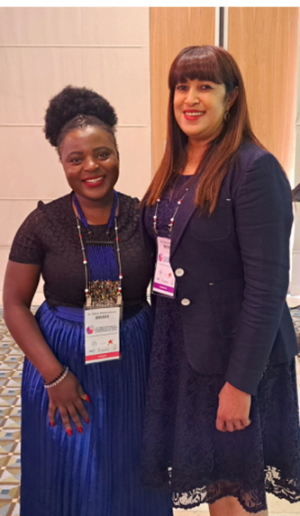
“From my side, I want to echo that you are the future African leaders in neuroscience and neuroethics — we have been waiting for, so please use this opportunity to the best of your ability to sharpen your skills and build networks for collaborations amongst each other. There has never been a more exciting time to pursue neuroscience and neuroethics in Africa. But with that there comes great responsibility to ensure that neuroscience benefits African people and African communities. You are all brilliant in all your areas of study, and we believe that you will go on to ensure that ethics is a crucial part of your research moving forward. We believe in you, and we are excited to learn together while seeing you shine this week and throughout your journey! Welcome to the African Neuroscience, Neuroethics and Society Short Course!” Dr Olivia Matshabane, Neuroethics Researcher, Department of Psychiatry, Stellenbosch University
About
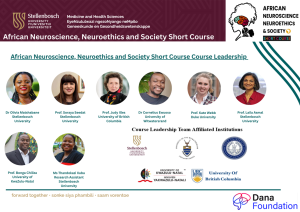
In partnership with the Dana Foundation in the United States, the Department of Psychiatry at Stellenbosch University offers a blended short course in neuroscience, neuroethics and society for South African master’s students in neuroscience, psychiatry, psychology, neurology, family medicine, and related fields. The course explores critical themes, including African and global neuroethics, AI and society, and social-justice-oriented neuroscience. It is co-led by Dr Olivia Matshabane and Prof. Soraya Seedat in the Department of Psychiatry at Stellenbosch University in collaboration with Prof. Laila Asmal (Stellenbosch University), Prof. Bonga Chiliza (University of KwaZulu-Natal), Dr Cornelius Ewuoso (University of Witwatersrand), Prof. Kate Webb (Duke University, USA) and Prof. Judy Illes (University of British Columbia, Canada).
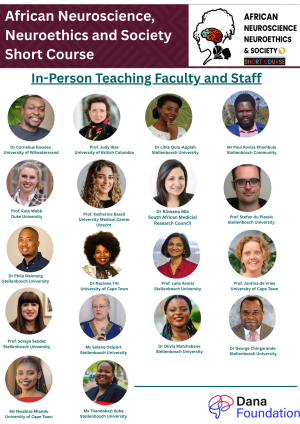
The short course runs from November to the end of May and is delivered in a blended mode (virtual and in-person at Stellenbosch University’s Biomedical Research Institute and Stikland Hospital) as well as group mentoring and society-engaged activities.
The short course is generously funded by the Dana Foundation in the United States.
Why did we develop this short course?
As advancements in neuroscience, neurotechnologies, artificial intelligence (AI) and generative AI continue to accelerate, there is a critical need to address the neuroethical implications of these emerging tools and the data they generate. Despite the increasing recognition of the need for global dialogue on neuroethics, opportunities for training and critical analysis on neuroethics issues remain limited in Africa. Neuroethics discussions must be integrated across multiple levels of society, and our fellows are being trained in this unique niche area.
Outcomes
This short course will equip emerging African scholars with contextually appropriate tools to design and implement community-engaged neuroscience research. Moreover, the short course will provide scholarly preparation in the ethical, legal, social, philosophical, and cultural implications of neuroscientific advancements in Africa and globally.
African Neuroscience, Neuroethics and Society Short Course Leads
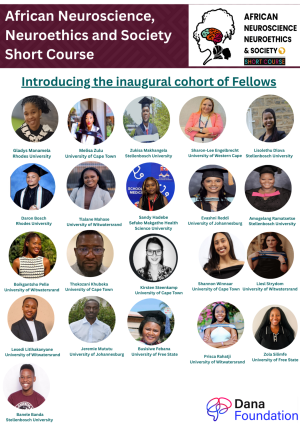
African Neuroscience, Neuroethics and Society Fellows