

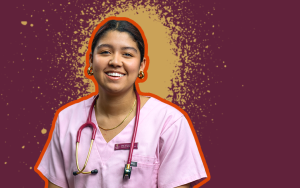
Third-year nursing student Alwaba Tom turned personal grief into a calling to support others through healthcare and peer mentorship.
Alwaba Tom creates safe spaces for students to grow
- #TogetherWeGrow: This Youth Month, we celebrate students who are creating opportunities, building communities and supporting others through mentorship, outreach, peer support and leadership. We also highlight the support structures at Stellenbosch University that help students grow, connect and make a meaningful impact.
For much of his childhood in the Eastern Cape, silence filled the small home where Alwaba Tom grew up. Encouragement was scarce. Money was tight. His grandmother carried the family with what he describes as “quiet strength”, while his aunt’s discipline and work ethic left a lasting impression on him. Even then, Tom learned early how to rely on himself. “In that silence, I learned to hold myself up not because I wanted to, but because I had to,” he says.
Today, the third-year nursing student at Stellenbosch University’s (SU) Faculty of Medicine and Health Sciences (FMHS) exudes confidence and warmth. Yet the road to becoming a student leader and mentor was shaped by grief long before it was shaped by academic success.
The defining moment came when his grandmother died of cancer. “Watching someone you love suffer changes the way you see life and people,” he reflects. “It forced me to ask myself: What can I do so that another person does not have to experience this kind of pain?”
Nursing was never part of some carefully mapped childhood dream. In the community where he grew up, career choices often depended more on opportunity than long-term planning. Yet, once he started his studies, he discovered something deeper about himself. “For me, nursing became more than a qualification. It became the space where I discovered who I am and how I connect with people in meaningful ways.
“One of the most important lessons nursing has taught me is that before people need medicine, they often need reassurance,” he says. “They need someone to listen, to treat them with dignity, and to remind them they are not alone.”
Creating spaces where students feel safe
Those same values now shape the way Tom supports fellow students at SU.
As Student Coordinator for the FMHS Subject-Specific Tutoring (SST) Programme, he works closely with around 40 tutors who provide peer support to undergraduate students struggling with difficult modules such as anatomy and physiology. This programme creates opportunities for students to seek academic help from fellow students in an environment that feels less intimidating than formal lecture spaces.
Tom’s role involves training, guiding and supporting tutors while helping build a culture of encouragement and accountability. The work has become deeply personal to him because he understands academic struggle firsthand.
His own journey to SU was not straightforward. Mathematics and physical sciences were major obstacles at school, and at one stage university felt out of reach. Joining SU’s SciMathUS bridging programme became the turning point that changed his trajectory. “The programme gave me the tools to rebuild my confidence and drastically improve,” he says.
He credits mentors for helping him recognise his own potential. He speaks with particular gratitude about Noni Kulati from SciMathUS, who consistently encouraged him to believe in himself, and Lamese Chetty from the FMHS’ academic advising structures, who helped nurture his leadership abilities.
Beyond the campus
His older brother, Lutho Ndyalvane, who graduated from SU last year, became another pillar of support during difficult periods of pressure, uncertainty and self-doubt. “My church community and close friends also helped keep me grounded during periods when I felt overwhelmed,” he adds.
That experience of being supported now informs the way Tom approaches leadership. “I believe many students carry fear and failure in silence. Too often, students delay asking for help because they are afraid of being judged,” he explains.
One interaction with a student changed the way he viewed tutoring entirely. After one of his sessions, a student told him the space that he created felt safer than many of her academic environments because, as a slower learner, she often felt embarrassed to ask questions. “That conversation opened my eyes,” he says. “Students don’t only need information; they need patience, reassurance, and someone who understands that people learn differently.
“This role has taught me that leadership is not about authority, but about responsibility,” he adds. “People thrive when they feel valued.”
Growing through struggle and giving back
As South Africa marks the 50th anniversary of the 1976 Soweto uprising this Youth Month, Tom believes young people today carry both opportunity and responsibility. “Many young people are facing financial stress, mental health struggles and uncertainty about the future. Youth Month reminds me of the young people of 1976 who fought for education and dignity.”
For him, the greatest way to honour that legacy is through collective upliftment. “Today, our responsibility is to support each other, create opportunities where we can, and use education to uplift others.”
Outside academics, Tom describes himself as social, vibrant and deeply reflective. He plays netball and says friendships, loss and personal growth have taught him difficult lessons about resilience and letting go. “People sometimes think I don’t struggle emotionally because I am open,” he says. “But I actually feel things deeply.”
Looking ahead, Tom hopes to continue building a future in healthcare. While he plans to gain experience as a nurse, his long-term ambition is to become a doctor. He also hopes to return to SU in a different capacity one day. “I see myself returning to the institution that built me from the beginning. Not just as a student but as someone who has grown and gives back.”
Related stories
Impact
Joy Schoor’s second chance at life inspires hope for others
At 14 years old, Joy Schoor was forced to confront something most teenagers cannot begin to imagine: the possibility of dying before her life had truly begun.
I...

Impact
Risuna Risimati helps to shape the future of student leadership at SU
Long before she became a member of Stellenbosch University (SU) Council, chaired the Academic Affairs Council or served as Chief Justice of the Student Court...

Impact
Adam Venter believes community is built through everyday acts of kindness, connection and service
When a series of rugby injuries brought Adam Venter’s sporting ambitions to an abrupt halt, he could easily have focused on what he had lost. Instead, he...