

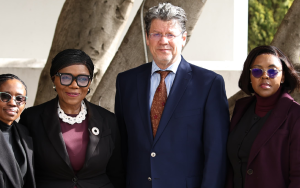
Prof Quinette Louw (third from left) and Luigia Nicholas (second from right) at the launch of the report
New SU-led report highlights Africa's assistive technology access crisis
- People with disabilities in Africa struggle to access assistive technologies.
- They face limited availability of products and services, high costs, weak service delivery systems.
- Investment in assistive technology sector needed.
Access to assistive technologies – tools, devices and systems that help people with disabilities perform everyday tasks more easily – remains limited and uneven across Africa, particularly for young people in rural and underserved communities. Barriers include limited availability of products and services, long travel distances to service providers, high costs, affordability challenges and weak service delivery systems.
These are among the key findings of a new report developed by a consortium led by Stellenbosch University (SU), in partnership with Kwame Nkrumah University of Science and Technology in Ghana, Humanity & Inclusion and the Clinton Health Access Initiative. The Assistive Technology Landscape in Africa Report highlights the broader significance of assistive technology for education, employment, entrepreneurship and economic inclusion across Africa.
Commissioned by the Mastercard Foundation to support its Disability Inclusion Strategy, the report aims to inform efforts to enable 1,5 million young people with disabilities to access education and economic opportunities through Young Africa Works. It was recently launched at the Inclusive Africa Conference on Global Assistive Technology Day in Nairobi, Kenya.
According to the consortium, the report provides one of the most comprehensive assessments of Africa’s assistive technology ecosystem to date. It examines access to assistive technology across Africa, policy and regulatory environments, market systems and financing mechanisms, service delivery models, innovation and local production capacity, economic opportunities within the sector, and barriers affecting persons with disabilities, particularly young people. It also establishes an evidence base to guide future investments, partnerships, policy engagement and ecosystem strengthening.
“An estimated 15 percent of Africa’s population lives with a disability. Yet millions of people continue to face barriers to education, employment, entrepreneurship and digital participation because they lack access to the assistive technologies they need,” says one of the report’s authors, Prof Quinette Louw of SU’s Division of Physiotherapy.
“Assistive technology is more than a health intervention. It is a critical enabler of education and lifelong learning, employment and livelihoods, entrepreneurship and innovation, independent living, digital inclusion, and social and civic participation.
“When assistive technology is unavailable, inaccessible, or unaffordable, individuals are excluded from opportunities that many others take for granted. Expanding access is therefore essential to achieving inclusive development and economic growth across Africa.”
Louw points out that assistive technology includes products and services such as screen readers, hearing aids, wheelchairs, braille devices, alternative and augmentative communication tools, digital accessibility technologies, and mobility, learning and communication devices.
According to another contributor to the report, Luigia Nicholas of SU’s Disability Unit, the report shows that policy progress is outpacing implementation.
“Even though many African countries have introduced disability inclusion and accessibility policies, implementation remains inconsistent because of limited funding and resources, weak coordination among stakeholders, and gaps between policy commitments and practical delivery.”
Nicholas adds that the assistive technology ecosystem is becoming more coordinated, with governments, organisations of persons with disabilities, innovators, service providers, researchers and development partners increasingly working together. However, progress varies significantly across countries and sectors.
Nicholas notes that the report also highlights the significant potential of local innovation.
“Innovation is growing across Africa, with local innovators developing solutions tailored to community needs and contexts. However, most assistive technology products are still imported, local manufacturing remains limited, and investment in African innovation and production is insufficient.”
The report also indicates that while the demand for assistive technology continues to increase across Africa, market growth is constrained by financing challenges, supply chain limitations, dependence on imported products, and affordability barriers for users.
Despite these challenges, the assistive technology sector creates economic opportunities, says Louw.
“The report identifies the assistive technology sector as an emerging source of youth employment, entrepreneurship, innovation and product development, manufacturing and production jobs, skills development and technical expertise.
“With the right investments and policies, the sector can contribute to inclusive economic growth while improving the quality of life for persons with disabilities.”
Looking ahead, the report provides an opportunity to explore:
- how limited access to assistive technology affects young people’s ability to attend school, access training, secure employment and participate in society;
- how African innovators are designing assistive technologies that respond to local realities and challenges;
- the opportunities that exist for young people within the assistive technology sector itself;
- why disability inclusion and accessibility policies often struggle to translate into meaningful outcomes on the ground; and
- how young people with disabilities are using assistive technology to pursue education, employment, entrepreneurship and leadership opportunities.
The Mastercard Foundation’s perspective
According to the Mastercard Foundation, the Assistive Technology Landscape in Africa Report supports its commitment to enable 1,5 million young people with disabilities to access education and economic opportunities. The report provides evidence to inform programme design and implementation, strategic investments, policy engagement and advocacy, ecosystem development, and partnerships across sectors.
Having launched its Disability Inclusion Strategy in 2023, the Foundation views the report as a starting point for deeper collaboration and action to strengthen Africa’s assistive technology ecosystem and expand opportunities for young people with disabilities.
Through its Young Africa Works strategy, the Mastercard Foundation aims to enable 30 million young Africans to access dignified and fulfilling work by 2030.
- The full report and executive summary are available at: https://mastercardfdn.org/en/our-research/assistive-technology-landscape-in-africa/
Related stories

Media release
Coventry University awards honorary doctorate to Prof Deresh Ramjugernath
Coventry University has awarded an Honorary Doctor of Education to Prof Deresh Ramjugernath, Rector and Vice-Chancellor of Stellenbosch University (SU).
The...
Media release
Career Day inspires future lawyers to carry Mandela’s legacy forward
Three decades after South Africa adopted one of the world’s most progressive constitutions, more than 150 aspiring lawyers gathered at Stellenbosch University...

Media release
New internship programme at SU clinics opens doors for aspiring medical receptionists
For many young South Africans, earning a qualification is only the beginning of a difficult journey. The next hurdle is finding the work experience employers...