
AI in research showcase - SU collaborators for cancer care
A decade's work towards AI-assisted radiotherapy
At Stellenbosch University, advances in AI-assisted radiotherapy have been driven by a close collaboration between the Division of Radiation Oncology and the Division of Medical Physics. The work brings together the leadership and expertise of Prof Chris Trauernicht, Director of Medical Physics at Tygerberg Hospital and Head of the Division of Medical Physics, Dr Henriette Burger, current Head of the Division of Radiation Oncology; and Prof Hannah Simonds, former Head of the Division.
Liela Groenewald, head of the Doctoral Office in the SU Faculty of Medicine and Health Sciences, reached out to members of the team about their research with artificial intelligence.
Over the past decade, the Division of Medical Physics and the Division of Radiation Oncology have contributed to a wider international collaboration through the Radiation Planning Assistant Consortium led by Laurence Court, Professor of Medical Physics at the MD Anderson Cancer Center in Texas, and Beth Beadle, Professor of Radiation Oncology at Stanford University.
SU medical physicists and clinicians have contributed to the development, validation, quality assurance and clinical evaluation of AI-based tools that automate time-intensive aspects of contouring and treatment planning for cervical, head and neck, lung, rectal, prostate and breast cancer.
The aim has been to increase access to life-saving radiotherapy in resource-constrained settings through the advancement of automated radiotherapy planning. “In many low- and middle-income countries, lack of modern radiotherapy machines and diminishing numbers of trained radiotherapy and surgical staff is leading to deaths from treatable cancers. The project had its origin in the shared recognition that automation of the RT process had the potential to mitigate some of these challenges,” says Burger.
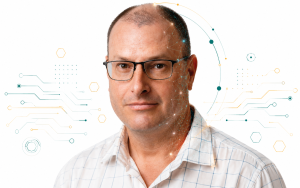
Prof Chris Trauernicht
Their work has also explored implementation barriers, clinical safety, risk assessment, treatment verification, software usability and the potential contribution of large language models to clinical workflow evaluation. The collaboration has produced numerous publications, a clinical implementation project and a prospective clinical trial evaluating the performance and cost-savings of the AI-based Radiation Planning Assistant (RPA), a tool that was conceived, designed and is now being implemented clinically by the team from MD Anderson, under the leadership of Prof Court. This sustained programme of research has helped move the technology from algorithm development and retrospective validation towards clinical implementation and prospective evaluation.
The Radiation Planning Assistant (RPA) is designed to automate parts of the radiotherapy-planning process while retaining specialist oversight. Rather than replacing clinicians and medical physicists, it can generate contours and treatment plans for experts to review and refine, with the aim of making high-quality planning faster, more consistent and more accessible in settings where specialist capacity is limited. A published overview of the collaboration's development since 2016 is available at this link: https://doi.org/10.1002/acm2.14334.
Building the evidence for AI-assisted radiotherapy
The collaboration has brought together a multidisciplinary team from Stellenbosch University's Divisions of Radiation Oncology and Medical Physics, with different individuals contributing to complementary aspects of the programme.
Prof Chris Trauernicht has been a consistent contributor to publications on automated radiotherapy treatment planning, contouring algorithms, quality assurance, software usability, risk assessment and, more recently, the use of large language models in radiotherapy workflows.
Prof Hannah Simonds (pictured) has contributed extensively to studies evaluating AI-assisted radiotherapy planning across multiple cancer sites and is a co-author on the ARCHERY study protocol.
Dr Henriette Burger has contributed to recent publications on AI-assisted radiotherapy planning and is a co-author on the ARCHERY clinical trial.
Other contributors from the Division of Medical Physics include Didier Duprez, whose work includes contouring algorithms, algorithm validation and cervical brachytherapy; Monique du Toit, who contributed to early Radiation Planning Assistant development and risk assessment studies; Andrea Marais, and Ricus van Reenen, who co-authored studies on software usability, workflow safety and failure mode analysis. The contribution by the Radiation Oncology clinical team has included work by former staffer Komeela Naidoo, whose publications span automated treatment planning, contouring and clinical evaluation across several cancer types; O'Brian Williams, who contributed to AI-assisted contouring in cervical brachytherapy as a registrar; and Kailin Naidoo, who contributed to research on failure mode and effects analysis.
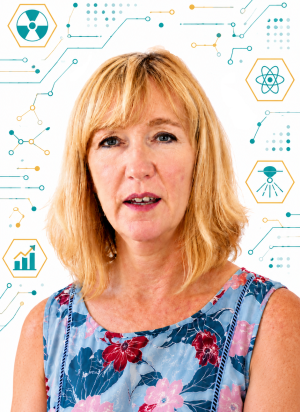
Prof Hannah Simonds
ARCHERY: Testing AI in real-world cancer care
This progression culminated in ARCHERY, one of the largest prospective evaluations of AI-assisted radiotherapy planning reported to date and the first multi-country trial to assess AI-based contouring and planning. The trial enrolled 1 029 patients with cervical, head and neck, or prostate cancer across seven public-sector hospitals, with Stellenbosch University contributing 171 participants between 2024 and 2026 (Aggarwal et al 2026). Automated plans were independently assessed against international quality standards, while researchers also investigated potential time and cost savings (Aggarwal et al 2026). The trial's international design provides an important basis for assessing whether successfully validated AI tools could strengthen access to radiotherapy across different resource settings (Aggarwal et al 2026).
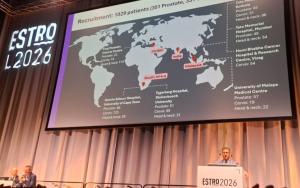
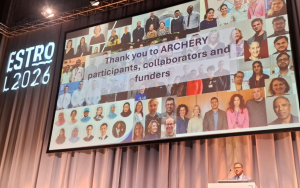
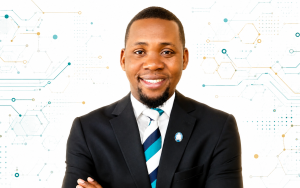
Dr Chuma Njovu (right) and Prof Chris Trauernicht represented SU research teams when the initial ARCHERY results were presented at the ESTRO conference in Stockholm in May 2026.
Burger says the SU teams were proud to have Trauernicht and Njovu represent them when the initial findings were presented at the European Society for Radiotherapy and Oncology (ESTRO) conference in Stockholm in May 2026.
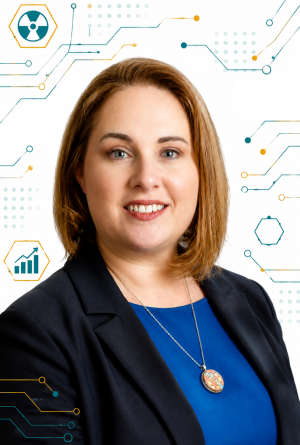
Dr Henriette Burger
Click on the links below to read the two trial publications to date. Or, please click here for a more comprehensive list of publications from these collaborations focused on the use of frontier technologies in cancer care.
Aggarwal A, Court LE, Hoskin P, et al. 'ARCHERY: a prospective observational study of artificial intelligence-based radiotherapy treatment planning for cervical, head and neck and prostate cancer'. BMJ Open 2023; 13:e077253. https://doi.org/10.1136/bmjopen-2023-077253
SU contributor: Hannah Simonds.
Aggarwal A, Court L, Murphy C, et al. 'ARCHERY: a global trial evaluating artificial intelligence-based radiotherapy treatment: results for cervix and prostate cancer'. ESTRO 2026 Proffered Paper 5494. ESTRO 2026 - Abstract Book PART II
SU contributors: Christoph Trauernicht and Henriette Burger.
The work reflects a long-term commitment to translating advances in artificial intelligence into practical improvements in patient care. By contributing to the development, validation and prospective evaluation of these technologies, Stellenbosch University's Medical Physics and Radiation Oncology teams, together with their international collaborators, are helping to build the evidence needed to expand access to high-quality radiotherapy, particularly in resource-constrained health systems.
Ongoing and future work will also look at using the RPA to train Radiation Oncology registrars and at Public and Patient Involvement (PPI) during trial design, data collection and dissemination of results.