
AI Futures Forum
Titus-Dawson invites all to join the FMHS AI Futures Forum
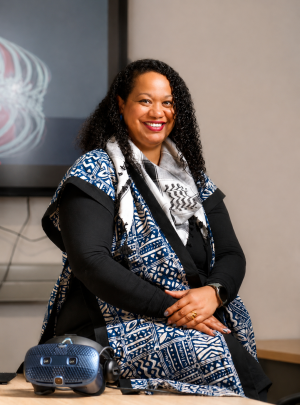
Dear Colleagues
We have launched the FMHS AI Futures Forum as a collaborative space for thoughtful engagement around the use of Artificial Intelligence (AI) within our Faculty. The Forum aims to bring together colleagues from across the Faculty to collectively explore how AI can be used in ways that support the academic project for both students and staff.
Through this initiative, we hope to:
- Develop faculty-specific practical guidelines for the responsible use of AI for students, staff and researchers
- Stimulate and support AI-related research and innovation
- Create a dialogue space where colleagues can reflect critically on contextually grounded and ethical AI practices
As a Faculty staff member, we would greatly appreciate your participation in the Forum. Diverse perspectives from across our disciplines will be important in ensuring that the work of the Forum reflects the needs and realities of the Faculty.
Importantly, student voice and partnership will be central to this forum, and as such, we also want to extend this invitation to our student body to help shape this work.
If you are interested in contributing to guideline development, research conversations, or future-facing AI initiatives, please sign up here:
https://forms.office.com/r/hsx6vUsgdy?origin=lprLink
We look forward to building this future together.
Kind regards | Ngemibuliso emihle | Vriendelike groete
Prof Simone Titus-Dawson | PhD
Department of Health Professions Education
Faculty of Medicine and Health Sciences
ORCID ID: https://orcid.org/0000-0003-3599-8918
Prof Simone Titus-Dawson is Associate Professor in the Department of Health Professions Education and leads the Faculty's Digital Education and Innovation focus area. Her work centres on technology-enhanced learning, including game-based learning, virtual reality, augmented reality, and the educational application of emerging technologies.
As a recipient of a 2025 Teaching Advancement at Universities (TAU) Fellowship, she leads research exploring innovative approaches to teaching and learning in health professions education. Artificial intelligence forms a growing part of this work. She is involved in research examining how AI can support cultural humility and storytelling in healthcare.
Titus-Dawson views AI as a tool that can help personalise learning, strengthen collaboration, and enable more authentic assessments that reflect real-world practice. She emphasises that AI should be used to enhance, rather than replace, the fundamental educational role of meeting learners where they are and supporting their development.
Upbeat about AI's potential, she advocates for a responsible and people-centred approach. She highlights the importance of equity, ethical practice, transparency, and practical governance frameworks to ensure that the way in which we employ AI does not widen digital divides. "I'm a techno-optimist and I see how AI can help us personalise learning, support collaboration, and build assessments that really reflect real-world needs. But let me be clear: We are not inventing something new. We are simply amplifying what we as lecturers have always done – to meet learners where they are."
"That said, we must be cautious. AI should serve higher education, not the other way around. We must prioritise equity and avoid widening existing digital divides. We also need ethical, practical frameworks for using AI responsibly. We must be intentional, transparent, and people-centred in how we bring AI into our classrooms."
Her work positions AI not as a technological end in itself, but as part of a broader commitment to innovation, inclusion, and meaningful learning in health professions education.
Delve deeper:
Titus-Dawson, S. 2024. 'https://www.universityworldne…'. University World News, 22 August 2024. https://www.universityworldnews.com/post.php?story=20240821075959556.
Titus-Dawson, S, Meyer, R and Hansen, A. 2025. 'AI: The ‘uninvited’ guest!!'. Medical Education, 20 May 2025. https://asmepublications.onlinelibrary.wiley.com/doi/10.1111/medu.15683?af=R.