
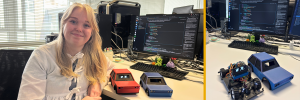
Final-year mechatronic engineering student Camryn Abrahamson with her interactive, speech-enabled toy car prototype.
A toy car that listens: Using speech technology to explore early math assessment
- Final-year mechatronic engineering project by Camryn Abrahamson, supervised by Herman Kamper.
- She developed an interactive toy car that asks maths questions and listens to children’s spoken answers.
What if a toy could help us understand how young children are developing early math skills? That question sits at the centre of a final-year mechatronic engineering project by Camryn Abrahamson, supervised by Prof Herman Kamper. Abrahamson, now a Master’s student, completed this research as part of her final-year skripsie in 2025. The project brought together an interactive toy car that asks children simple math questions, listens to their spoken answers and responds instantly.
Many young children in South Africa struggle with basic math skills and these challenges are often picked up too late. In busy classrooms, it can be difficult to give each child individual attention. Formal assessments can also feel intimidating and are often only used once a problem has already been identified.
This project explored whether something as simple as a toy could offer a more relaxed, accessible way to check in on early math development. It is not meant to replace teachers or formal assessments, but rather to support early screening in a way that feels natural and engaging for children. It also addresses what researchers call a “double low-resource problem” — limited data for both South African languages and children’s speech.
Teaching a toy to listen
Getting a toy to understand children’s speech is not as easy as it sounds. Most voice recognition systems are trained using large amounts of data. But for many South African languages, and especially for children’s voices, that data simply doesn’t exist.
Children also speak differently to adults. Their voices are higher, less consistent and still developing, which makes them harder for computers to understand.
To work around this, the project focused on something simple and practical: recognising numbers from 0 to 9 instead of trying to understand full sentences. The system compares what a child says to a small set of example recordings and chooses the closest match. Behind the scenes, this is supported by a lightweight but effective approach that uses pre-trained speech features and compares patterns in how words are spoken, even if they are said at different speeds.
How the toy car works
The toy car itself was more than a casing for the software. It was designed as the physical interface for the whole system. Built using a small computer and 3D-printed parts, the car has a simple “face” on a screen and lights that show its reactions. The system runs on a compact single-board computer, making it portable and easy to deploy in different settings. A connected system asks age-appropriate math questions, like basic addition, counting, and simple comparisons (such as which number is bigger).
The question is spoken out loud and the child responds verbally. Once the child finishes speaking, the system quickly checks the answer.
- If the answer is correct, the car reacts happily.
- If the answer is wrong, it responds with a sad expression.
This creates a fun, interactive loop where the child is learning and responding in real time.
What the results showed
The results were promising. The system was able to correctly recognise children’s spoken answers most of the time - around 79% accuracy in English and 77% in Afrikaans.
That was a clear improvement over the Whisper baselines used for comparison, which reached 56.86% on English and 22.11% on Afrikaans.
The Afrikaans result is especially interesting, since the system was tuned mainly on English child speech and still transferred well. The findings also showed that the system performs well even with relatively small amounts of training data, suggesting it could be adapted to other languages without needing large datasets.
Opening new doors for early learning
This project shows that simple, focused solutions can make a real difference, especially in environments where resources are limited. By combining technology with play, the toy car offers a glimpse into how early learning tools could become more interactive, accessible and child friendly.
With further development, tools like this could help educators identify learning challenges earlier and support children in a way that feels less like a test, and more like play. Future improvements could include expanding beyond single-digit answers and making the system even more responsive in real-world classroom environments.
(Click here to read the original article)
Related stories
Engineering and technology
SU Engineering Industry Showcase explores engineering solutions for a changing world
From artificial intelligence and renewable energy to aerospace innovation and climate resilience, the latest engineering research addressing real-world...
Engineering and technology
Engineering Open Day returns to a reimagined space
Grey skies and a passing thunderstorm did little to deter prospective students and their families from attending the Faculty of Engineering’s 2026 Open Day on...

Engineering and technology
Engineering students gain real-world insight through Virtual Industry Tour initiative
The Faculty of Engineering is equipping students with a valuable head start in the world of work through its innovative Virtual Industry Tour initiative, which...