
Facilities
Built to evolve
A campus that grows with its people
The Tygerberg Campus that stands today bears little resemblance to the institution that first opened its doors 70 years ago. What began as a cluster of chalk-and-blackboard lecture halls and modest clinical training spaces has evolved into one of Africa's most comprehensive academic health science hubs, integrating education, research, clinical training, and community engagement.
This transformation reflects sustained investment in the facilities, tools, and technologies needed by each new generation of students and researchers.

Decade by decade: a campus takes shape

From foundation to forefront
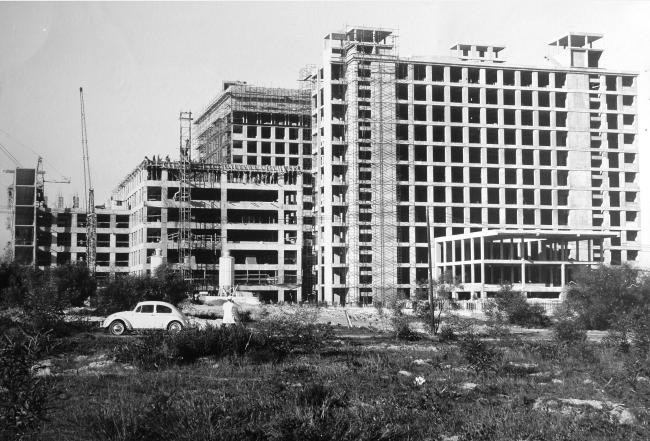
The Tygerberg campus, then and now — seven decades of growth.


Then – building from the ground up




Now — a campus that keeps pace


Our faculty continues to improve to keep pace with international technology
Transformed learning spaces
The passive lecture hall, where students sat in rows and copied notes, has given way to modern venues purpose-built for interactive and blended learning. Digital infrastructure now enables hybrid participation, online learning integration, and real-time engagement across platforms. The Medical Morphological Learning Centre (MMLC) and a newly developed library offer dedicated collaborative spaces where students can work together, think together, and learn from one another, reflecting a growing understanding that the best education happens in community, not isolation.

The Faculty of Health and Medical Sciences

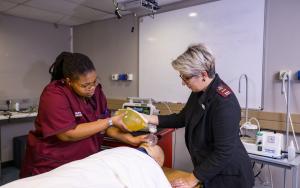
Our Simulation and Clinical Skills Unit
Simulation has become central to clinical training
Where students once moved directly from theory to the ward, the Simulation and Clinical Skills Unit (SCSU) and the SunSkill facility now represent a step change in how they are prepared for the realities of clinical work. Before entering a ward or theatre, students can practise procedures, manage simulated emergencies, and build confidence in a safe, controlled environment. This approach of learning by doing, without risk to real patients, is now internationally recognised as best practice in health professions education.
Research has found its permanent home
The Biomedical Research Institute (BMRI) stands as perhaps the most visible symbol of the campus's evolution. Where earlier generations of researchers worked in scattered departments with limited resources, the BMRI now brings together more than 500 researchers and students working across fields including tuberculosis, neuroscience, HIV, cardio-metabolic disease, rare genetic disorders, and reproductive health. Africa's largest biomedical research complex, it includes the first automated Biorepository in the Southern Hemisphere, capable of storing millions of samples under continuous monitoring, as well as the largest BSL-3 laboratory in South Africa.

Our Biomedical Research Institute
Connecting inward and outward
The campus also connects inward and outward. Informally, it has invested in the human dimensions of student life, green spaces, social areas, accessible design, and environments that support wellbeing alongside academic achievement. Formally, it has extended its reach to clinical training platforms across the region, ensuring that students are exposed to real healthcare environments from the earliest stages of their training, in hospitals and community health settings that serve some of the country's most complex patient populations.
Shaped by ambition, built for the future
Next: Alumni
From physical campus to global reach — discover what comes next.