

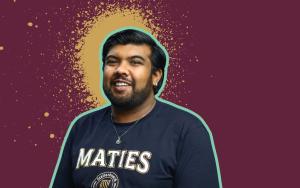
Growing up in Eldorado Park, Tyrese Human learned early that being different often comes at a cost – but he refused to let others define who he could become. The final-year education student has risen through Stellenbosch University's (SU) student leadership structures while remaining committed to helping others find their voice and sense of belonging.
Tyrese Human wants every child to know they belong
- #TogetherWeGrow: This Youth Month, we celebrate students who are creating opportunities, building communities and supporting others through mentorship, outreach, peer support and leadership. We also highlight the support structures at Stellenbosch University that help students grow, connect and make a meaningful impact.
When Tyrese Human was eight years old, he made a bold announcement to his family. One day, he declared, he was going to move overseas, buy a limousine and a private jet, and come back to fetch them.
Years later, his mother Samantha Holt still reminds him of that moment whenever he shares another academic result, leadership appointment or achievement. “It was audacious,” Human laughs. In hindsight, he knows his childhood dream wasn’t really about the limousine. It was about possibility.
Growing up in Eldorado Park, south of Johannesburg, Human was surrounded by stories that suggested certain futures were inevitable. The community is often associated with gangsterism, substance abuse and limited opportunities. Many young people grow up believing that where they are born determines where they will end up.
Human decided early that he would not accept that narrative. “My mother raised me with a mentality that if I want something, I can get it, provided I keep my faith and my humility,” he says. That conviction would become one of the defining forces of his life.
As a child, Human loved books, school and learning. He was naturally curious and often gravitated towards adults, teachers and mentors. But being different was not always easy. “I loved reading, which was very rare for a lot of boys my age,” he says. “For some reason the girls always loved me in school. And I loved them back.”
In a community where expectations about how boys should behave could be rigid, Human often found himself standing apart. His mannerisms, interests and personality made him a target for bullying that stretched from primary school into high school.
What helped him endure was an unwavering support system. His mother, sister Simoreece and stepfather Nolan and extended family continually reinforced a message that would shape the rest of his life: He was allowed to be himself. “They reminded me that I am not what people think of me. I get to define who Tyrese Human is.”
Finding his place
Human arrived at SU as the first person in his family to attend university, aided by NSFAS funding. Initially, he was uncertain about his choice of degree. Education had not been part of a grand master plan. But as he researched foundation phase teaching, something clicked.
Today, he cannot imagine doing anything else. Looking back, there were signs all along. As a child, he would gather imaginary learners around a whiteboard at home and play teacher while the adults prepared Sunday lunch. “I realise now that the love for teaching was always there.”
The transition to university was quite a shock and Human initially felt a bit intimidated and uncertain. His instinctive response was to stay busy. He joined the Education Student Committee (ESC) during his first year and quickly discovered a passion for leadership.
What followed was a remarkable journey through student governance, leadership development and advocacy. Over the years, he took on increasingly significant responsibilities. He became the chairperson of the ESC, then the chairperson of the Academic Affairs Council now serving on the Student Representative Council (SRC) as an ex officio member.
For Human, leadership has never been about titles. “It goes back to my why,” he explains. “If I can make a difference in one student’s life, if one person can say there was somebody who didn’t give up on me, then I’ve done what I needed to do.”
Along the way, he found mentors who helped him grow. He speaks warmly of staff members such as Janice Ghalpie, Delecia Davids and Dr Joy Petersen, as well as many classmates, colleagues and University leaders who encouraged him when self-doubt crept in. “There is a culture of community at Stellenbosch. It’s sometimes overwhelming to know how many people are rooting for you!”
A flame worth passing on
Despite his many leadership commitments, Human’s future vision remains rooted in the classroom. After graduating, he plans to teach locally before spending time teaching in China. Longer term, he hopes to work his way through the education system, combining practical experience with leadership and policy development.
Whatever position he eventually occupies, his goal remains consistent. “I want learners to have the same affirmation that I had as a child.” He wants children to know they are allowed to dream beyond the limitations of their circumstances. He wants them to understand that their differences are not weaknesses. He wants them to discover their own agency.
As South Africa commemorates the 50th anniversary of the Soweto Uprising this Youth Month, Human draws inspiration from young people who refused to remain silent in the face of injustice. “They weren’t waiting for change,” he says. “They took action and claimed agency. Yes, there are still a lot of issues that we need to campaign for tirelessly today, but I cannot imagine what our fight would look like if it wasn’t for the bravery of the class of 1976.”
Today, the boy who once dreamed of private jets and limousines understands that success looks different than he imagined. It is not measured by status or material worth. It is measured by impact.
It is found in the student who gains confidence, the learner who discovers their voice, or the young person who begins to believe that their future can be bigger than their circumstances. For Human, that has always been the point.
After all, sometimes the most powerful thing a person can do is remind someone else that they are allowed to take up space. So, he makes a point of always concluding with: “I am Tyrese Human and this is my story.”
Related stories
Campus life
Keenen Gilbert turns compassion into action at SU
Keenen Gilbert likes to joke that his blood is maroon and gold. After nine years at Stellenbosch University (SU), four degrees and countless leadership roles...

Campus life
Hannah Sieberhagen turns ideas into communities
For much of her childhood, Hannah Sieberhagen lived a life that few students at Stellenbosch University (SU) can relate to. Born in South Africa to South...

Media release
Stellenbosch University launches #GivingMaties, 40-day drive to fight student hunger
Student hunger remains a pressing reality at Stellenbosch University (SU) – and from 5 March to 15 April, the SU community is mobilising to respond. Alumni...