
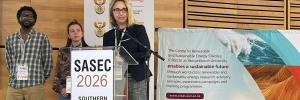
Prof Cristina Trois, Director of Stellenbosch University’s Centre for Renewable and Sustainable Energy Studies, presents research on unlocking value from vine waste at the Southern African Sustainable Energy Conference 2026. With her are co-authors Dr Yared Abera (left) and Martina Mariani. Picture: Desmond Thompson
Taking sustainable energy research from the lab to the market
- The Southern African Sustainable Energy Conference draw participants from across the globe
- Participants explored how research can become commercial products and successful businesses with wide societal impact.
South African researchers should measure success not only by publications and patents, but by the tangible technologies, businesses and jobs their work creates.
That message echoed throughout the Southern African Sustainable Energy Conference (SASEC) 2026, held at the Nombolo Mdhlululi Conference Centre, Skukuza, in the Kruger National Park from 23 to 26 June. The event brought together 151 researchers, policymakers, industry leaders and postgraduate students from around the world for more than 100 presentations.
The discussions took place against the backdrop of the global transition to cleaner energy systems, as countries seek to reduce greenhouse-gas emissions while strengthening energy security and economic development. The conference theme was “From ambition to implementation: Accelerating the impact of sustainable energy innovation for inclusive socio-economic growth”.
The event was hosted by the University of Pretoria (UP) in collaboration with Stellenbosch University (SU), with support from the Department of Science, Technology and Innovation (DSTI) and the South African National Energy Development Institute (Sanedi).
Opening the conference, SASEC 2026 Chair, Prof Willem le Roux of UP, said: “We have an opportunity to use our skills and knowledge to improve our communities. We can help make this region safer, cleaner and more sustainable for future generations.”
‘Commercialisation no longer optional’
In his keynote address, Dr Kenny Tenza, Acting Deputy Director-General for Technology Innovation at the DSTI, challenged delegates to think beyond traditional scientific excellence.
“The reality we must confront is unemployment,” he said, noting that almost one in three South Africans is unemployed while youth unemployment exceeds 60%.
Sustainable energy innovation must therefore become “more than a technical agenda – it must become an industrial agenda, a jobs agenda and a national development agenda.”
That theme was already evident in the pre-conference workshop on technology commercialisation, where participants explored how research can move beyond publications, patents and laboratory prototypes to become commercial products and successful businesses with wide societal impact.
Prof Cristina Trois, Director of the Centre for Renewable and Sustainable Energy Studies (CRSES) at SU and Co-Chair of SASEC 2026, argued that meaningful innovation depends on close collaboration across sectors. “Academia cannot work in isolation. Industry cannot work in isolation. Government cannot work in isolation,” she noted.
Moderating the discussion, Dr Francois Rozon, Associate Director of CRSES and Scientific Advisor to the conference, reminded delegates that commercialisation is “not only about patents or spin-off companies or funding”. Ultimately, he said, bringing technical innovations to market is about “people, relationships, trust and purpose”.
Crossing the ‘Valley of Death’
Dr Richmore Kaseke, Manager of Strategic Partnerships at Sanedi, described the notorious “Valley of Death” where many promising technologies stall after successful laboratory demonstrations. This usually occurs because they outgrow public research funding before attracting commercial investment. Strategic partnerships, he argued, provide the critical bridge across that gap.
As an example, he highlighted an SU-led consortium developing a mobile, 1 000-litre bioreactor to produce renewable ethanol. SU provides the foundational intellectual property and research capability, while Toyota South Africa, Illovo Sugar, LogiCam, Sanedi and the DSTI contribute manufacturing, biomass feedstock, testing and deployment expertise.
From prototypes to products
Prof Sampson Mamphweli, Head of the DSTI Energy Secretariat at Sanedi and former Director of CRSES, argued that South Africa should focus on technologies where it enjoys genuine competitive advantages.
“China has both manufacturing capability and raw materials. The US and Canada possess manufacturing capability but more limited raw material availability. Europe and Japan have sophisticated manufacturing technologies but rely heavily on imported raw materials,” he said.
“South Africa possesses both the raw materials and the technology. That combination creates a genuine competitive opportunity.”
Research serving society
The emphasis on implementation continued through the technical programme.
Prof Bernard Bekker, recently appointed as SARChI Chair in Power Systems Simulation, presented new approaches to electricity planning designed to help South Africa build a more resilient power system as renewable energy expands.
Prof Nkosinathi Gule, who leads the wind-energy component of the Renewable Energy Hub and Spokes Programme of the DSTI and Sanedi at SU, offered this advice to researchers interested in commercialisation: solve real problems. “If your research addresses an important problem, partnerships tend to develop naturally.”
Developing the next generation
Trois reminded participants that commercialisation is only one measure of impact.
“Sometimes the greatest impact of a project isn’t the technology itself,” she said. “It’s the students who were trained while developing it.”
SU research featured prominently in the programme, with four current or former master’s students walking away with best presentation awards:
- Argon Poorun (in the category Circularity of Renewable Energy Technologies)
- Ronan Wademan (in Demand-Side and Energy Storage Applications)
- Remi du Plessis (in Power Systems Planning and Operations)
- George Fischer (joint winner in Solar PV Energy Systems)
Electric wheels
Electric vehicles captured the imagination at SASEC this year.
Thula demonstrated its locally designed and manufactured all-electric 4x4 safari vehicle, which pairs near-silent operation for non-intrusive wildlife viewing with zero tailpipe emissions, thereby significantly reducing its environmental footprint.
Volvo showcased electric vehicles driven from Johannesburg to Skukuza as part of a DSTI awareness programme, demonstrating the viability of long-distance electric travel across South Africa.
Growth path
Originally established as the Southern African Solar Energy Conference and held in Technopark in 2012, SASEC has evolved into a broader platform for sustainable energy research, innovation and commercialisation.
Hosted by SU in 2024, the conference returned this year to the Kruger, where UP previously hosted it in 2015. Le Roux said the park provided a fitting setting for a conference on sustainable energy because it showcased how people could live more closely with nature.
Delegates visited SANParks’ solar photovoltaic installation and the Skukuza Science Leadership Initiative Campus, part of the international Organisation for Tropical Studies network.
Sponsors included the DSTI, Sanedi, Campbell Scientific, SEM Energy Engineers, Kirby Engineering & Construction, PVinsight, GeoSUN, Thula Solutions, SOLTRAIN, Sasol and Investec Private Banking.
As was the case in 2024, selected peer-reviewed papers from the conference will be published by Springer, extending the reach of the research presented at SASEC 2026.
Road ahead
The organisers announced that the University of Cape Town will host the next SASEC, probably in 2028. They also confirmed plans to explore closer alignment with Sanedi’s annual conference, further strengthening one of South Africa’s premier platforms for bringing government, academia and industry together around sustainable energy innovation.
* Desmond Thompson is a freelance journalist
Related stories

Events
Prof Mesias Alfeus’s vision brings global finance congress to Africa
The announcement that Stellenbosch University (SU) will host the 14th World Congress of the Bachelier Finance Society (BFS) in 2028 – the first time the...

Arts, languages and social sciences
Building community through multilingualism at SU Teaching-Learning-Assessment Day
Multilingualism should be seen not merely as a policy requirement, but as a powerful tool for learning, participation and belonging in higher education.
This was...

Media release
Seven days of gambling could wipe out a year of national student funding
At the current rate at which South Africans gamble, it would take just seven days to spend the equivalent of the country’s entire national student funding...