
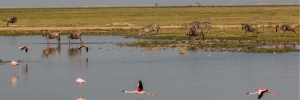
Populations of diverse plants and animals across Sub-Saharan Africa have declined.
Sub-Saharan Africa has lost nearly a quarter of its biodiversity
- Sub-Saharan Africa has already lost 24% of its biodiversity since pre-industrial times.
- Large mammals have declined most severely.
- 80% of remaining wild plants, animals live outside of formally protected lands.
A new African-led study finds that sub-Saharan Africa has already lost 24% of its biodiversity since pre-industrial times. This means that, on average, the populations of diverse plants and animals across the region have declined by nearly a quarter.
Some species, particularly large mammals, have declined much more severely, and protected areas are vital as safeguards for these species. The research also highlights that more than 80% of the region’s remaining wild plants and animals live outside of formally protected lands.
The study, published on 3 December in Nature, provides the most comprehensive assessment of biodiversity intactness yet produced for sub-Saharan Africa. A unique feature of the project* is that it brings together a wide range of ecological knowledge from 200 experts in Africa’s diverse plants and animals, including researchers, field ecologists, rangers, tour guides, and museum curators working in the region’s changing landscapes. This enormous undertaking took over five years to complete.
“Many global biodiversity assessments do not represent African conditions well because they rely on sparse local measurements and draw insights from more data-rich regions of the world, where contexts are very different,” says lead author Dr Hayley Clements from the Centre for Sustainability Transitions (CST) at Stellenbosch University. “By working directly with the people who study and manage African ecosystems, we were able to capture a much more realistic picture of where biodiversity is declining, where it is being sustained, and why.”
Bottom-up method
The biodiversity data underlying this assessment come from a structured expert-elicitation process. The 200 contributors independently estimated how different human activities –from croplands to livestock grazing to urbanisation – affect the population abundance of different species in different areas. They then discussed the trends collectively in facilitated online meetings, providing an opportunity to learn from each other, reflect on uncertainties and refine estimates.
The result is a continent-wide map of the Biodiversity Intactness Index (BII), which measures the percentage of original abundances of all species that remain in an area relative to pre-industrial levels. Importantly, this bottom-up method incorporates an understanding of the regional context that is often missing from global biodiversity models that rely on patchy data. For the first time, national and regional decision-makers have access to an indicator built from in-country ecological expertise.
Where biodiversity is lost and remains
The study found large variations across ecosystems, countries and species groups. While plants that can withstand environmental disturbances have experienced declines as small as 10%, large mammals such as elephants, lions and some antelope species have lost more than 75% of their historical abundance. These declines are primarily due to habitat loss for croplands, and unsustainable levels of harvesting and livestock grazing.
Central African countries retain some of the highest levels of intactness due to the persistence of humid forests, while West Africa shows low intactness due to severe degradation of forests and savannas from overharvesting and agricultural expansion.
Crucially, over 80% of remaining wild populations of plants and animals occur in working lands – forest and rangelands where people coexist with nature. These landscapes support more than 500 million people and underpin crucial ecosystem services such as clean water, pollination, building materials, grazing resources, wild foods and carbon storage.
“This fundamentally shifts where and how we think about biodiversity conservation in Africa,” says Clements. “Protected areas remain vital, especially for Africa’s large mammals, but alone they are insufficient to curb biodiversity loss. Sustainable management of shared working landscapes is key to maintaining biodiversity and supporting livelihoods.”
“We can learn from successful examples of landscape governance systems, such as sustainable pastoralism practices, community-led wildlife conservancies, and biodiversity-positive farming approaches, that support both conservation and sustainable development.”
Agriculture and rangelands
The assessment also found that cropland expansion is one of the greatest pressures on biodiversity, with the lowest intactness recorded in Nigeria and Rwanda, the two countries with the highest cropland coverage. Intensive, high-yield agriculture reduces habitat diversity and increases chemical inputs, with significant impacts on a wide range of species. In contrast, traditional smallholder systems tend to maintain more ecological complexity and support higher levels of biodiversity.
With cropland projected to double and cereal demand expected to triple by 2050, the authors argue that biodiversity-positive farming practices will be critical to reconciling food security and ecosystem health.
Rangelands – grassy systems where wildlife and livestock graze – are also key, both in harbouring biodiversity and driving losses when intensively managed. The study shows that lower-intensity pastoralism supports higher biodiversity than intensive livestock farming, although increasing restrictions on herd mobility are threatening this balance.
A policy tool
This assessment addresses a major gap for African countries, which often lack the biodiversity information needed to inform policy, reporting and land-use planning. By integrating context-specific local knowledge into a regional measure, decision-makers now have a tool that can be applied across multiple scales.
According to Clements, their findings can support national biodiversity planning and help correct global biodiversity assessments that misrepresent Africa. Their expert-based approach may also be extended to other regions, to better capture local complexities.
“This study showcases the depth of ecological expertise across Africa. By grounding biodiversity measurement in local expertise, we now have a more credible evidence base to support development strategies that sustain both nature and people,” adds Prof Oonsie Biggs, Co-Director: CST and co-author on the study.
*This project was made possible by a Jennifer Ward Oppenheimer Research grant that supports African early career researchers to facilitate solutions to the continent’s challenges.
- Source: Clements, H et al. 2025. A place-based assessment of biodiversity intactness in sub-Saharan Africa. Nature https://www.nature.com/articles/s41586-025-09781-7
- Project website: https://bii4africa.org/
- Meet the contributing experts: https://bii4africa.org/category/experts/
- Explore the map: https://geethensingh.users.earthengine.app/view/bii
- Learn about biodiversity changes across the region: https://bit.ly/4ajCjNR
Related stories
Media release
New internship programme at SU clinics opens doors for aspiring medical receptionists
For many young South Africans, earning a qualification is only the beginning of a difficult journey. The next hurdle is finding the work experience employers...
Media release
Stellenbosch University researchers and international partners develop global ‘Declaration on Multilingual Healthcare’
Patients who do not speak the same language as their healthcare providers are disadvantaged worldwide when it comes to accessing healthcare services and...

Media release
Seven days of gambling could wipe out a year of national student funding
At the current rate at which South Africans gamble, it would take just seven days to spend the equivalent of the country’s entire national student funding...