
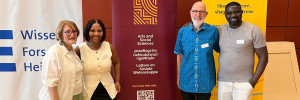
Prof Leslie Swartz and his fellow researchers in Hamburg
Stellenbosch University researchers and international partners develop global ‘Declaration on Multilingual Healthcare’
- Hamburg Declaration a practical guidance for healthcare professionals to deliver more linguistically equitable care.
- Sets out specific recommendations for improving linguistically inclusive care structures.
- Wants to help patients who do not speak the same language as their healthcare providers.
Patients who do not speak the same language as their healthcare providers are disadvantaged worldwide when it comes to accessing healthcare services and ensuring high-quality care. Healthcare staff often must rely on family members, acquaintances or other unqualified individuals to act as interpreters, or use machine translation tools, whose quality is limited, particularly for less commonly spoken languages.
Despite the far-reaching consequences for patients and healthcare systems, structural solutions and sufficient awareness of the problem are still lacking in many places. This is the conclusion reached by a team of international researchers, including researchers from Stellenbosch University (SU).
To provide healthcare professionals worldwide with practical guidance on delivering more linguistically equitable care, they have published the ‘Hamburg Declaration on Multilingual Healthcare’. It is one of the outcomes of a four-year study on ‘Multilingualism in Providing Quality Mental Health Care to Migrants – Needs, Resources and Practices (MiM2M)’ funded by the Volkswagen Foundation.
Launched at the international conference ‘Global Perspectives on Multilingualism in Healthcare’ in Hamburg, Germany on 26 and 27 June 2026, the declaration sets out specific recommendations for improving linguistically inclusive care structures. It also highlights five strategies to overcome language barriers in healthcare services: adapted direct communication between healthcare providers and patients, the use of technological tools, the use of multilingual communication materials, practitioners who speak multiple languages, and professional as well as non-professional interpreters.
More than 250 researchers, healthcare professionals, policymakers, artists, and representatives of interest groups from numerous countries attended the conference to explore the challenges and potential of multilingualism in healthcare, as well as how healthcare systems worldwide can be made more linguistically inclusive and equitable.
One of the key recommendations of the Hamburg Declaration is that all health professionals should be empowered to change their way of communicating directly, in such a way that patients who do not speak the same language as the healthcare provider can more easily follow the conversation.
“Simply recording patients’ language preferences systematically in their basic medical records would be an important step towards more patient-centred healthcare,” said Prof Dr Mike Mösko, project leader at the University Medical Centre Hamburg-Eppendorf.
Another important recommendation is that each health facility should assess whether staff members, including non-clinical staff, provide any form of interpreting services to colleagues within the facility. Where this occurs, interpreter training, ongoing supervision, separate contractual arrangements, and additional remuneration for such interpreting services should be provided.
“There is an urgent need for structural improvements in the healthcare system – in particular, access to professional interpreters who are paid appropriately for their demanding work. This is the only way to avoid misunderstandings, unnecessary tests and misdiagnoses,” said Dr Jana Husemann, Chair of the Hamburg Association of General Practitioners.
The declaration also recommends that healthcare users should be provided with information that access to healthcare is a human right and that successful communication is the responsibility of the healthcare provider.
It also emphasises that children should be prohibited from acting as interpreters within healthcare facilities.
“Unfortunately, it is a regular occurrence in medical facilities that children act as interpreters for their parents. This can have serious consequences for the children involved,” said Houssie Shirin from the Federal Association of Networks of Migrant Organisations in Germany.
“I was particularly surprised by the extent to which healthcare staff worldwide are left to cope with language barriers on their own, whilst at the same time clearly inadequate solutions are accepted,” said Prof Leslie Swartz of the Department of Psychology at SU.
Swartz noted that the declaration is especially relevant to South Africa. He explains: “The issue of language barriers in healthcare in general and mental healthcare in particular is not new in South Africa, and is not linked just to migration. For example, though isiXhosa and South African Sign Language (SASL) are official languages, an isiXhosa-speaking person born and living in Cape Town may find in certain public health facilities that the clinicians treating them cannot work in isiXhosa and have no access to interpreting services.
“Across the country, a Deaf person accessing healthcare may struggle to find a clinician in the public health system able to work in SASL or able to call on an interpreter. Our Constitution outlaws discrimination based on language and encourages inclusion.”
Swartz said many professional training institutions, including SU, are addressing language issues in some training programmes for healthcare workers, but challenges and obstacles remain.
“As a result, and largely as an outcome of this project, the SU team has been engaging constructively with the Communications Directorate of the Department of Health and Wellness of the Western Cape Government. The team is also collaborating with the Health Communication Unit at the University of the Witwatersrand to bid to undertake a Consensus Study for the Academy of Science of South Africa (ASSAf). Should this be approved for ASSAf, the findings will be shared nationally with relevant government departments.”
During the conference, the findings of the international MiM2M study carried out by South African researchers in collaboration with colleagues from Germany, Romania, the Netherlands and China were presented for the first time. Among other things, it examined the prevalence and quality of the use of unqualified interpreters, the possibilities and limitations of technological translation aids in healthcare, and the development, delivery and evaluation of a training programme on managing multilingualism for healthcare staff.
“The aim of our funding programme ‘Global Challenges: Mobility – Global Medicine and Health Research’ was to facilitate new insights into global health challenges that have received little research attention to date. This is precisely what has been achieved here: the project has highlighted the importance of language for equitable healthcare and developed concrete solutions in collaboration with international partners,” said Dr Cora Schaffert-Ziegenbalg, the Volkswagen Foundation’s programme manager for the funding initiative.
Successful examples of multilingual healthcare in practice were also presented at the conference. These include, among others, a platform run by the German Federal Institute for Public Health, which provides information on sexual health and body knowledge in 14 different languages.
- The Hamburg Declaration, along with further information on the findings of the MiM2M project and the conference, is available at www.mim2m.net.
Related stories

Media release
Seven days of gambling could wipe out a year of national student funding
At the current rate at which South Africans gamble, it would take just seven days to spend the equivalent of the country’s entire national student funding...

Media release
Cape Winelands Airport and SU forge strategic partnership for smart and sustainable development
Cape Winelands Airport and Stellenbosch University (SU) have entered into a cooperation agreement aimed at advancing innovation under the shared themes of...

Media release
SU Policy Innovation Lab helps equip Parliament for AI
The growing influence of artificial intelligence (AI) across society is creating opportunities and new responsibilities for lawmakers.
Recognising the need for...