
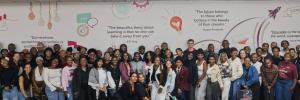
Students step up for social impact at first CASIT Engagement Conference
- SU’s first Student Engagement Conference brought together students, staff and community partners to explore the meaning of being “in service of society.”
- Speakers emphasised that academic success must be coupled with social responsibility and active citizenship.
- Student voices and community partners highlighted the importance of sustained, meaningful engagement in addressing inequality and driving social impact.
It is not every day one sees a university venue that full at 08:00 on a Saturday, especially with students keen to talk about community engagement. “This must really matter to you,” teased the Rector, setting the tone for a day centred on purpose, reflection and action.
Students, staff and community partners gathered in the Stellenbosch University (SU) Vroueverenigingsaal (VV Hall) at the Neelsie on Saturday, 11 April 2026, for the first Student Engagement Conference, hosted by the Centre for the Advancement of Social Impact and Transformation (CASIT) in collaboration with the Centre for Student Life and Learning (CSLL) and the Student Representative Council. The focus was clear: what it means to be ‘in service of society’ and how students can put that into practice in their daily lives.
Opening the programme, the Director of CASIT, Dr Zethu Mkhize, said it was a privilege to introduce a keynote speaker committed to advancing social impact at the SU. That commitment became a central thread throughout the day.
Service to society at the heart of the student experience
In his keynote address, Rector and Vice-Chancellor, Prof Deresh Ramjugernath, emphasised that the idea of being ‘in service of society’ should sit at the heart of the University’s purpose. While academic excellence remains important, he noted that it cannot exist in isolation. Instead, the knowledge students gain, the skills they develop, and the opportunities they receive should ultimately extend beyond personal success and contribute meaningfully to society.
He highlighted that in a country like South Africa, where inequality remains one of the most pressing challenges, the responsibility to create change cannot rest on government alone. “It is every single one of us in society that has to play a role,” he said, stressing that students, as emerging graduates, have a critical part to play in shaping a more equitable future.
Ramjugernath also pointed out that the realities of inequality are not distant or abstract, but visible in communities surrounding the University. This, he argued, makes the call to action more immediate and relevant. Community engagement, therefore, is not an optional extra, but an essential part of both personal development and social responsibility.
The university experience should go beyond technical knowledge, aiming instead to develop well-rounded SU graduates who are also engaged citizens. This includes the learning that takes place both inside and outside the classroom, through academic work, co-curricular activities, and direct involvement in communities. “Education is not only about personal achievement, it is about public contribution,” Ramjugernath stressed while urging students to recognise their responsibility to give back and to use their opportunities to uplift others.
From reflection to action
The message resonated with many in the room, particularly during a session led by SU alumnus Dr Ricardo Smart. Sharing his journey from Blackheath to university, he spoke about the power of small acts. A teacher who once paid for his university application sparked a desire to give back. That desire grew into a community initiative supporting learners with mathematics. “The impact you make right now you might forget, but the lives you have touched you will never forget,” he said.
Student voices played a central role throughout the conference. In a discussion facilitated by the Manager for Leadership, Diversity and Inclusion at the CSLL, Yeki Mosomothane, students reflected on how they understand community engagement in their own lives. One student described it as “something we do beyond ourselves,” while another admitted that their thinking had shifted after listening to the Rector’s speech and realised that “It’s not just about giving back at home, it’s about the community where I am now.”
Others spoke about the realities students face. Balancing academic pressure with community involvement is not always easy, but many agreed that even small contributions matter. “You’re sharing the little that you have,” one student said, describing donation drives and outreach efforts that support nearby communities.
A second panel led by First-Year Student Experience Coordinator, Dr Joy Petersen, focused on Stellenbosch students, explored personal growth, and agency. One speaker reflected on arriving at university focused exclusively on academics, before realising the importance of broader involvement along the way. “I came here for my degree… but I realised I had to do more,” they said. Another encouraged students to take initiative: “Take things into your own hands… know your why.”
The importance of consistency in community work was also highlighted. One audience member noted that short-term involvement could sometimes do more harm than good.
Finding purpose through engagement
The final session, led by Cluster Education Coordinator at the CSLL, Ayanda Mlatsha, brought together community organisations working closely with SU. Their stories reflected both the challenges and rewards of long-term engagement. One speaker shared that their journey was shaped over time: “It wasn’t one moment… it was many moments that made me realise this is my purpose.” Another spoke about the emotional weight of community work, particularly when engaging with stories of hardship. “There was such a need… that was a turning point of knowing that I need to do more,” they said.
Michelle Pietersen, Manager: Engaged Citizenship at CASIT, highlighted opportunities for student involvement and mentioned structured programmes available to students who are interested in volunteering and leadership in social impact. Students were encouraged to take the first step and commit to the process. Ms Pietersen concluded by saying, “You don’t know what volunteering is about until you feel it; the time is today.”
Towards the end of the conference, the energy in the room remained strong. What began as a simple observation about a packed venue on a Saturday morning became something more meaningful a reminder that students are willing to show up, engage, and take responsibility for the world around them.
Related stories

Events
Prof Mesias Alfeus’s vision brings global finance congress to Africa
The announcement that Stellenbosch University (SU) will host the 14th World Congress of the Bachelier Finance Society (BFS) in 2028 – the first time the...

Arts, languages and social sciences
Building community through multilingualism at SU Teaching-Learning-Assessment Day
Multilingualism should be seen not merely as a policy requirement, but as a powerful tool for learning, participation and belonging in higher education.
This was...

Media release
Seven days of gambling could wipe out a year of national student funding
At the current rate at which South Africans gamble, it would take just seven days to spend the equivalent of the country’s entire national student funding...