
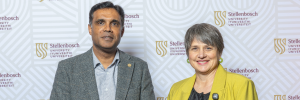
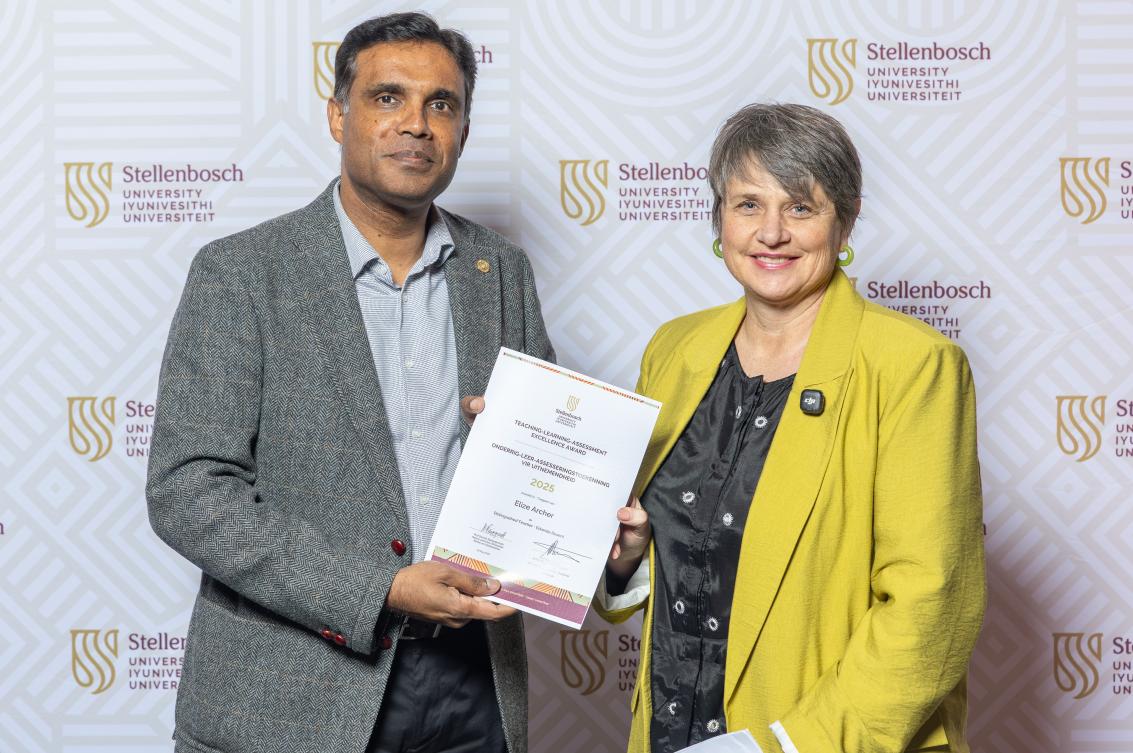
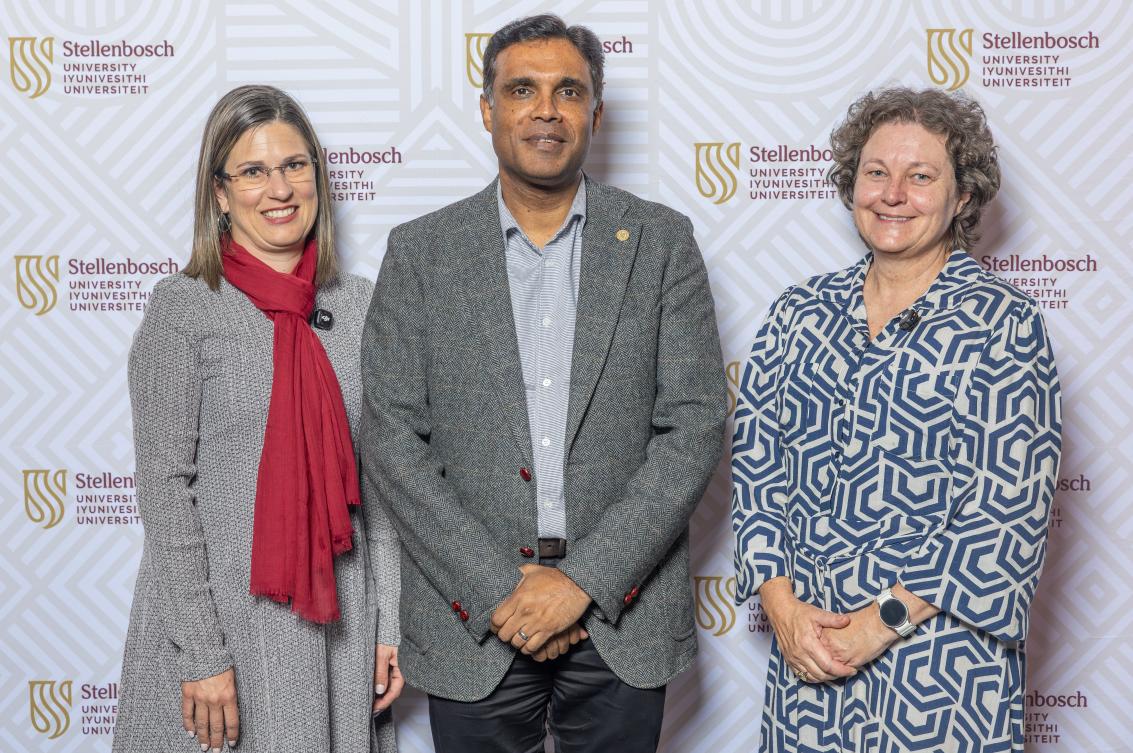
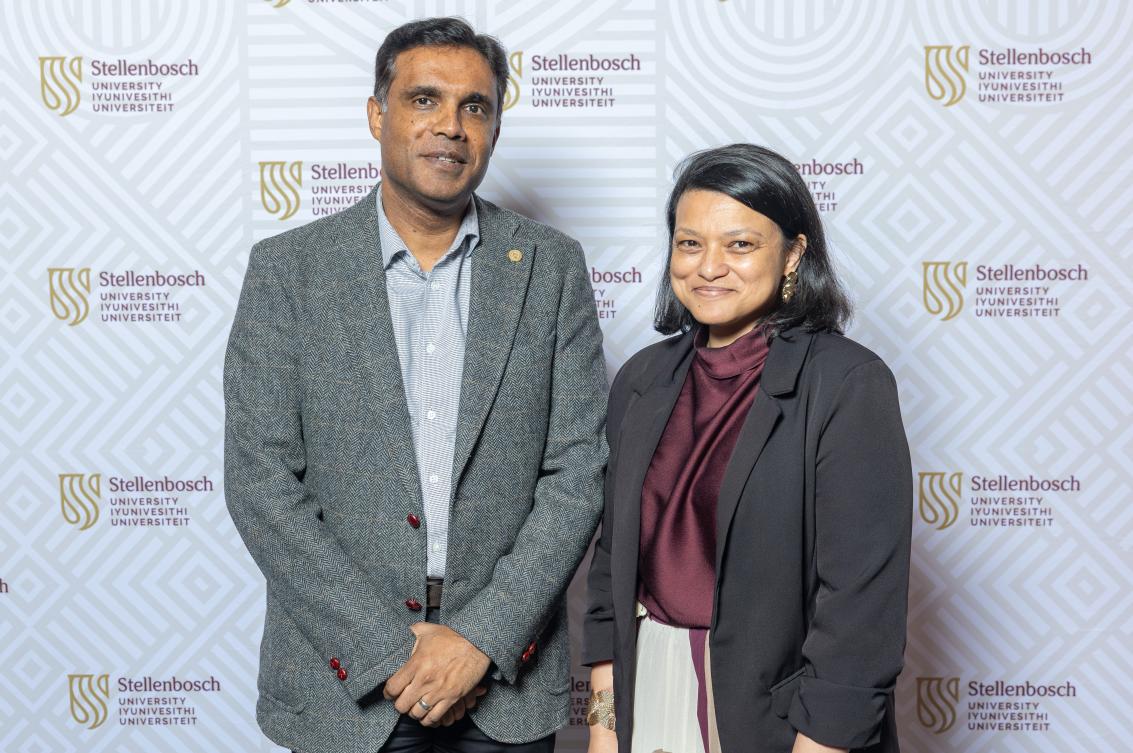
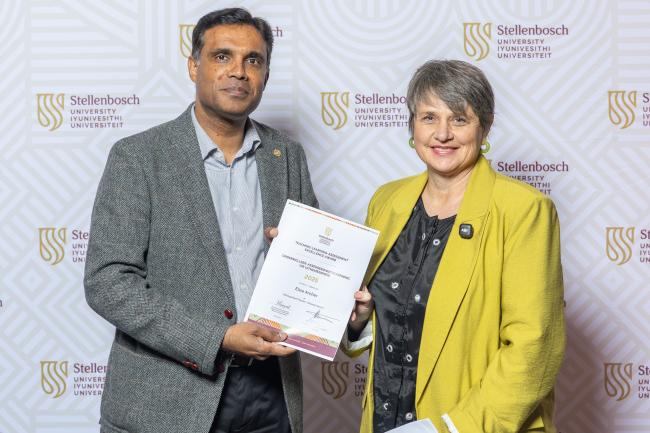
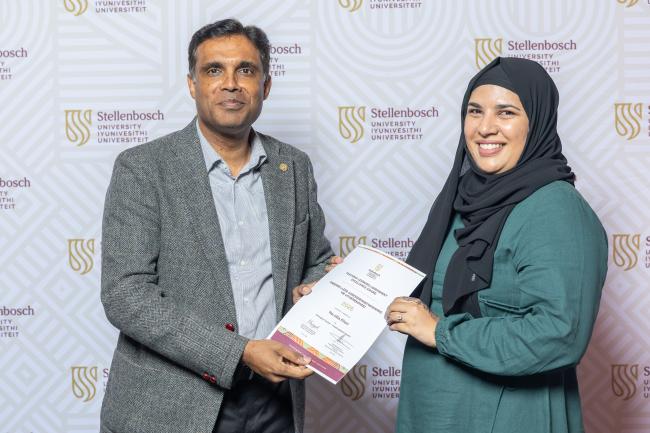
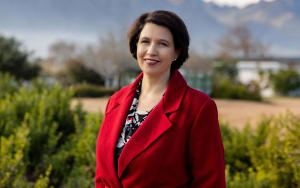
Prof Deresh Ramjugernath presented the Distinguished Teacher Award to Prof Elize Archer from the Faculty of Medicine and Health Sciences.
Top lecturers take centre stage at TLA celebration
- SU honoured top academics and innovators in teaching, learning and assessment at a prestigious celebration at STIAS.
- Prof Elize Archer received the Distinguished Teacher Award, while Profs Karin Wolff, Deborah Blaine and Sonia Fidder were celebrated for their national teaching award.
- Prof Ramjugernath said teaching excellence and research excellence are “deeply intertwined” in shaping the future of higher education.
An accomplished audience recently gathered at the Stellenbosch Institute for Advanced Study (STIAS) for Stellenbosch University’s (SU) annual “Celebrating Excellence in Teaching-Learning-Assessment” event, where the institution honoured lecturers, researchers and teaching fellows whose work is reshaping higher education across disciplines ranging from engineering and medicine to military science and theology.
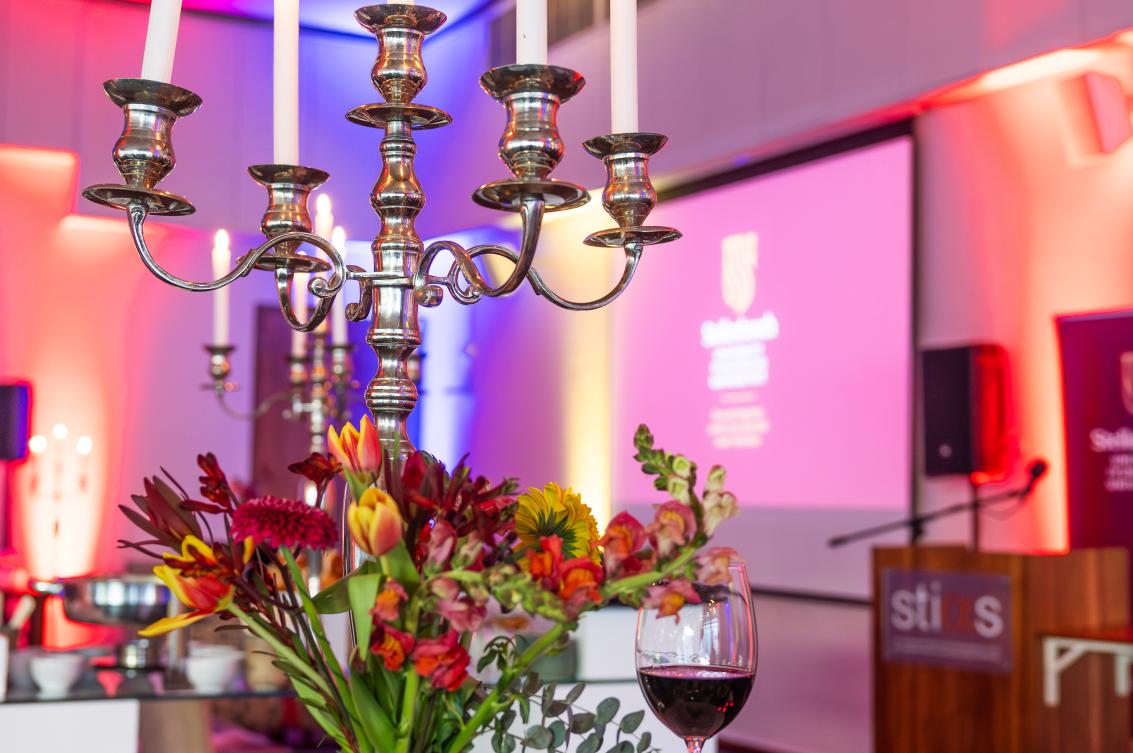
The marimba rhythms drifting through the venue set the tone for a sparkling programme that moved between awards, reflection, music and conversation. Directed by Dr Nicoline Herman, Acting Senior Director of the Division for Learning and Teaching Enhancement (DLTE), the event brought together members of the rectorate, deans, vice-deans and senior academics.
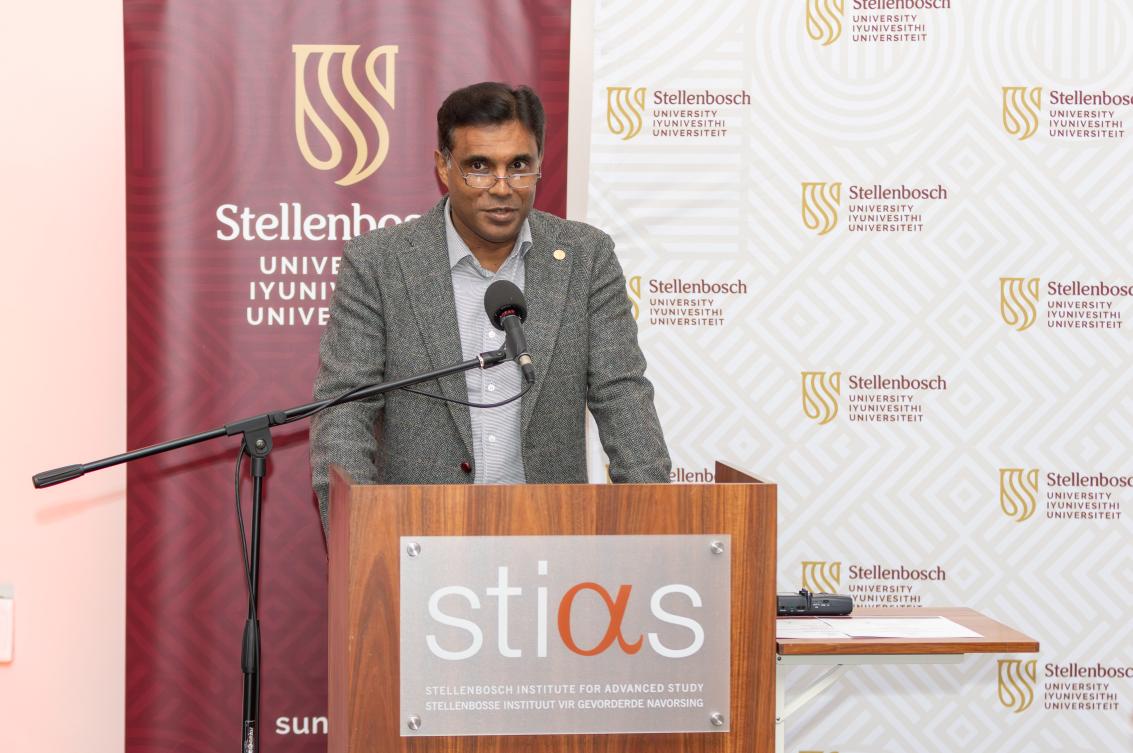
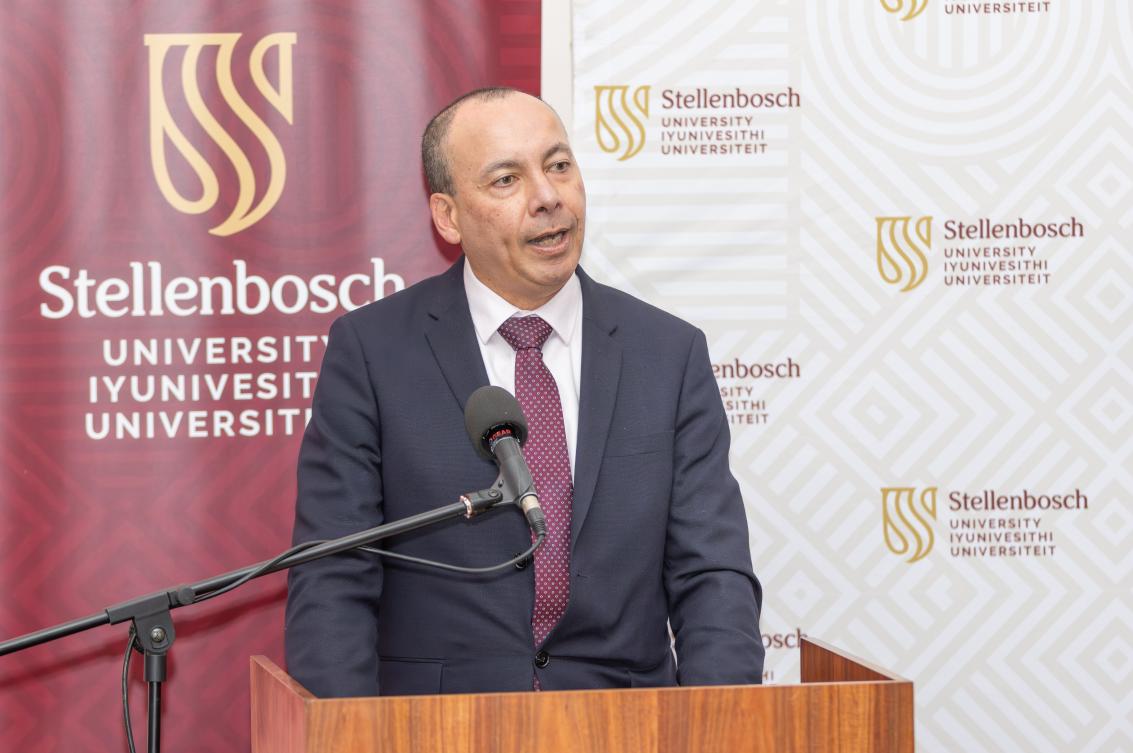
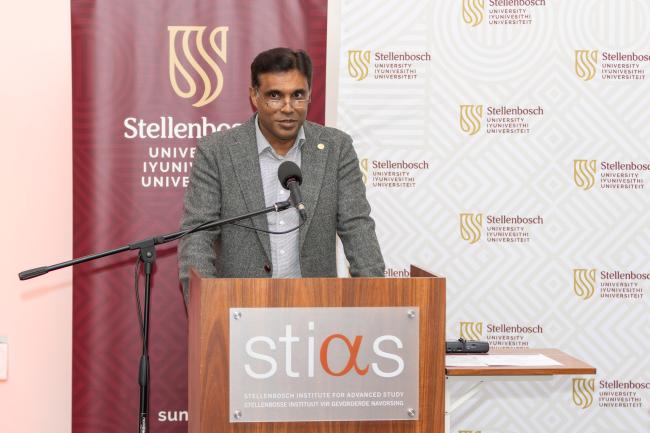
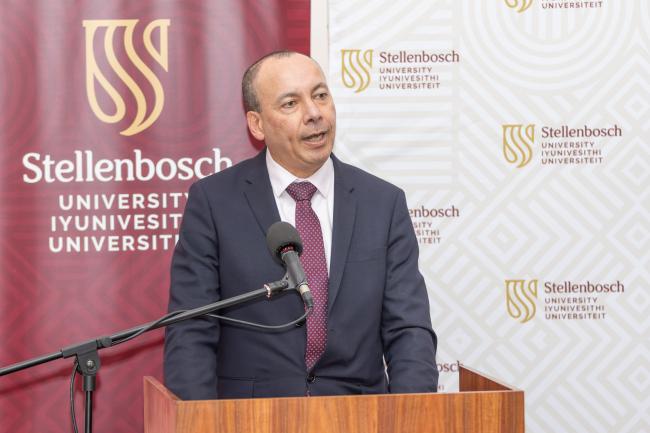
In his welcoming message, Rector and Vice-Chancellor Prof Deresh Ramjugernath argued that excellent teaching lies at the heart of what defines a university. “We often speak about Stellenbosch University as a research-intensive institution,” he said. “But research excellence and teaching excellence are not separate pursuits; they are deeply intertwined. Ultimately, the true measure of a university is not only what we discover, but what we enable students to become.”
Ramjugernath described teaching excellence as intentional, reflective and continuously developed. He praised the academics recognised during the evening for their commitment to student success and for helping shape teaching and learning practices not only at SU, but nationally. “If we get teaching, learning and assessment right at this institution – and in the higher education sector – we actually get the future right with regard to education,” he added.
Beyond content delivery
While the first half of the evening recognised a wide range of professional learning initiatives including staff who successfully completed courses and who gave acclaimed conference presentations, the highlight of the programme emerged during the Teaching Excellence Awards.
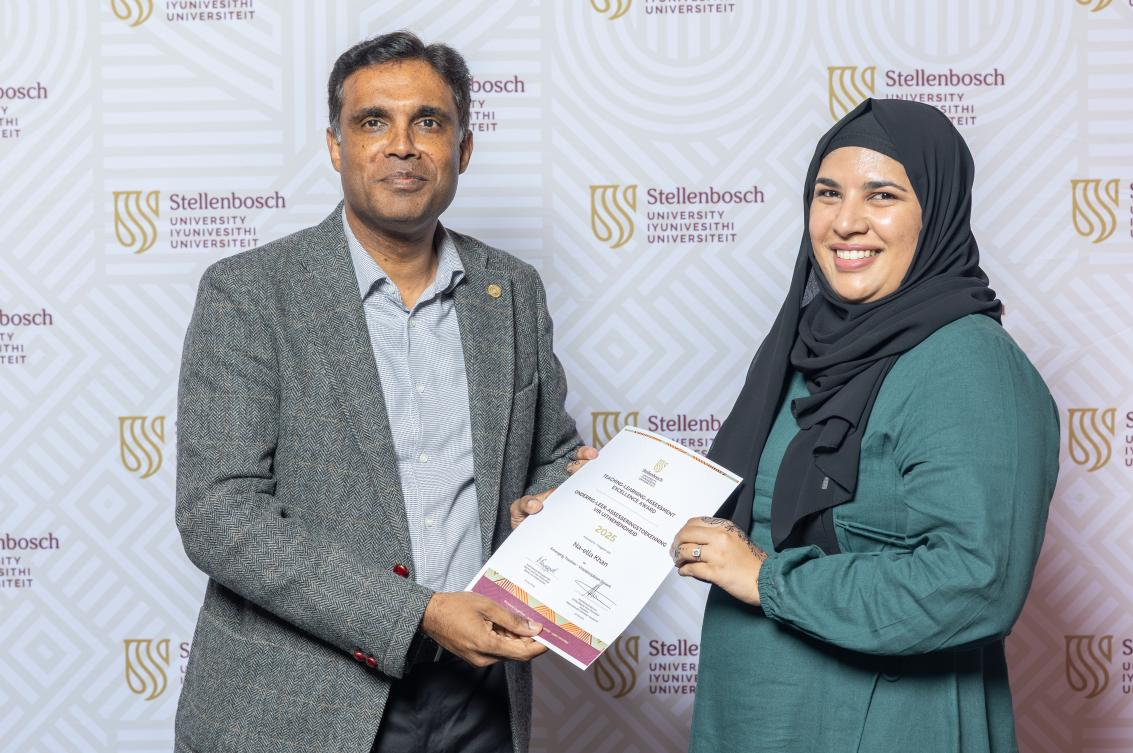
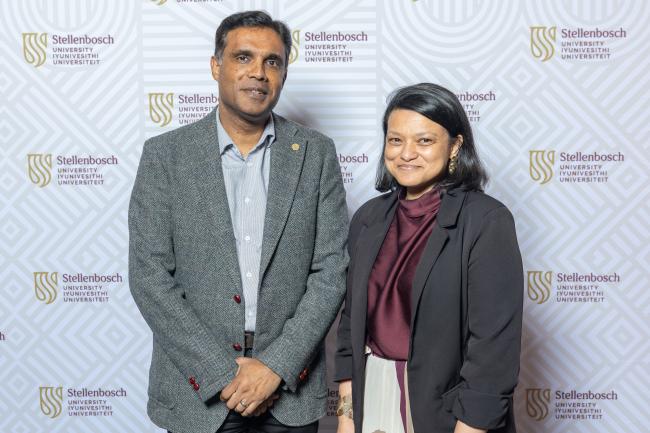
The Emerging Teacher Award recognised Dr Susan Henrico from the Faculty of Military Science and Na-Ella Khan from the School of Accountancy in the Faculty of Economic and Management Sciences.
Henrico reflected on the importance of combining academic rigour with genuine care for students navigating demanding military and personal environments. Drawing on African examples, real-world case studies and intelligence scenarios, she spoke about creating learning spaces where students feel both supported and challenged.
She also encouraged lecturers to recognise the educational leadership they already practise daily through curriculum refinement, student support and thoughtful assessment design. Good teaching, she said, was less about perfection than “honesty, reflection and a willingness to keep learning”.
Khan, who teaches auditing to undergraduate and postgraduate students, described a teaching philosophy centred on independent thinking and problem-solving. Acknowledging that auditing can feel abstract and intimidating to students, she said she deliberately integrates practical examples to make learning more meaningful and relevant.
Considering the pressures lecturers face, Khan said her motivation is renewed by even a single engaged student eager to learn. She urged younger academics to embrace gradual innovation in their teaching practices, arguing that small, consistent changes often have the deepest long-term impact.
The evening’s highest individual honour, the Distinguished Teacher Award, went to Prof Elize Archer from the Faculty of Medicine and Health Sciences.
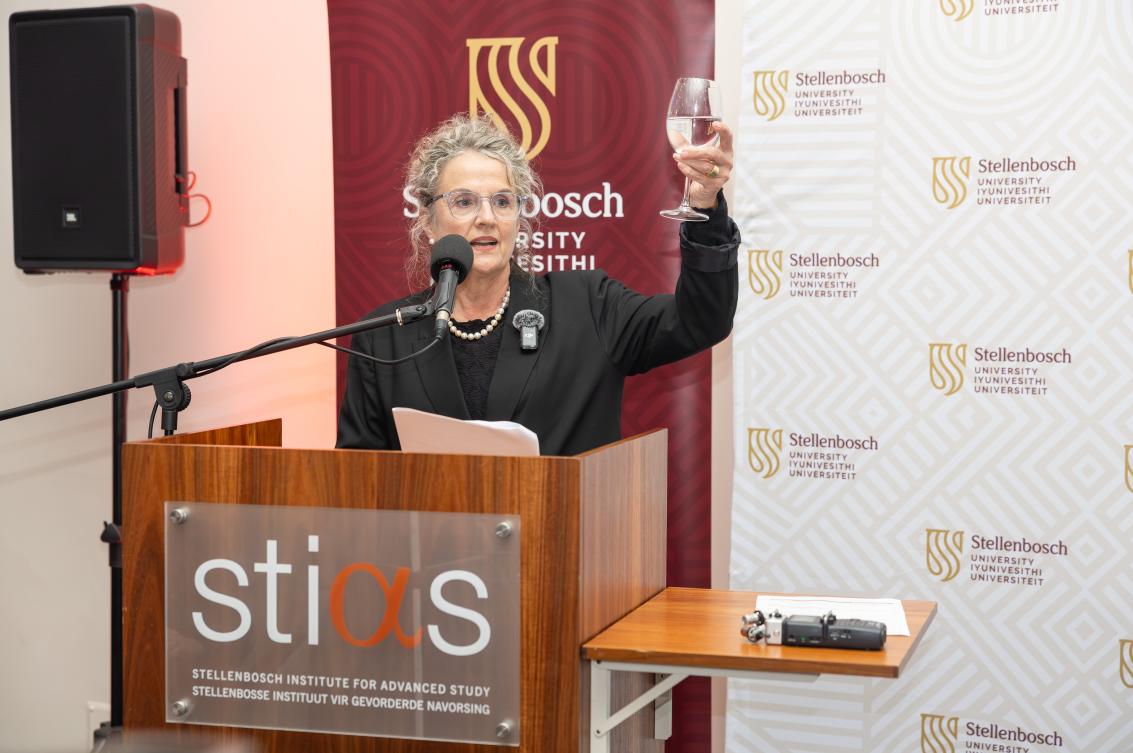
Archer spoke about how her own journey from critical care nurse educator to specialist in health professions education transformed her understanding of teaching over the past two decades. She described teaching as an empathetic and collaborative process rooted in helping students take ownership of their learning.
One of the most important lessons of her career, she said, was realising that successful teaching is not measured by how much content lecturers deliver, but by whether students truly connect with and apply what they learn. “Gone are the days of being a sage on the stage. Today, teaching is about being the guide on the side, the facilitator of learning rather than somebody with the sole knowledge,” Archer concluded.
Rethinking student success
A slideshow listing all awardees provided an overview of SU’s Teaching Fellows and the University’s participants in the Teaching Advancement at University (TAU) Fellowship Programme. Several fellowship recipients used the opportunity to reflect on broader questions facing South African higher education.
Dr Marnel Mouton from the Department of Botany and Zoology, recognised for completing an SU Teaching Fellowship last year, challenged narrow definitions of student success based purely on pass and throughput rates. Her fellowship research explored the experiences of students in extended curriculum programmes across the Faculties of Science, AgriSciences and Engineering.
Prof Nicola Plastow from Occupational Therapy, who completed a second SU Teaching Fellowship, reflected on service-learning work undertaken with students in Bishop Lavis. Occupational therapy students spent six weeks in a social housing development for older people, co-designing interventions aimed at promoting social participation and well-being.
Plastow described the project as profoundly transformative for students, forcing them to navigate conflict, relationships and mental health challenges alongside rehabilitation goals. She said her teaching fellowships had made her more intentional and reflective in her everyday teaching practice.
A national recognition for collaboration
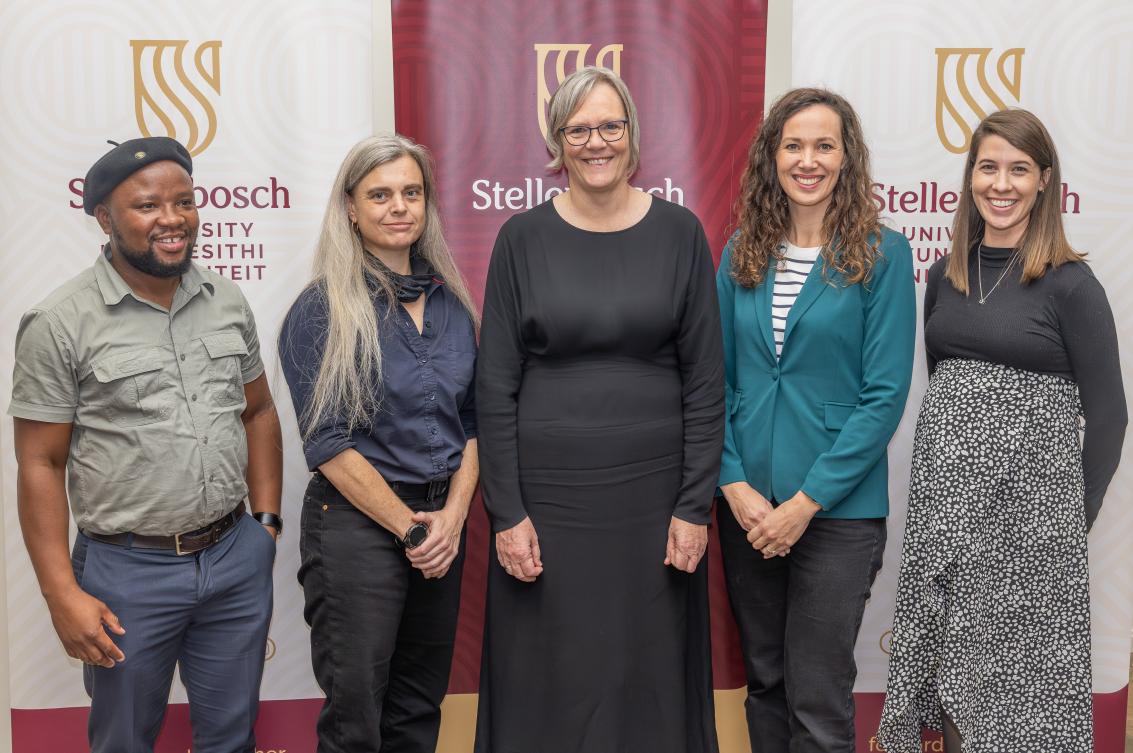
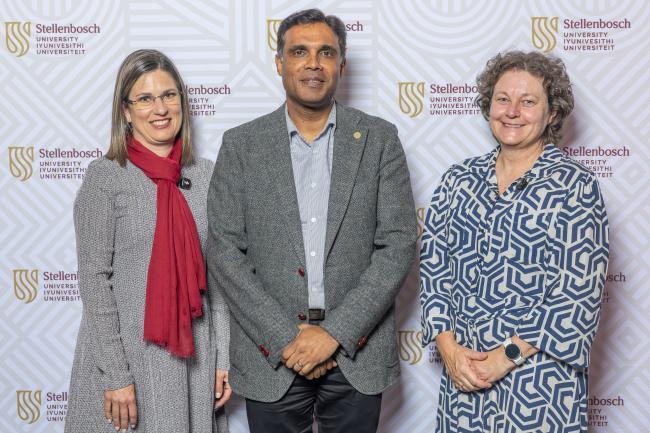
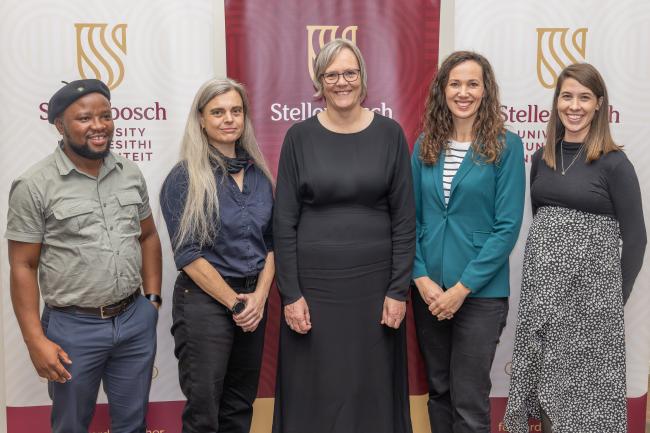
The evening culminated in recognition for Profs Karin Wolff, Deborah Blaine and Sonia Fidder, recipients of the prestigious National University Teaching Awards (NUTA) Collaborative Award for their work in engineering education.
Although Wolff could not attend, Blaine paid tribute to her colleague as the driving force behind the initiative and praised the Recommended Engineering Education Practices (REEP) group for helping build a culture where teaching excellence became a source of professional pride within the Faculty of Engineering.
Fidder highlighted the long-standing collaboration between Engineering and the mathematical sciences, which led to the creation of innovative teaching tools helping students better understand the practical relevance of applied mathematics in engineering contexts.
Recognition through awards such as NUTA, she said, motivates lecturers to continue investing time and energy into teaching innovation despite the competing pressures of disciplinary research.
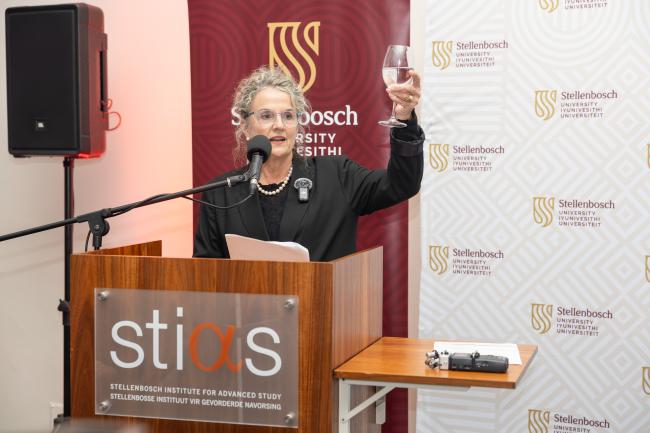
Closing the evening, Prof Richard Stevens, Acting Deputy Vice-Chancellor: Academic, reflected on teaching as “the quiet, consistent work of shaping futures”. “What we have celebrated tonight is not only excellence,” he noted, “it is intention and care.”
Stevens thanked the award recipients and fellows who have engaged in professional learning for setting such high standards. “You are not only advancing your own practice, but you are also strengthening the very foundation of this institution. As we go home tonight, I hope we do so with a renewed sense of purpose, because tomorrow the work continues.”
- A complete list of all the recipients can be found here:



Related stories

Institutional news
Celebrating a partnership that invests in Africa's future
As the Gerda Henkel Foundation celebrates its 50th anniversary this year, Stellenbosch University (SU) reflects on the impact of its own decade-long partnership...
Institutional news
Connecting the dots: Prof Liezl van Dyk’s vision as new DVC: Academic
Stellenbosch University’s (SU) new Deputy Vice-Chancellor: Academic, Prof Liezl van Dyk, sees patterns everywhere: in 14-year chapters, prime numbers and the...

Events
Prof Mesias Alfeus’s vision brings global finance congress to Africa
The announcement that Stellenbosch University (SU) will host the 14th World Congress of the Bachelier Finance Society (BFS) in 2028 – the first time the...