
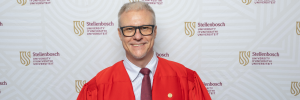
South Africa must invest in concentrated solar power – Prof Craig McGregor
- Prof Craig McGregor of the Department of Mechanical and Mechatronic Engineering delivered his inaugural lecture on Tuesday 19 May 2026.
- His work focuses on solar thermal energy and its applications, particularly for generating clean, renewable electricity.
- Concentrated solar power can help address South Africa’s future electricity needs.
Prof Craig McGregor of the Department of Mechanical and Mechatronic Engineering in the Faculty of Engineering delivered his inaugural lecture on Tuesday 19 May 2026. The title of his lecture was Sun, steel and storage: Solar thermal in South Africa’s energy future.
McGregor, who also hold the Acwa Chair in Concentrating Solar Power, explained to the Corporate Communication and Marketing Division why South Africa needs to invest in concentrated solar power.
Tell us more about your research and why you became interested in this specific field.
My research focuses on solar thermal energy and its applications, particularly for generating clean, renewable electricity. Solar radiation can be concentrated using mirrors to create high-temperature heat, just like you can do with a magnifying glass in the sun. This heat can be captured, either for heating purposes or to drive a turbine and generate electricity. When electricity is the final product, it's called concentrated solar power, or CSP.
I spent over twenty years at Sasol leading industrial research and development, where I took three technologies from concept to commercial deployment. One was the Stellio heliostat for solar thermal. The heliostat was developed for South Africa in collaboration with our German partners, SBP Sonne. It went on to win the SolarPACES Innovation Award. Unfortunately, Stellio has not yet been deployed in South Africa, but it is operating across 300 megawatts (MW) of CSP plants in China.
That experience shaped how I think about energy research. South Africa has the sun, industry, and engineering talent to lead in this field, but research only matters if the technology is built. I joined Stellenbosch in 2019 to focus on closing that gap. My research examines how CSP performs under South African conditions, how much of it can be built locally, and what it costs to deploy at scale.
How would you describe the relevance of your work?
South Africa must replace 23 gigawatts (GW) of ageing coal-fired power stations by 2042. Load shedding has already shown the serious economic damage this ageing infrastructure can cause. Besides electrical energy, South African industry is heavily dependent on coal for thermal energy at high temperatures.
Together, industry and electricity production account for over 80% of the country's greenhouse gas emissions, and most of this sector must also be decarbonised by 2050. Solar thermal is well-suited to the temperature range most industrial processes require.
What makes concentrating solar power such a viable alternative for energy production?
South Africa has the perfect sun for CSP. There is only one place in the world with significantly better sun than the Northern Cape: the Atacama Desert in Chile. Spain and China have deployed around 2 GW of CSP each, and China plans to reach 15 GW by 2030. We have significantly better solar resources than either.
What advantages does concentrating solar power offer over conventional solar panels?
Unlike conventional solar panels (PV), CSP includes energy storage as part of the technology. In CSP, this is thermal energy storage, which is incredibly cheap. Because of this, it’s possible to include daily storage, meaning CSP plants can produce electricity 24/7, whereas conventional solar panels stop producing as soon as the sun sets. This means that CSP can play the same role as nuclear power, but at a significantly lower cost, faster to build, and without the waste and safety concerns of nuclear power.
Why did South Africa stop purchasing CSP?
CSP has historically been compared against PV on cost. While CSP and PV are both solar power technologies, this is a mistake because CSP includes energy storage. The appropriate comparison is CSP versus PV with battery energy storage. CSP remains significantly cheaper on an apples-for-apples comparison.
The policy planners fell into the trap of comparing CSP directly with PV instead of PV with batteries — the classic apples-to-oranges comparison. They did not even include it as an option within their studies for the Integrated Resource Plan (IRP).
What must we do to build CSP on a large scale?
The first thing is to stop the exclusion of CSP from the IRP. CSP should be allowed to compete on an equal footing with nuclear and PV with batteries. The second is to give CSP the same level of localisation support that these other renewable technologies receive.
Unlike conventional batteries and solar panels, where South Africa has to compete against the Chinese, CSP plants are constructed from steel, glass and concrete. This is a technology which matches our industrial base. South Africa has a real opportunity to take a lead in the development and deployment of the technology.
Higher education can be challenging. What keeps you motivated when things get tough?
I am making a difference, particularly to our country, by helping to train the next generation of engineers, the ones who will need to do the hard work transitioning our energy system.
What aspects of your work do you enjoy the most?
I really enjoy the mentorship, particularly with postgraduate students, where you work with them individually throughout their studies. I can bring my industrial experience to the university environment, tying what they learn to real-world practice. And I genuinely enjoy the analytical work itself.
Tell us something exciting about yourself that people would not expect.
There is nothing quite like a weekend board game session with friends. Settlers of Catan, Carcassonne, that kind of thing. There is something satisfying about a strategy game that plays out across a table over several hours, with the people you are competing against sitting in front of you.
How do you spend your free time?
I enjoy reading, listening to audiobooks, gardening and playing computer games.
Related stories

Institutional news
Celebrating a partnership that invests in Africa's future
As the Gerda Henkel Foundation celebrates its 50th anniversary this year, Stellenbosch University (SU) reflects on the impact of its own decade-long partnership...
Institutional news
Connecting the dots: Prof Liezl van Dyk’s vision as new DVC: Academic
Stellenbosch University’s (SU) new Deputy Vice-Chancellor: Academic, Prof Liezl van Dyk, sees patterns everywhere: in 14-year chapters, prime numbers and the...

Media release
Cape Winelands Airport and SU forge strategic partnership for smart and sustainable development
Cape Winelands Airport and Stellenbosch University (SU) have entered into a cooperation agreement aimed at advancing innovation under the shared themes of...