
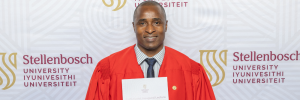
From farm to fork: Prof Mapiye is rethinking meat through alternative diets
- Prof Cletos Mapiye from the Department of Animal Sciences delivered his inaugural lecture on 30 April 2026.
- His research looks at how sustainable, non-conventional feeds for cattle, sheep and goats influence the quality of meat we eat.
- His work contributes to healthier and more sustainable and equitable food systems.
Prof Cletos Mapiye from the Department of Animal Sciences in the Faculty of AgriSciences delivered his inaugural lecture on Thursday 30 April 2026. The title of his lecture was Climate-smart phytogenic diets for enhanced ruminant meat quality.
Prof Mapiye spoke to the Corporate Communication and Marketing Division about how sustainable, non-conventional feeds for cattle, sheep and goats (ruminants) can help improve the nutritional quality, safety, taste and flavour, shelf life, and affordability of meat.
Tell us more about your research and why you became interested in this specific field.
My research looks at how sustainable, non-conventional feeds for cattle, sheep and goats influence the quality of meat we eat. Specifically, it explores whether these alternative feeds can enhance meat yield, nutritional value, healthfulness (nutritional quality), palatability (taste and flavour) and shelf life, while reducing reliance on expensive conventional feedstuffs that place financial pressure on farmers and harm the environment. My hands‑on upbringing on a small-scale crop-livestock farm sparked a lasting passion for livestock, and an interest in how animal diet shapes the quality of meat, and the sustainability and resilience of food systems.
How would you describe the relevance of your work?
By improving the healthfulness, safety, palatability, shelf life and affordability of meat, my research has practical benefits far beyond the farm. It can help families access better diets, reduce food losses across supply chains and improve returns for livestock producers. In turn, these outcomes contribute to healthier and more sustainable and equitable food systems. They also strengthen food security and build resilience in farming communities, particularly in regions where rising feed costs and resource pressures threaten livelihoods and nutrition for many vulnerable households.
Can you give examples of how your research is applied in real-world contexts?
My research advances climate-smart nutrition by showing how low-quality phytogenic (natural, plant-based ingredients added to animal feed) feedstuffs can be incorporated into commercially validated diets for ruminants that improve meat quality while reducing climate impacts. This work has moved beyond experimentation into practice: producers and feed companies now use validated phytogenic feedstuffs, including invasive tree foliage and fruit byproducts, in commercial diet formulations to sustainably enhance the quality of meat.
How can non-conventional, climate-smart phytogenic ruminant feed resources improve meat production and quality?
Non-conventional, climate-smart phytogenic feed resources are naturally endowed with bioactive phytochemicals (natural compounds produced by plants), including polyunsaturated fatty acids, polyphenols, essential oils and saponins, that have antimicrobial (killing or preventing the growth of bacteria, viruses, fungi, etc.) and antioxidant properties. After absorption, these compounds are deposited within the muscle tissue to improve the fatty acid composition, palatability, oxidative stability (how well meat stays fresh when exposed to oxygen) and microbial safety of meat (meat does not contain harmful germs).
You plan to establish a consumer-centric, climate-smart Meat Hub. Why is such a hub important?
The proposed Hub will serve as a strategic platform for repositioning ruminant meat as a ‘future‑fit’ food by aligning evolving preferences of consumers with industry priorities and sustainability imperatives. The Hub will integrate indigenous knowledge, modern science and circular innovation (designing products that can be recycled, repaired and reused) to co‑create sustainable phytogenic diets that enhance the quality of meat and strengthen food and nutrition security. Through inclusive value‑chain partnerships, transparent traceability, and credible health and sustainability branding, the Hub will support vulnerable communities, rebuild public trust and contribute to a healthier, more just and resilient global food system.
Higher education can be challenging. What keeps you motivated when things get tough?
Academic life is demanding and often intensely stressful. Amid mounting pressures, I am sustained by a passion for discovery, the privilege of shaping young minds, the pursuit of research that delivers real-world impact and professional accolades that affirm hard-won expertise, public contribution and a deeper sense of purpose.
What aspects of your work do you enjoy the most?
I enjoy writing and editing scientific manuscripts – processes which sharpen ideas, strengthen rigour and transform complex science into clear, compelling, trustworthy narratives with real-world impact for broad, diverse audiences around the world.
Tell us something exciting about yourself that people would not expect.
I lead charitable initiatives that mobilise and distribute essential resources to the needy, promoting social equity and translating specialised knowledge into public value. This work sustains a strong sense of moral purpose in me and provides profound intellectual, ethical and spiritual fulfilment.
How do you spend your free time?
On weekdays, I unwind by surfing social media and watching reality and family game shows. Come weekends, leisure turns active through gardening, darts and overnight camping with family and friends.
Related stories

Institutional news
Fama Jallow: Reaching beyond the stars to reimagine solutions for Africa
Matie alumna, aerospace engineer and climate-tech entrepreneur Fama Jallow is a woman of firsts – The Gambia’s first licensed female drone pilot and first...
Institutional news
SU again ranked among top universities in the world
Stellenbosch University (SU) has been ranked among the world’s leading universities in two global rankings released in the same month.
SU broke into the top 300...
Institutional news
SU and TUT join forces to develop SA’s future research leaders
Stellenbosch University (SU) and Tshwane University of Technology (TUT) have formalised a new partnership aimed at developing the next generation of researchers...