

‘Decay without mourning’ conference offers new ways of caring for the past
- International scholars and artists reframe decay as a creative force in heritage practices.
- Conference links heritage to environmental change, colonial histories and future responsibility.
- Academic discussions intertwined with exhibitions, performance and music.
An international conference at Stellenbosch University (SU) has challenged long-held assumptions about heritage, urging scholars, artists and archivists to rethink decay not as loss, but as a generative condition shaping how societies remember and imagine the future.
Held from 15 to 17 April at the Stellenbosch Institute for Advanced Study (STIAS), Decay without mourning: Future-thinking heritage practices brought together delegates from across the globe. The event marked the culmination of a five-year research collaboration between SU, the KTH Royal Institute of Technology in Sweden and the University of São Paulo.
At its core was a deceptively simple proposition: that decay – whether in fragile archives, eroding landscapes or contested monuments – can produce new meanings, relations and forms of knowledge. “In our work we do not view decay simply as loss,” said Prof Lizabé Lambrechts, organiser of the conference and researcher at SU’s Africa Open Institute. “We reframe it as a transformative condition through which new meanings emerge.”
A conference grounded in place
Opening the conference, Prof Vasti Roodt, Dean of the Faculty of Arts and Social Sciences, located the discussion within SU’s own layered past. She recalled that her faculty building once bore the name of apartheid prime minister BJ Vorster and was built on land cleared through forced removals in 1964.
“Today, the name is gone. The bronze bust of BJ Vorster has been removed from the foyer and in its place are murals depicting the community from Die Vlakte that was destroyed to make way for the building,” she noted. This raised a deeper question: what should be done with such histories? For Roodt, the conference rejected a false choice between preserving everything and letting everything disappear – not by offering a third option, “but by sitting seriously with the tension between holding on and letting go”.
Prof Stephanus Muller, Director of the Africa Open Institute, drew on literature to describe the project’s ambition. Referencing Gabriel García Márquez’s story of a drowned stranger whose arrival transforms a village, he argued that encounters with decay can expand “architectures of thought”.
“Once that excess has been encountered, it cannot be unthought,” Muller said, suggesting that even after exhibitions or performances end, the questions they open continue to reshape research and creative practice.
Project principal investigator Dr Lize-Marié Hansen van der Watt of KTH outlined the intellectual shift underpinning the collaboration. Rather than trying to halt deterioration at all costs, the project treats decay as “a potentially creative process” that reveals how heritage evolves over time. This approach extends across archives, landscapes, indigenous knowledge systems and conservation practices in diverse global contexts.
From preservation to relational care
The conference’s keynote sessions deepened this rethinking of heritage. On the first day, Prof Njabulo (Jabu) Chipangura, an anthropologist at Maynooth University in Ireland and former curator at Manchester Museum, challenged conventional museum practices by asking whose interests are served when institutions promise to preserve objects indefinitely.
“These objects are cared for to live forever,” he noted of large African collections held in European museums, “but whose posterity are we guaranteeing if originating communities cannot access their own heritage?”
Chipangura called for a shift from treating objects as static artefacts to recognising them as “living cultures” embedded in ongoing social and spiritual worlds. Central to his argument was the idea of “relational care”, grounded in the ethic of Ubuntu – “you are because we are”. This approach emphasises collaboration with source communities, transparency about colonial histories and a rebalancing of authority in heritage work.
A second keynote, by Swedish archaeologist Prof Christina Fredengren, extended the conversation into deep time and environmental change. She explored how radiocarbon dating – a cornerstone of archaeological research – is being disrupted by fossil fuel emissions, which dilute the atmospheric signals used to measure time.
By mid-century, she noted, radiocarbon readings could make contemporary materials appear centuries old, creating what she described as a “temporal eraser”. For Fredengren, this disruption highlights the need for new ways of telling stories across time in the Anthropocene, where human actions reshape both the past and future.
Together, the speakers argued that caring for heritage requires confronting colonial violence, environmental instability and the shifting meanings of time itself.
Decay in a warming, unequal world
On the second day, keynote speakers turned to the lived realities of decay in a rapidly changing world. Prof Taku Iida, an ecological anthropologist based in Japan, presented a case study of the 2023 Al Haouz earthquake in Morocco, which devastated both communities and cultural heritage.
Drawing on fieldwork in the Atlas Mountains, Iida argued that heritage should be understood as a system that includes both tangible and intangible elements. Post-disaster reconstruction, he showed, often accelerates social change rather than restoring a fixed past. In rebuilding villages, new technologies and infrastructures reshape daily life, from labour patterns to gender roles.
“Heritage changes, both intentionally and unintentionally,” he said, noting that what some perceive as decay may be experienced by others as renewal.
Prof Sven Dupré, a Belgian historian of art and science, traced how modern conservation practices have prioritised material stability, often treating change as failure. Yet in fields such as restoration ecology, disturbance is understood as a natural process that can lead to new forms of balance. Dupré suggested that heritage conservation might benefit from a similar perspective, recognising decay as part of a dynamic system rather than a threat to be eliminated.
Johannesburg-based artist and academic Prof Leora Farber brought these ideas into the realm of artistic practice. In her installation Leftovers at the table (or, what we are left with), domestic objects linked to colonial histories are slowly overtaken by living moss. The work foregrounds what she calls the “ruinations” of empire – ongoing processes rather than completed events.
“I became a collaborator in an unscripted, ever-unfolding series of interactions,” Farber said of working with living material that resisted control. In this context, decay becomes a connective force, linking human histories, ecological processes and more-than-human forms of life.
Beyond academic conversations
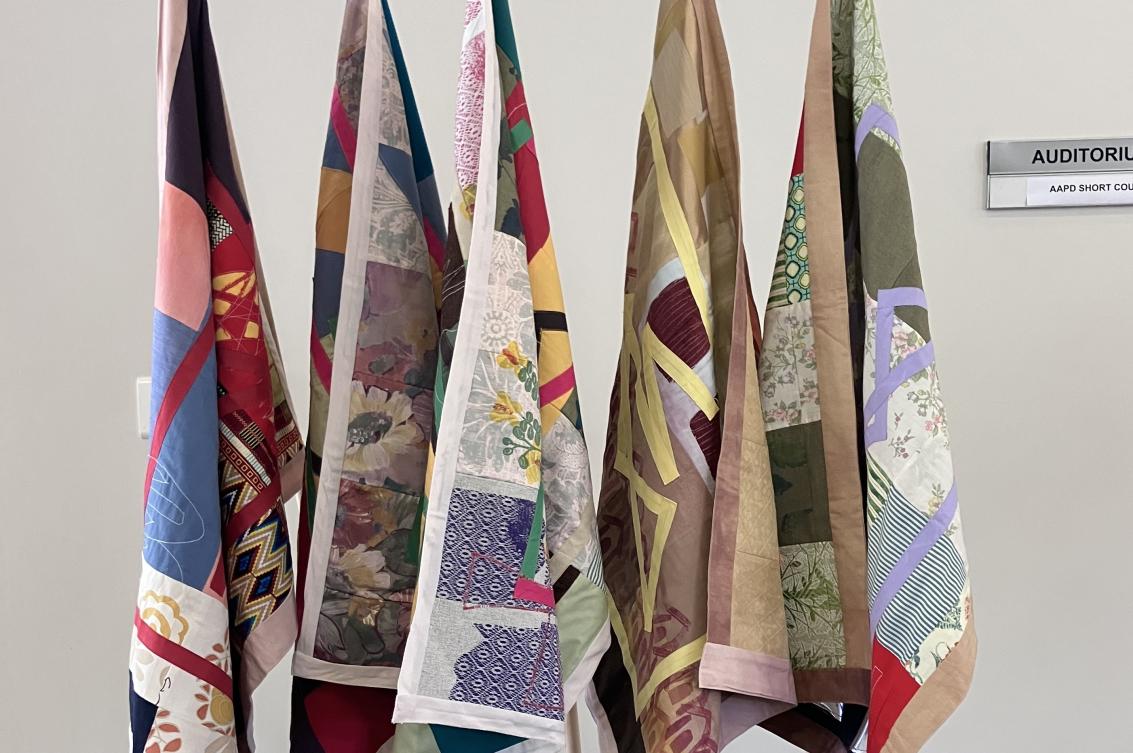
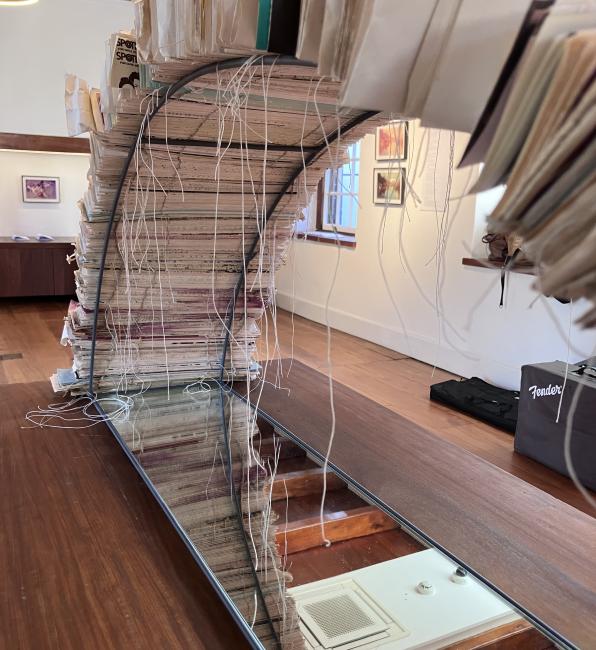
The conference extended beyond theoretical discussions to include exhibitions, performances and musical works. The Deaccessioned exhibition, curated by Prof Lizabé Lambrechts and Dr Nicola Deane, reimagined decayed photographic negatives as sites of transformation, while composer Dr Cara Stacey’s Hypha explored sound as a form of decomposition and regeneration. Choreographer Nelisiwe Xaba’s vRot used the language of decay to interrogate corruption and social breakdown.
These works contributed to the conference’s central insight: that decay is not simply an endpoint, but an ongoing process that shapes both memory and possibility.
Rather than resisting disintegration, Decay without mourning suggested, the task ahead is to learn how to live with it and to recognise in its slow, often unsettling processes the seeds of new futures.





Related stories
Events
New archive at SU sheds light on overlooked liberation history
A major archive documenting one of South Africa’s most influential – yet often overlooked – liberation traditions has found a home at Stellenbosch University...
Awards and milestones
Top lecturers take centre stage at TLA celebration
An accomplished audience recently gathered at the Stellenbosch Institute for Advanced Study (STIAS) for Stellenbosch University’s (SU) annual “Celebrating...
Events
‘A crime does not rot’: Africa Day lecture calls for radical slavery reparations
The enslavement of black Africans was a “world-breaking crime” that continues to shape global inequality, sovereignty and power today – and now is the time to...