
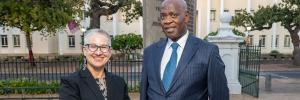
Justice Rammaka Steven Mathopo was the speaker at the 20th Annual Human Rights Lecture, hosted by the HF Oppenheimer Chair in Human Rights Law (Prof Sandra Liebenberg).
ConCourt judge delivers ‘milestone’ human rights lecture
- Justice Rammaka Steven Mathopo called for a renewed focus on spatial justice and housing rights in South Africa.
- He was the speaker at the 20th Annual Human Rights Lecture
- The lecture was hosted by the HF Oppenheimer Chair in Human Rights Law
Justice Rammaka Steven Mathopo of the Constitutional Court delivered the 20th Annual Human Rights Lecture at Stellenbosch University (SU) on 16 April 2026, calling for a renewed focus on spatial justice and housing rights in South Africa.
The event was hosted by the HF Oppenheimer Chair in Human Rights Law in the University’s Faculty of Law, which “has long been an important space for legal scholarship and constitutional reflection”, he said.
“It is therefore a particular honour to have the opportunity to engage this community on questions that lie at the intersection of human rights, urban development and the lived realities of many communities.”
Lived reality
Titled A Right to Remain: Spatial Justice and a Transformative Approach to Housing Rights, Mathopo’s lecture explored the enduring spatial inequalities of apartheid and their implications for constitutional rights.
He grounded the lecture in personal experience. “I grew up in a South Africa that was deeply segregated, and I witnessed our transition into a democratic dispensation with core values in human rights. I do not view spatial justice as an abstraction,” he said.
Born in Soweto and educated in rural Limpopo, Mathopo lived through the spatial divides he now encounters as a judge tasked with upholding the Constitution. He spent 17 years in legal practice before joining the bench in 2006, later serving in the High Court and the Supreme Court of Appeal before his appointment to the Constitutional Court in 2022.
Unfulfilled promise
Spatial injustice was a defining feature of apartheid, Mathopo explained. “Laws such as the Group Areas Act and the Prevention of Illegal Squatting Act did not merely regulate land use; they engineered distance – distance between black bodies and economic opportunity, distance between communities and social goods, and distance between personhood and dignity.”
It was this legacy, he pointed out, that the 1996 Constitution, adopted shortly after South Africa’s transition to democracy, set out to redress. It promised “a society where dignity, equality and freedom would be lived realities”.
Yet that promise remains unfulfilled – the spatial divides of the past are still deeply entrenched. Mathopo pointed to communities living without access to basic services, as well as those displaced in the name of development and relocated far from economic opportunities.
Development without displacement
A central theme of the lecture was the need to rethink development in a way that protects people’s connections to place, community and livelihood.
“Homes are not merely structures of brick and mortar,” Mathopo said. “They are places where people build lives, sustain livelihoods and form the social bonds that give meaning to everyday existence.”
He argued that a transformative constitutional approach requires addressing spatial inequality not only as a historical legacy, but as an ongoing constitutional challenge.
While acknowledging the pressures faced by municipalities as urban populations grow, he emphasised that human dignity must remain central.
“Those who are homeless still belong somewhere,” he said. “It is that right of belonging that underpins all other rights. You may not have a house, but you still call South Africa your home.”
Law, limits and responsibility
Mathopo situated these challenges within South Africa’s constitutional framework.
Section 25 of the Constitution protects property rights while enabling land reform, while Section 26 guarantees access to adequate housing and provides protection against eviction without a court order.
Through years of jurisprudence, he noted, the courts have established that evictions must be just and equitable, that municipalities must engage meaningfully with affected communities, and that no one should be rendered homeless without due consideration.
The courts do, however, face institutional limits. “We cannot design housing policy, nor can we allocate budgets,” Mathopo conceded.
But he left the audience with a pointed question: “Are we using the powerful mechanisms that exist to their true potential?”
In an Old Main Building room filled with law practitioners, legal scholars and students, as well as several judges attending in person and online, he concluded with a challenge: “We can, and must, insist that constitutional obligations are met.”
‘Thought-provoking’
The lecture marked the 20th anniversary of the series.
Speaking on behalf of the Rector and Vice-Chancellor Prof Deresh Ramjugernath, Acting Deputy Vice-Chancellor: Learning and Teaching Prof Richard Stevens described the event as “a milestone that speaks not only to longevity, but to sustained intellectual and moral commitment”.
He added: “We are acutely aware that our history places a particular responsibility on us. We cannot speak about rights in the abstract. We must engage them in context.”
Graham Viljoen, Managing Director of Webber Wentzel, the law firm sponsoring the series, said it was “a genuine honour” for the firm to have been involved from the beginning.
“This kind of sustained interrogation matters – not just as an intellectual exercise, but as a civic one,” he said.
The incumbent of the Chair, Prof Sandra Liebenberg, thanked Mathopo for what she described as a “profound and thought-provoking lecture”.
“Not only your jurisprudential rigour, but also your humanity, empathy and compassion for those excluded by poverty have truly shone through,” she said.
* Desmond Thompson is a freelance journalist.
Related stories
Media release
Career Day inspires future lawyers to carry Mandela’s legacy forward
Three decades after South Africa adopted one of the world’s most progressive constitutions, more than 150 aspiring lawyers gathered at Stellenbosch University...
Events
Taking sustainable energy research from the lab to the market
South African researchers should measure success not only by publications and patents, but by the tangible technologies, businesses and jobs their work creates...

Events
Prof Mesias Alfeus’s vision brings global finance congress to Africa
The announcement that Stellenbosch University (SU) will host the 14th World Congress of the Bachelier Finance Society (BFS) in 2028 – the first time the...