
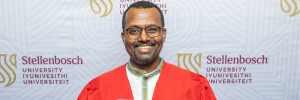
Access to finance helps SMEs survive – Prof Ashenafi Fanta
- Prof Ashenafi Fanta, of Stellenbosch Business School, delivered his inaugural lecture on Thursday, 7 May 2026.
- He examines how financial access influences the performance of SMEs.
- Expansion of digital infrastructure and credit guarantee schemes can improve SME finance.
Prof Ashenafi Fanta, of Stellenbosch Business School in the Faculty of Economic and Management Sciences, delivered his inaugural lecture on Thursday, 7 May 2026. The title of his lecture was Rethinking SME finance: what works, what doesn’t, and why it matters.
Fanta described to the Corporate Communication and Marketing Division why a lack of finance is a major impediment to the survival and growth of small and medium enterprises (SMEs). He also highlighted ways in which SME finance could be improved.
Tell us more about your research and why you became interested in this specific field.
My research falls in the domain of financial economics, specifically focusing on the role of finance at macro and micro levels. At a firm level, my research is aimed at understanding the role of finance in the survival and growth of businesses. This led to the development of a series of projects that cast a light on how firms interact with financial institutions and whether their access boosts business performance.
My interest in this topic is driven by an observation that entrepreneurial initiatives supported with finance succeed, bringing immense benefit beyond the entrepreneur. Small businesses play several roles in the economy, including providing employment opportunities for medium-skilled and low-skilled labour, and serving as a breeding ground for large businesses.
How would you describe the relevance of your work?
Given that SMEs constitute a significant share of firms, easing the financing challenges they face will enable them to play a critical role in reducing unemployment and inequality in developing countries. Insights from my research assist policy makers to design an SME-friendly policy environment that promotes a thriving sector crucial to addressing several societal challenges.
Why does finance stand out as a major impediment to the survival and growth of SMEs?
Finance is at the forefront due to its effect on day-to-day operations and growth of SMEs. Regardless of how well SMEs manage several aspects of their business – such as building a client base or offering a distinguishable product or service – a lack of finance can still put them under serious pressure.
A small firm that struggles to access enough finance will be unable to meet its operational needs, which will restrain its ability to meet the needs of its customers. This, in turn, leads to loss of market and eventual closure. Similarly, a lack of finance will restrain a firm’s growth that would be achieved by seizing opportunities as they arise.
SMEs are also highly vulnerable to shocks such as the Covid-19 pandemic. Access to finance enables them to remain in business by withstanding the shock.
Based on your research, what should be done to improve access to finance for SMEs?
Improving SME finance requires public sector commitment to the expansion of digital infrastructure as well as credit guarantee schemes that would reduce lending risks for banks. Strengthening regulatory frameworks is equally important, particularly in adapting to fintech innovations, as enhanced regulation ensures investor protection and fosters an environment conducive to financial innovation.
Financial institutions must complement these efforts by designing SME-specific financial products with lower collateral requirements and flexible repayment terms. Integrating fintech-driven credit assessments and data analytics can help bridge information asymmetry to enable more accurate risk evaluations and reduce default rates.
Higher education can be challenging. What keeps you motivated when things get tough?
Education is key to societal transformation. It provides the opportunity for people to realise their potential, with benefits extending far beyond the students themselves.
When things get tough, I stay motivated by remembering that higher education is not only about personal achievement, but about gaining the knowledge, skills, and confidence to make a meaningful contribution to society. The challenges are part of the process of growth, and each obstacle strengthens my resilience and determination.
What aspects of your work do you enjoy the most?
I love both teaching and research. Teaching allows me to engage in a scholarly discourse with my students, and this requires me to remain updated with respect to emerging issues in my field. Most rewarding is witnessing the transformation of my students as they grow and develop new skills through my classes.
I equally enjoy research as it allows me to understand what works in an African context. As a social scientist, I like identifying conditions that explain economic phenomena in the local context, providing a basis to apply theories that consider the contextual reality in Africa.
Tell us something exciting about yourself that people would not expect.
I love painting and I used to spend considerable time drawing icons of saints. At home, I have a 32-year-old painting of St Mary that I completed weeks after writing matric.
How do you spend your free time?
Playing table tennis with my sons and watching football matches. I’m not a fan of any club as I want to enjoy each game and support the team that performs the best.
Related stories

Media release
Cape Winelands Airport and SU forge strategic partnership for smart and sustainable development
Cape Winelands Airport and Stellenbosch University (SU) have entered into a cooperation agreement aimed at advancing innovation under the shared themes of...

Institutional news
Prof Hafizah Chenia listens in on microbes to improve global health
Prof Hafizah Yousuf Chenia of the Department of Microbiology in the Faculty of Science delivered her inaugural lecture on Tuesday 23 June 2026. The title of her...

Institutional news
Reshard's path from Stellenbosch to Yale
From a first-generation student arriving at Stellenbosch University (SU) on a recruitment bursary to becoming a doctoral candidate at the prestigious Yale Law...