
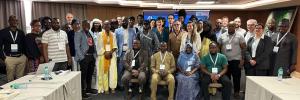
Dr Meli M Ncube Presents at Countering Foreign Interference (CFI) Africa Forum in Senegal
- Expert Participation: Stellenbosch University’s Dr. Meli Ncube joined African researchers and policymakers in Senegal to address the growing threat of foreign and domestic information manipulation.
- Structural Analysis: Dr. Ncube argued that "information disorder" is not just about fake news, but a systemic issue rooted in digital colonialism, platform dominance, and fragile media economies.
- Holistic Solutions: The forum concluded that countering interference requires moving beyond simple fact-checking toward large-scale regulatory reform and cross-continental research collaboration.
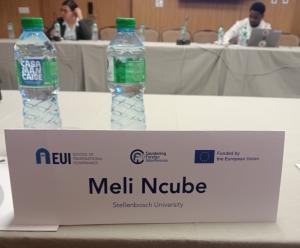
Dr Meli M Ncube of Stellenbosch University’s Department of Journalism was among the researchers, policymakers, journalists and civil society organisations from across the continent invited to weigh in on the growing challenge of information manipulation in Africa’s evolving digital and geopolitical landscape.
The speakers shared their insights at the 2026 Countering Foreign Interference (CFI) Africa Forum, held in Dakar, Senegal, on 10 and 11 February.
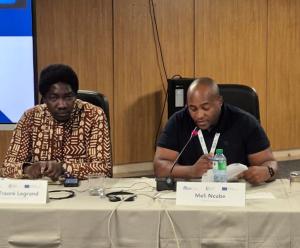
The opening session, moderated by Admire Mare, an Associate Professor in the Departmentof Communication and Media at the University of Johannesburg, focused on strengthening independent research and fostering cross-country collaboration on foreign and domestic information manipulation (FIMI). Joining Ncube on the panel were Hanani Hlomani, representing the University of Zimbabwe; Adama Sow, Independent Researcher and Bah Traoré Legrand, Research Associate, Sahel, West Africa Citized Think Tank (WATHI).
Panellists discussed the key actors and tactics shaping contemporary information manipulation, including political actors, state-linked networks and coordinated influence operations. The session also highlighted emerging research approaches such as computational social analysis, cross-platform monitoring tools and multilingual tracking systems.
Participants noted several challenges facing African research, including limited sustained funding, uneven access to platform data and the lack of shared monitoring infrastructure across the continent.
In a subsequent session, Ncube argued that information disorder in Africa should not be understood primarily as a problem of false content or irresponsible user behaviour. Instead, he framed it as a structural governance challenge shaped by the political economy of digital platforms, fragile media ecosystems and global inequalities in digital infrastructure.
Drawing on insights from the Information Disorder and Resilience in the Global South project, Ncube emphasised that widely used responses such as content moderation, fact-checking and media and information literacy (MIL) remain important but insufficient when pursued as isolated interventions. While these initiatives help address immediate harms, they often fail to tackle the systemic conditions that allow manipulation to flourish.
He highlighted four structural factors that contribute to vulnerability in African information environments: the dominance of global digital platforms; the economic fragility of news media organisations; regulatory asymmetries between African states and transnational technology companies; and forms of digital colonialism that reinforce existing global inequalities.
Ncube argued that meaningful responses to information disorder require systemic interventions across multiple levels. These include addressing platform concentration, strengthening regulatory and institutional capacity, supporting sustainable models for independent journalism and building shared monitoring and research infrastructures across African countries.
The forum also highlighted the role of initiatives such as the Centre for Information Integrity in Africa in fostering collaboration between researchers, policymakers and civil society actors working to strengthen information integrity across the continent.
Ncube concluded that building resilient information environments in Africa requires moving beyond short-term technical fixes towards transforming the broader political, economic and governance structures that shape digital information ecosystems.
Related stories
Arts, languages and social sciences
From podcast policy to African perspectives: honours students engage with media spaces
The 2026 BAHons Journalism students engaged with South Africa’s evolving media landscape by attending the Portfolio Committee Meeting on Communication and...

Arts, languages and social sciences
Collaboration with Stanford to digitise colonial newspaper
Prof Gawie Botma from the Journalism Department of Stellenbosch University (SU) is collaborating with two academics from Stanford University in the United...

Arts, languages and social sciences
Journalism graduates score SAFTA-nomination for doccie
Four graduates from the BAHons Journalism class of 2023 have made history through a nomination for the Best Student Film at the 19th Annual South African Film...