
Collaboration with Stanford to digitise colonial newspaper
- Historical Digitization: Stellenbosch and Stanford are collaborating to digitize The South African Commercial Advertiser, a landmark 19th-century newspaper for press freedom.
- AI-Driven Accessibility: The project uses HistoryGenie AI to turn microfilm into searchable, machine-readable text for scholars and the public.
- Educational Research: This partnership provides South African students with an authentic digital corpus to research their own historical past.
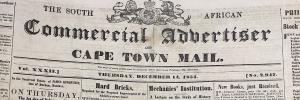
Prof Gawie Botma from the Journalism Department of Stellenbosch University (SU) is collaborating with two academics from Stanford University in the United States in the HistoryGenie project to digitise a prominent Cape colonial newspaper, The South African Commercial Advertiser (SACA) from 1829 to 1864. SACA was the first independent newspaper in the Cape colony and played a major role in the struggle for press freedom in the early 19th century.
HistoryGenie (https://history.genie.stanford.edu/) is a free, “history-from-below" AI-assisted archive designed in a university environment to increase access to historical sources and voices. Essentially, HistoryGenie is designed to allow any community, museum, scholar, or teacher to turn materials in their possession into a corpus of machine-readable, searchable, and queryable text. AI is used to provide reliable, fast transcription of text, to manage a semantic search engine, and to help students and researchers find and organize material.
In the case of the SACA, Prof Grant Parker and Prof Trevor Getz of Stanford University are responding to requests by scholars for greater access to this source, but also are building a curriculum (and hence a corpus) for South African students to do authentic research in their historical past. HistoryGenie already has fourteen West African newspapers, and these are frequently used by a wide range of researchers and by instructors in Ghana and the US. Digital copies of SACA between 1824 and 1829 are also available, and the collaboration with SU will enhance the collection.
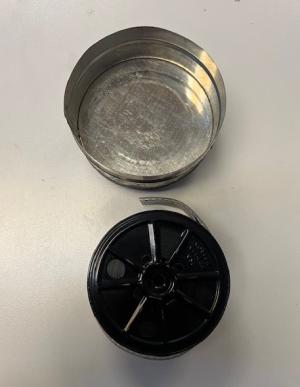
The first step in the transcription process is to turn the microfilm into .pdf or .tiff format documents that can be "chunked’" transcribed by the AI, and examined by humans for accuracy. Prof Botma applied and received permission from the Stellenbosch University Library to release 25 tins of microfilm of SACA temporarily for the project. Once the microfilm is processed, copies will be made available to Stanford, while Stellenbosch University also plans to host it in their digital repository.
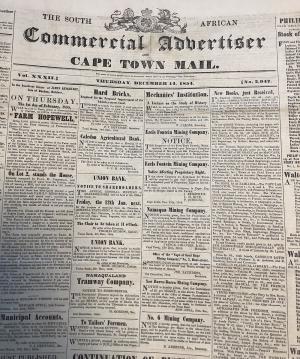
The front page of SACA in 1854.
Microfilm of the newspaper will be digitised and turned into searchable texts.
Related stories
Arts, languages and social sciences
From podcast policy to African perspectives: honours students engage with media spaces
The 2026 BAHons Journalism students engaged with South Africa’s evolving media landscape by attending the Portfolio Committee Meeting on Communication and...
Arts, languages and social sciences
Dr Meli M Ncube Presents at Countering Foreign Interference (CFI) Africa Forum in Senegal
Dr Meli M Ncube of Stellenbosch University’s Department of Journalism was among the researchers, policymakers, journalists and civil society organisations from...

Arts, languages and social sciences
Journalism graduates score SAFTA-nomination for doccie
Four graduates from the BAHons Journalism class of 2023 have made history through a nomination for the Best Student Film at the 19th Annual South African Film...