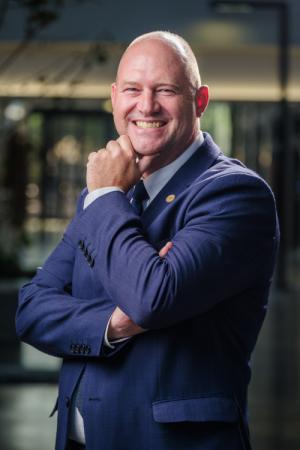
AI Vision of the Vice Dean: Research and Internationalisation
Gey van Pittius calls on Faculty to lead through innovation
Dear Colleagues
Artificial intelligence (AI) is reshaping the future of health research, teaching and learning in the health sciences, clinical practice, and health-related administration. It offers transformative possibilities across areas such as diagnostics, drug and vaccine design, treatment development, personalised medicine, health systems innovation, health professions education, and operational and business process efficiency.
The Faculty of Medicine and Health Sciences at Stellenbosch University, recognised as one of the leading health sciences faculties on the African continent, is committed to remaining at the forefront of health sciences innovation. Central to this commitment is the responsible integration of digital and other frontier technologies, including AI and robotics, into the Faculty’s systems, processes, research, teaching, service platforms and administrative functions. These developments are not viewed as isolated technical advances, but as strategic opportunities to enhance the way the Faculty advances education, clinical service, research, discovery and institutional effectiveness in an increasingly connected and data-driven environment.
AI therefore represents a significant strategic leadership opportunity for both the Faculty of Medicine and Health Sciences and Stellenbosch University. To realise its full potential, the Faculty must proactively develop the knowledge, capabilities, governance frameworks and partnerships required to harness these technologies effectively, ethically and securely, rather than merely reacting to them as they emerge. This will require deliberate investment in AI literacy, responsible innovation, data stewardship, interdisciplinary collaboration and practical opportunities for staff and students to engage with emerging developments and contribute meaningfully to their application across the Faculty.
The new Faculty Strategy (2026-2030) positions Digital Transformation and Innovation as a key strategic pillar for the Faculty. The associated objectives include the implementation of integrated and secure data systems; the digitisation and automation of core administrative processes and workflows; the integration and embedding of AI and other frontier technologies across faculty systems; the inclusion of AI and digital literacy for all staff and students within the continuous professional development pipeline; and the incentivisation of widespread adoption and uptake of AI and digital innovation projects.
In this context, the Faculty recognises that AI will have a profound impact on higher education, medicine, health sciences, biomedical research and health systems more broadly. Through learning, collaboration, innovation and shared leadership, the Faculty will build the capacity required to use these technologies responsibly and effectively. By strengthening understanding, participation and capability across its community, the Faculty aims to ensure that the benefits of AI and related technologies are realised in ways that support its collective institutional, clinical, academic and societal mission.
My vision is therefore to position the Faculty of Medicine and Health Sciences as a leading African centre for responsible, human-centred and impactful AI-enabled health sciences innovation — where technology strengthens research excellence, enriches teaching and learning, improves clinical and health system outcomes, enhances operational effectiveness, and contributes meaningfully to better health for communities in South Africa, Africa and beyond.
Kind regards | Ngemibuliso emihle | Vriendelike groete
Prof Nico C Gey van Pittius | BSc (PU), BSc Hons (PU), MSc (PU), PhD (Stell), LLB (UNISA), LLM (Stell), MBA (Stell), MPhil (Stell), OAMLP (Oxford) | M.ASSAf, M.Akad.SA.
Vice-Dean: Research & Internationalisation and Professor of Molecular Biology
ResearchGate | ORCID ID: 0000-0002-8807-4105 | LinkedIn