
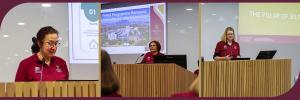
Impact of programme renewal showcased along the pillars of self, community, and health systems
- The FMHS Annual Academic Renewal Mini Symposium explored how programme renewal goes beyond curriculum design to support student success through the pillars of Self, Community and Health Systems.
- Speakers highlighted how the renewed curriculum is helping students develop stronger professional identities, deeper community engagement, and a better understanding of healthcare systems, resulting in graduates who are more confident and practice-ready.
- Discussions underscored the importance of authentic reflection, mentorship, role modelling and clinical learning experiences in preparing socially responsive healthcare professionals for complex healthcare environments.
Following the success of last year’s event, the office of the FMHS Vice Dean: Learning and Teaching hosted the Annual Academic Renewal Mini Symposium in May. Delegates joined the hybrid event both in person and online.
In her opening address, Professor Karin Baatjes, FMHS Vice Dean: Learning and Teaching, emphasised that programme renewal extends beyond curriculum design to include the broader support structures that enable student success. She highlighted the key drivers of programme renewal and the Faculty’s Programme Renewal framework, the CIPP (context, input, process, and product), which supports programme development, as well as evaluation, research and stakeholder engagement. Baatjes stressed that the ultimate goal is to graduate to graduate competent, socially responsive healthcare professionals who understand the importance of the health system, community, patient-centred care, and ongoing personal-development.
An interactive panel discussion formed the basis of the symposium with three speakers representing the pillars of the Self, Community and Health Systems. Dr Therese Fish, FMHS Vice Dean: Clinical Services and Social Impact, facilitated the discussion highlighting the ‘Pillar of Self’ with the goal of ensuring competent competent professionals who are caring, confident and contextually aware.
Maria van Zyl, MBChB module lead for Being and Becoming in Healthcare, said that historically, the concept of the ‘Pillar of Self’ has been neglected. The redesigned curricula focus on growth of professional identity formation, developing the student as a person that is more than just a clinician. Van Zyl elaborated on the importance of personal development and students developing awareness of themselves, their values and their aspirations. Early clinical exposure and longitudinal placements enable students to train with more peer-assisted learning opportunities and assignments dedicated to reflection and self-evaluation. She added that the outcomes of these changes have been very promising and that students are more confident in their skills, have a better capacity to reflect, which in turn enables them to be more socially accountable and ready for practice. Challenges have been identified surrounding the problem of reflection fatigue and the intensity and unpredictability of clinical environments.
Reflecting on the ‘Pillar of Community’, Cameron Reardon from the FMHS Division of Physiotherapy, described community as a construct to be “deeply nuanced” and that it’s especially evident when highlighting how this pillar shows up across the various undergraduate programmes. Reardon suggested that the Pillar of Community finds expression across the faculty in three primary forms: as place, as people and as participation: “it’s each of these things, and all of these things”. He described community as encompassing relationships between service users, students, clinicians, educators and other stakeholders, with meaningful participation fostering inclusive partnerships and mutual learning between students and communities. Examples from Nursing, Speech-language and Hearing Therapy, and Occupational Therapy demonstrated how community-based education and stakeholder involvement contribute to curriculum renewal and service delivery. While acknowledging challenges such as diverse community contexts, logistical complexities, and staff turnover, the presentation highlighted the considerable value of community engagement. These benefits include enhanced student understanding of the social determinants of health, meaningful contributions to service delivery, and opportunities for communities to play an active role in shaping curriculum development, service delivery, and research initiatives.
Maryke Geldenhuys, module lead for the MBChB Health and Wellness module, introduced the ‘Pillar of Health Systems’ and explained how this pillar is implemented across programmes, starting with student engagement within the health systems. Students are exposed to all levels of care from primary to tertiary in the public and private sectors, with an emphasis on team-based care in community contexts. This provides an invaluable learning environment through addressing issues of access, equity, and service delivery. Progress has been made by greater degree of integration within the curricula with reduced fragmentation and importantly, it is producing graduates who are better prepared for the diverse settings they will be exposed to. However, this is impacted by the realities of the health systems, as resource constraints and overstretched clinical platforms interrupt learning. There are also educational constraints, as health systems content is often undervalued and considered secondary to biomedical training.
A recent graduate from the Human Nutrition programme made a valuable contribution through a prerecorded message. Natasja Ludik reflected on how the inclusion of the pillars in the renewed curriculum had challenged her to be more self-aware and identify areas for personal and professional improvement, as well as providing a broader understanding of the social determinants of health beyond an academic context. Thanks to the new curriculum, she shared that that she felt confident entering the professional world equipped with the skills required to adapt to any healthcare and community context.
There were also meaningful discussions between the audience and the panellists. A key observation was whether students are being adequately equipped with the skills required for effective self-reflection. It was noted that there is a growing tendency for students to rely on AI tools to generate reflective submissions. In response, participants emphasized the need for more intentional integration of reflection within the curriculum, including the potential value of creative, arts-based approaches to deepen authentic reflective practice.
The importance of role modelling was emphasised, with students requiring support to evaluate professional behaviours and distinguish whether practices align with healthcare values. The panel explored broader challenges facing healthcare education, including increasing burnout among healthcare professionals and its impact on teaching and learning environments. The panellists stressed the importance of helping students understand healthcare systems, develop a clear sense of their professional roles, and successfully transition from recipients of care, to care providers. Learning in clinical settings was identified as a key component of development, with a need to integrate service and learning and explicitly supporting students on how to learn within the clinical environments.
In conclusion, Fish highlighted the importance of reflective spaces for both students and educators, as well as the centrality of relationships with mentors, peers, patients, and communities. There is also a need to help students recognise learning opportunities within complex systems and to make a shift from patient-centred to person and place-centred care. Programme renewal emphasises responsiveness to population health needs and not only individual patients.
Related stories

Medicine and health
SU secures EDCTP grant to advance rapid diagnostic test for childhood TB meningitis
Stellenbosch University (SU) has been awarded a substantial grant from the European and Developing Countries Clinical Trials Partnership (EDCTP) to support...

Medicine and health
Clinicians point to systemic barriers behind schizophrenia relapse
Schizophrenia relapse is a common and troubling reality in South Africa, with approximately one in three people living with the condition experiencing a...
Medicine and health
Global experts, led by SU, outline urgent response to Ebola outbreak
In response to the ongoing Ebola outbreak in the Democratic Republic of Congo (DRC) and Uganda, scientists from Stellenbosch University (SU) have collaborated...