
Turning Target Impacts Into Instant Wireless Feedback
- A final-year mechatronic engineering project at Stellenbosch University developed a target hit indicator for long-distance precision shooting. The prototype uses an accelerometer to detect impact on a steel gong target and LoRa radio to send feedback to a handheld receiver, giving the user near-instant confirmation without relying on cameras or visual spotting.
In long-distance precision shooting, confirming a target impact becomes harder as distance increases. Spotting scopes, cameras, and sound-based confirmation can help, but each has limits. Heat shimmer, dust, wind, target colour, and background contrast can make visual confirmation uncertain. Sound can also become unreliable when several people are using nearby targets.
Dean van Zyl’s final-year mechatronic engineering project, completed under the supervision of Professor Arnold Rix, set out to solve that problem with a Target Hit Indicator, or THI, that detects impact at the target and sends feedback wirelessly to the user.
The practical aim was to design, build, and test a prototype that works with standard steel gong targets. The system needed to detect target impacts, communicate over long range, provide immediate feedback, run on battery power, and stay simple enough for field use.
A Two-Part System
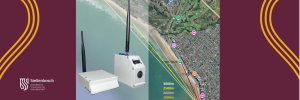
The prototype has two modules. The transmitter attaches to the back of the steel target. It carries the sensor, microcontroller, LoRa radio, battery, and antenna. The receiver stays with the user and displays the hit count on a small OLED screen. The high-level diagrams in the report show this split clearly, with the transmitter mounted near the target and the receiver acting as the user interface.
The transmitter uses an ADXL375 accelerometer. An accelerometer is a sensor that measures rapid changes in motion. In this project, it identifies the sharp acceleration pattern produced when a target is struck. The receiver uses push buttons and an OLED display to show feedback and allow simple score control. Both modules use the STM32WL55CCU6 microcontroller, which is a small embedded computer with a built-in LoRa radio. LoRa is a low-power radio technology designed to send small data packets over long distances.

Figure 1: High‑Level Block Diagram ‑ Transmitter
Why an Accelerometer Made Sense
The report compares several impact detection methods, including acoustic sensors, piezoelectric sensors, cameras, induction sensors, and accelerometers. Acoustic methods can require several microphones and may confuse shock waves or nearby impacts with target hits. Cameras still require visual checking unless image processing is added. Piezoelectric sensors need firm contact with the target, which can limit quick attachment and removal. Induction sensors could be affected by normal target movement, such as wind sway.
An accelerometer suited the project because it can distinguish between a sharp impact and slower movement. The selected sensor was configured to register impacts above 25g for 3.1ms. In simple terms, the firmware looks for a short, high-force motion profile rather than ordinary swinging or vibration. That lets the prototype detect a hit while ignoring lower-energy movement.
Designing for Range and Battery Life
The wireless link needed to work over at least 500 m line of sight, with a target range of 1 km or more. The project used the 868 MHz LoRa band, with a spreading factor of SF7 and bandwidth of 15.63kHz. Spreading factor controls how LoRa balances speed and range. A higher spreading factor can improve range, but it also increases the time it takes to send a packet. The selected settings were chosen to keep feedback within the target latency while still supporting long-range communication.
Power use also shaped the design. The report selected 18650 lithium-ion batteries because they offered enough capacity for the expected operating time. Testing later showed the transmitter had an estimated battery life of 107.2 hours, while the receiver reached 123.6 hours. That exceeded the project’s 12-hour battery-life requirement by a wide margin.
Building and Testing the Hardware
The hardware design used custom printed circuit boards designed in KiCad and enclosures designed in Autodesk Inventor. The report’s assembly images show separate transmitter and receiver housings, each with its internal board, antenna, battery, and enclosure parts. The receiver includes the display and user buttons, while the transmitter keeps the target-side electronics compact.
Electrical testing checked the power rails, debug interface, multiplexer logic, radio-frequency switch, and switch-mode power supply. One issue arose during switch-mode power supply testing when a capacitor was connected to the wrong node. The system showed abnormal voltage readings and heating. After rework, the voltage levels passed the required tests. That detail gives the project a useful engineering story: the prototype wasn’t only assembled, it was tested, diagnosed, and corrected.
What the Range Tests Showed
The LoRa range test took place at Strand Beach in the Western Cape under line-of-sight conditions. The transmitter sent 1000 packets at each distance while the receiver logged packet delivery, signal strength, and signal-to-noise ratio. Packet delivery ratio, or PDR, measures how many sent packets arrive correctly.
The system achieved 100% packet delivery at 500m and 99.9% at 1000 m. At 1500 m, the packet delivery ratio dropped to 66%, and at 2000 m it dropped to 9.3%. The report treats 1km as the reliable tested range for the selected settings, even though theoretical calculations had suggested about 1.65km.
The difference was linked to real-world losses such as beach visitors, electromagnetic interference, and multipath effects, where radio signals reach the receiver by different reflected paths.

Figure 2: LoRa Performance Testing Experimental Setup
Testing Hit Detection
The hit detection test used a suspended target surrogate to compare two motion profiles. In the first phase, the surrogate struck a wall to simulate a target impact. In the second phase, it swung freely to simulate wind-induced movement. The system recognised each simulated impact and rejected the wind-sway profile. Based on those results, the report recorded 100% impact detection accuracy and a false positive rate within the project target, with the note that ricochets near adjacent targets could still cause practical false positives.
Where the Prototype Can Improve
The prototype met most engineering targets. It recorded 206.8ms latency, 1km reliable wireless communication range, 100% impact detection accuracy, 107 hours battery life, rechargeability, and a capital cost of R2,183. The main unmet target was weather resistance, since the enclosure rated below IP65.
The report recommends a tougher enclosure material, improved antenna mounting, a smaller battery, integrated charging circuitry, and a possible repeater station. On the software side, it suggests better power management, expanded user settings, and automatic LoRa parameter selection based on signal quality.
Final Thoughts
This project takes a familiar challenge in precision sport shooting and handles it through embedded sensing, wireless communication, and measured field testing. It doesn’t rely on the user’s ability to see or hear the impact from a distance. It measures the event at the target, filters the signal, and sends a small wireless message back to the receiver.
The result is a working prototype that shows how mechatronic design can turn a difficult observation task into a clear, low-latency feedback signal.
Related stories

Engineering and technology
A Smarter Way To Manage Home Energy During Load-Shedding
For many South African households with solar panels and batteries, the hard part isn’t installing the hardware. The harder part is deciding when to charge the...
Engineering and technology
When Mobile Networks Fail, A Phone Can Still Reach Your Group
At a concert, sports event, or outdoor gathering, people often assume their phones will work when they need them. In practice, that can fall apart fast. If too...
Engineering and technology
Engineering Open Day returns to a reimagined space
Grey skies and a passing thunderstorm did little to deter prospective students and their families from attending the Faculty of Engineering’s 2026 Open Day on...