
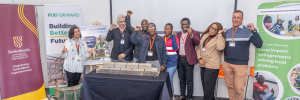
On 9 July 2026 a pioneering national entrepreneurship programme, which translates SU research into practical business opportunities for young builders and brickmakers, was launched at the Council for Scientific and Industrial Research (CSIR) in Stellenbosch.
From laboratory to local communities: Stellenbosch University research helps entrepreneurs build a greener future
- Professor John Babafemi's research into sustainable cement is moving beyond the laboratory, helping young entrepreneurs across South Africa build greener businesses while translating Stellenbosch University research into real-world community impact.
Professor John Babafemi spent years researching sustainable alternatives to conventional cement. That research is now helping young entrepreneurs across South Africa reduce costs, grow their businesses and build more sustainably.
For years, Professor John Babafemi, Professor in Sustainable Concrete Materials in the Department of Civil Engineering at Stellenbosch University (SU), has researched ways to make one of the world’s biggest contributors to carbon emissions—cement—more sustainable.
He has published scientific papers, collaborated with industry, supervised postgraduate students, and led research into innovative construction materials. Yet despite these achievements, one ambition remained.
“I’ve always had this dream of touching the local community,” he says.
On 9 July 2026, that dream took an important step towards becoming reality when a pioneering national entrepreneurship programme, which translates SU research into practical business opportunities for young builders and brickmakers, was launched at the Council for Scientific and Industrial Research (CSIR) in Stellenbosch.
The Circular Cement Youth Entrepreneurship Programme (CCYEP) will support 100 young entrepreneurs from underserved communities across the Western Cape, KwaZulu-Natal, Mpumalanga and North West. Participants will learn to use locally available industrial and agricultural waste materials as alternatives to conventional cement, helping them reduce construction costs, build profitable businesses and contribute to more sustainable building practices.
Developed by Fix Forward and Impact Hub Cape Winelands in collaboration with SU and funded by the Industrial Development Corporation (IDC) through the Presidential Youth Employment Initiative (PYEI) and the Department of Employment and Labour, the initiative demonstrates how government, academia and civil society can work together to translate research into practical economic opportunities.
For Babafemi, however, the programme is about far more than research findings.
“I want to see people building with these materials. I want to see informal settlements being transformed,” he says.
His research focuses on developing sustainable concrete materials that improve material efficiency while reducing the environmental impact of the cement and concrete sector. Rather than relying solely on conventional cement, the research investigates how locally available industrial and agricultural by-products—including fly ash, slag, agricultural waste and waste glass—can partially replace cement without compromising the required strength or durability.
The implications are significant. Concrete is the world’s second most-consumed material after water, and cement production accounts for about 8% of global carbon dioxide emissions. Reducing the amount of conventional cement used in concrete products is therefore an important step in lowering the construction sector’s environmental footprint.
But the programme is not only about emissions. By taking proven research beyond the laboratory, it aims to help small builders and brickmakers reduce their input costs, improve their profit margins, create more jobs and make building materials more affordable in their communities.
From an idea to a national programme
The collaboration began after Marli Goussard, CEO of Impact Hub Cape Winelands, met Babafemi at an SU Social Impact Committee meeting. After hearing about his research, she asked whether the methods could be taught to a contractor working in an under-resourced community—and whether the necessary materials would be accessible locally.
Babafemi’s answer was simple: yes.
That conversation helped set in motion a partnership that now brings together academic research, enterprise development, public funding and the lived experience of entrepreneurs.
Goussard said the programme reflects Impact Hub Cape Winelands’ belief that those closest to societal and environmental challenges are often best placed to develop solutions.
“At Impact Hub Cape Winelands, we believe local people are best positioned to solve local challenges,” she said. “What makes this programme particularly powerful is the collaboration between academia, industry, government and civil society to ensure that research is translated into real opportunities that can improve lives.”
Research that lands in society
Professor Wikus van Niekerk, Dean of SU’s Faculty of Engineering, said the programme demonstrates what engineering research should ultimately achieve.
“We are not satisfied with knowledge that remains on the shelf,” he said. “Our responsibility is to take sound research, test it rigorously, and translate it responsibly and help ensure that it becomes useful in society.”
He said engineering was not only about knowledge, equations, laboratories and technical reports, but about improving people’s quality of life and contributing to economic development.
The circular cement programme, he said, brings together several critical priorities: sustainable construction, waste reduction, lower environmental impact, more affordable building solutions and economic opportunities for young people.
For Josh Cox, CEO of Fix Forward, the programme’s strength lies in the combination of partners contributing specialist expertise, resources and support.
“We are blending the cutting-edge innovation happening in academia and taking it to the grassroots level,” he said. “All of these pieces combined have the chance to move the needle on some of the biggest issues we are facing.”
Participants will receive technical training based on SU’s research, along with business development support, individual coaching and mentoring, access to equipment and production support, and assistance in connecting with suppliers and markets.
Cox said this integrated approach was necessary because technical knowledge alone was not enough to ensure a small business’s success.
Making a difference on the ground
For Vuyisile Handa, a brickmaker and programme participant, the potential impact is immediate and practical.
The high cost of cement and aggregates places considerable pressure on the profitability of small brickmaking and construction businesses. Using suitable waste-derived materials could help entrepreneurs reduce these costs while producing durable, climate-friendly products.
“This programme has ignited so many dreams for entrepreneurs like me,” Handa said. “Now we can save on cement and aggregates, make bricks that are climate-friendly and sell more affordable products to people in our communities.”
He said the opportunity was not only about increasing his own profits. Lower production costs could allow him to expand his business, employ more people and help families in his community access quality building materials at more affordable prices.
The programme’s first group of 100 entrepreneurs will also provide an opportunity to test and strengthen the model for wider use.
Noluthando Miambo, representing the Presidential Youth Employment Initiative, said the programme stood out because it brought together youth employment, entrepreneurship and innovation.
“If we support these 100 entrepreneurs and are able to prove this concept, we can replicate it and create a value chain,” she said. “It was important for us that young people should benefit.”
The programme will also investigate which waste materials are available in different provinces so that entrepreneurs can use resources close to where they operate, rather than transporting materials over long distances and adding unnecessary costs and emissions.
For Babafemi, success will mean far more than publishing further research.
He wants to see the work applied in the places where it can make the greatest difference: in small businesses, local communities and the homes people build.
The launch may have marked the start of a new entrepreneurship programme, but it also represented something Babafemi had imagined for years—the moment when research developed in a university laboratory began finding its way into the hands of people who could use it to change their communities.
Links to videos:
Please see the following link to access the shortened Circular Cement Youth Entrepreneurship Programme (recruitment) video.
Alternatively, here is the link to Youtube where the video.
For further enquiries
Petro Mostert
C 0823346193
Related stories
Media release
From intern to curator: Annerie Senekal becomes first female to lead Stellenbosch University Botanical Garden
For many visitors, the garden is a place of calm, offering a welcome pause from the bustle of the busy town life. But the Botanical Garden is far more than a...
Media release
Supporting the Places Where Learning Happens: Facilities Management Changes Name to Campus Development, Infrastructure and Services (CDIS)
Stellenbosch University’s (SU) Facilities Management Division (SUFM) adopted a new name: Campus Development, Infrastructure and Services (CDIS), a title that...
Media release
What if the answer is simply to play?
A unique PhD at Stellenbosch and Coventry Universities PhD explores how storytelling, imagination, and tabletop role-playing games can unlock learning and...