
MIng (Bedryfsingenieurswese) Gestruktureerde Fokus: Datawetenskap
The programme consists of eight 15-credit modules, a 60-credit research assignment and a smaller Professional Communication module.
The modules will be presented in blocks of ca. 9 weeks. The typical module consists of a 2-week self-paced pre-reading/pre assignment period which is followed by either a lecture block week and a post assignment period, which lasts ca. 6 weeks, or the pre-reading period is followed by smaller lecture blocks (2 days, 2 days, 1 day) spread across 4 weeks (see timetable). Each smaller block is followed by a ca. 2 week post assignment.
Students must attend all five lecture days full time. The lecture days take place online. In addition to the online presentation, limited modules may also be delivered in person. Beside the lecture days/week no further contact time will be required.
Modules offered by other departments can have a different structure and presence requirements.
The five data science modules are compulsory, and the students must further select two out of the four generic structured master’s level modules, as well as one specialisation module. Note that additional modules hosted by the Department of Applied Mathematics may be made available as specialisation module options.
The module content can build on previous modules. Therefore, most modules must be taken in a specific order (see co-requisites).
A final 60 credit data science research project must be completed, where the knowledge gained in all eight modules will be applied on a relevant industry related or academic project.
Furthermore, students will automatically be registered for the Professional Communication 871 module of 1 credit to be completed online.
To be considered for admission for the year 2027 you must:
- Hold at least a BEng, a BScHons, another relevant four-year bachelor’s degree, an MTech, a BTechEng(Hons), or a PGDip (Eng); or
- Hold other academic degree qualifications and appropriate experience that have been approved by the Faculty Board. The department’s chairperson must make a recommendation regarding such a qualification and experience to the Faculty Board.
Students must have passed the following 1st year subjects at university level:
- Mathematics, Applied Mathematics, or Mathematical Statistics; and
- Computer programming (proof of any assessed programming qualification equivalent to first year tertiary programming will also be considered).
Students who do NOT meet the computer programming requirements can still qualify for the program by completing one of the following courses:
- MITx: Introduction to Computer Science and Programming Using Python: https://www.edx.org/learn/computer-science/massachusetts-institute-of-technology-introduction-to-computer-science-and-programming-using-python
- CS50’s Introduction to Computer Science https://learning.edx.org/course/course-v1:HarvardX+CS50+X/home
- Expressway to Data Science: Python Programming Specialization https://www.coursera.org/specializations/python-programming-data-science#courses
In this case the programming certificate and the marks received must be uploaded along with your academic history on the application portal before you submit your application. Current SU student who experience upload issues may contact [email protected]. After submission of the application, no further documents can be added to your application.
Note that the marks of your last academic degree will be evaluated against an annual minimum requirement, as this is a competitive programme. For the intake 2027 the average of your last academic year must be at least 65%.
See application process here.
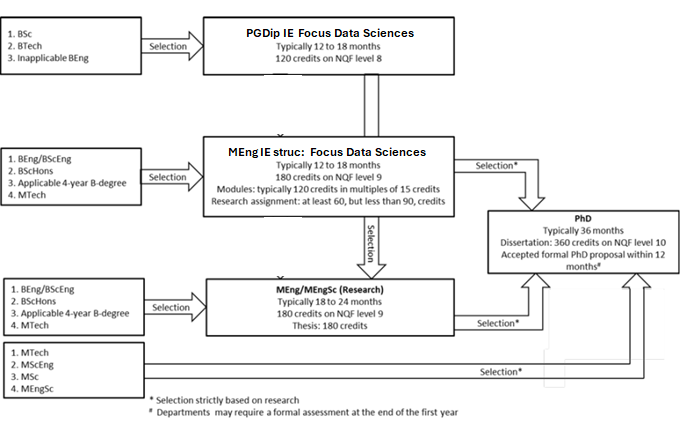
Also refer to the postgraduate admission model in Figure 3.1, in Section 3.2 in the Engineering Yearbook, reproduced below.
Note the MEng Ind Eng struc Focus Data Science Full time has a minimum duration of 2 years.
During each module assessments take place during the pre-reading, the lecture block week and the post block assignments to test the application of the theory exposed to in the module. These marks will be combined to give a final module mark. Also see assessment information for core data science modules.
Die volgende vyf kernmodules in datawetenskap is almal verpligtend:
Enige een van die volgende modules kan as die spesialiseringsmodule gekies word:
Studente moet enige twee van die volgende generiese fakulteitsmeestersmodules doen:
The following modules have co-requisites. It is critical for the student to consider the co-requisites of modules at registration, meaning that the student must have previously passed the co-requisite module or be registered for it in parallel in the given year, irrespective of the performance in the module.
The 60 credit research assignment is an exception here the pre-modules must be passed.
| Modules | Pre-requisite (status Jan 2026) |
|---|---|
| Data Science (Eng) 874 | Programming knowledge at 1st year university level |
| Modules | Co-requisite Modules (status Jan 2026) |
| Applied Machine Learning 874 | Data Science (Eng) 874 |
| Applied Deep Learning 874 | Data Science (Eng) 874, Applied Machine Learning 874 |
| Data Analytics (Eng) 874 | Data Science (Eng) 874, Applied Machine Learning 874 |
| Optimisation (Eng) 874 | Data Science (Eng) 874, Applied Machine Learning 874 |
| Big Data Technologies (Eng) 874 | Data Science (Eng) 874, Applied Machine Learning 874 |
| Internet of Things 874 | n.a. |
| Research assignment 876 | The modules Data Science 874, Applied Machine Learning 874 and Data Analytics 874 must be passed before a student may register for the research assignment module. In addition, some research assignment topics may have further project-specific pre-requisites. (updated for 2027 project allocation) |
Students will be required to apply and consolidate the knowledge gained throughout this programme. For this purpose during their 60 credit research assignment (module Industrial Engineering 10881-876), students will solve a real-world data science project, providing solutions for each step of the data science project life cycle. As outcome of this project, students will produce a research assignment, describing all of the life cycle phases and research conducted in order to provide a solution to a specific data science problem. It is encouraged that the knowledge gained in specialisation module selected above, is utilised in the project.
Students must have passed their 5 core modules to be allowed to proceed with the data science project (see co/pre-requisites).
A call for project proposals will be sent to possible industry and academic partners around mid-year. The project proposals received by the industry and academic partners will then be distributed amongst the students and each student will be required to place a bid for a number of projects. The industry and academic partners will review the bids. Based on their preferences and the discretion of the programme coordinator, students will be allocated a project.
The company which a student works for will also be allowed to submit a project proposal and specify that the project needs to be completed by a particular student.
Each student will be allocated a supervisor from one of the departments involved in this programme, as well as a mentor from the industry/academic partner if applicable. Upon completion of the project, a research assignment will be completed and submitted for examination to the supervisor and an external examiner.
From MEng Industrial Engineering (struc) to PhD
If you want to further your academic journey at the IE department you can, with a strong MEng (structured) Focus Data Science degree, apply for the PhD (Industrial Engineering) with a Data Science topic.
The average mark over your five data science core modules must be at least 65% and your research assignment must have a mark of at least 75%.
You need to have a potential Data Science supervisor.
Please contact Ms M Molapo for information on the PhD application process and application deadlines.