
Botaniese Tuine Geleentheidskalender
Werkswinkels
Praatjies
Geleide Toere
Uitstallings
Exhibitions
Upcoming Exhibitions
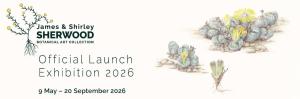
James and Shirley Sherwood Botanical Art Collection
9 May – 20 September 2026
This world-class art collection will be housed in the historically significant Garden Office and will showcase artworks of many top South African botanical artists, as well as promising early-career artists. The collection will capture the beauty of South African plants, with a focus on the SUBG's living collection of rare and threatened plants. The project will strengthen South African botanical art capacity, connect garden visitors to the Cape's phenomenal plant diversity, and inspire people to get involved in plant conservation.
Read more
The current collection at SUBG was started and is being curated by in 2023 by Karen Stewart, a specialist botanical art curator, and Dr Donovan Kirkwood, the late curator of SUBG. They recognised the value of botanical art to communicate the often-fleeting beauty of plants, to inspire people to connect with nature, and in doing so to raise awareness of the conservation needs of many plants. Since 2023, SUBG has hosted an annual Botanical Art and Photography exhibition, and this project led to the establishment of this permanent botanical art collection. It will include paintings by some of South Africa’s top and early-career botanical artists, each work tied to the garden’s conservation collections. The gallery will be named the Kirkwood Garden Gallery after Dr Donovan Kirkwood whose passion for botanical art inspired him to create a unique space to showcase these valuable artworks within the SUBG.
SUBG is home to over 200 collections of species at threat of extinction. Many of these are inaccessible to most in their natural habitat, and can only be seen when visiting this garden. Yet, many plants in these special collections are dormant in summer, and will look drab or may even completely disappear underground for several months. The artworks in the James & Shirley Sherwood Botanical Art Collection will create a powerful reminder of the seasonal beauty of these plants and inspire visitors to appreciate nature through all seasons. Many species in the SUBG collections have never been illustrated before and many are extremely threatened, or only now being formally described.
A unique opportunity for botanical artists
An important component of this project is to support botanical artists and to raise the profile of South African botanical art. Artists contributing to this project will gain special access to rare living plants to paint, something that can often be a challenge for botanical artists. Contributing artists will receive support from SUBG experts and academic partners to strengthen their knowledge of their subject matter, and reignite an understanding and appreciation for scientifically accurate botanical works. Early-career botanical artists will receive special support through a mentoring programme by some of the most experienced South African botanical artists.
This opportunity enables the establishment of the only formal scientific institutional home for botanical art in South Africa. Through the James & Shirley Sherwood Botanical Art Collection, SUBG aims to raise the profile of botanical art by generating awareness and interest in the purchase of investment pieces by established artists.
We hope the Stellenbosch University Botanical Garden and the James & Shirley Sherwood Botanical Art Collection can continue to provide inspiration, learning and growth for botanical artists and the garden visitors alike.
Donation opportunity
Patrons of the arts and companies are offered a unique opportunity to be associated with a prestigious, high-profile project that aims to document the precious flora of the Cape and South Africa. The artworks will be permanently housed, cared for and curated by a specialist team at Stellenbosch University Botanical Garden. This collection will highlight the urgent need for the world-class leading conservation work the Botanical Garden does, and enhance the visitor experience substantially.
About the team
This special collaborative project is the initiative of Karen Stewart M.Phil (specialising in Botanical Illustration) and chair of the Botanical Artists’ Association of southern Africa’s Cape branch, Dr Donovan Kirkwood (PhD Botany Ecology) late curator of the Stellenbosch University Botanical Garden, Annerie Senekal (acting curator of SUBG), Martine Robinson B (Arch) a well-respected South African botanical artist focusing on rare and threatened geophytes, and academic partner Prof Léanne Dreyer, expert in the mega-diverse Cape Oxalis. Vicki Thomas and Chris Lochner form part of our selection panel.
Information for artists
Funders can request a detailed proposal and budget projection information from: Annerie Senekal [email protected]
Artists who wish to apply to become involved in the project can email the art curator: Karen Stewart [email protected]
Past Exhibitions
Brendel Botanical Model Exhibition (13 February – 8 March 2026)
A fascinating exhibition of rare 19th century botanical teaching models, bringing science and history together to reveal the inner workings of plants. These artistically composed models use a variety of ingeniously assembled materials, each a mini sculpture in its own right.
A fascinating exhibition of rare 19th century botanical teaching models, bringing science and history together to reveal the inner workings of plants. These artistically composed models use a variety of ingeniously assembled materials, each a mini sculpture in its own right. Botanical art curator Karen Stewart says: “Considering their scientific precision and realism, the educational value of these models has not diminished in the least, and we have used them to bring deeper botanical knowledge to our visitors of all ages”.
In the 19th century, Robert and Reinhold Brendel produced beautifully detailed, botanically accurate plant models for teaching. A collection of these models was acquired by Stellenbosch University, likely in the 1920s, and used for decades to teach plant morphology and anatomy to eager students. Over time they fell out of use, were packed away in storage, and largely forgotten. A few years ago they were rediscovered, and Professor Léanne Dreyer recognised their value and kept them safe in her office. She has now donated the models to Stellenbosch University Botanical Garden, where they will be publicly accessible and support teaching initiatives in years to come.
These wonderful models spark curiosity and invite closer study of the plants they represent. They sit at the intersection of art and science. Each model is a handcrafted artwork, built from materials such as papier-mâché, cellulose, wire, wood and glass. Makers used an inventive range of natural substances to recreate fine textures and structures, including small amounts of animal fur and feathers that are visible on some models. Our first scientific exhibition returns them to their original purpose: educating enquiring minds about botany. For each model, we highlight one engaging scientific insight, designed to encourage deeper exploration.
The exhibition is fairly unique. Only a handful of Brendel model exhibitions have been held internationally. Notable examples include a Manchester Museum exhibition entitled “Object lessons” (2017), and the Smithsonian Design Museum (NYC) also included some models in their “Botanical Lessons” exhibition (2019-2023).
The models were developed for botanical teaching before photography and modern botanical equipment were available. Their accurate enlarged scale – sometimes up to 40 times life size – makes key features and differences between plant families easier to see. Some can be taken apart to show internal structures and pollination mechanisms. These scientifically precise models remained educationally valuable, making botanical knowledge accessible and engaging for all ages.
THE HISTORY OF SCIENTIFIC MODELS
The late 1800s and early 1900s was a period rich in scientific innovation. New discoveries, especially the microscope, revealed previously invisible plant structures and transformed scientific understanding. But microscopes were costly and not always available in classrooms, creating a need for accurate, enlarged teaching tools..
From the 1860s, Robert Brendel and his son Reinhold built one of the most respected botanical model companies in Germany, based in Breslau and Berlin. Working with skilled artisans and leading scientists they produced exceptionally precise plant models, still regarded among the finest ever made.
By 1898 the Brendel company had earned international recognition, winning gold medals at major exhibitions in Moscow, Cologne, and Chicago, and expanding into zoology, mineralogy, and crystallography. After Reinhold’s death in 1927, the company’s later history became fragmented, although the German firm PhyWe continued producing models under the Brendel name.
Today, Brendel models are held in collections worldwide, with international efforts underway to document them. Other celebrated model makers of the era included Leopold and Rudolf Blaschka, whose intricate glass plant models remain on display at the Harvard Museum of Natural History.
Although the dedicated exhibition of the models has ended, the models are exhibited permanently in the SUBG Garden Gallery.
Student and Novice Art Exhibition (14 March – 17 April 2026)
In SUBG’s first Student and Novice Art Exhibition, 50 artworks by novice artists of all ages was featured. In this exhibition, artists were invited to work in any medium, resulting in a collection that is both diverse and refreshingly unconventional.
In SUBG’s first Student and Novice Art Exhibition, 50 artworks by novice artists of all ages was featured. In this exhibition, artists were invited to work in any medium, resulting in a collection that is both diverse and refreshingly unconventional. Alongside several excellent watercolour paintings were works in less traditional media, including crocheted and embroidered pieces. Each artwork depicted a real plant species (with a few animal subjects as well), and a remarkable variety of plants were chosen as subjects.
South Africa is blessed with extraordinary, globally unique plant biodiversity, as well as a community of exceptionally talented botanical artists. Yet no art form is mastered overnight. and no accomplished artist emerges without time, practice, opportunities and development. For this reason, we believe it is essential not only to showcase established artists, but also to support emerging talent as they develop into the next generation of South Africa’s botanical artists.
We were struck by the curiosity and appreciation of nature all of the artists in this exhibition share. Connecting with nature is the first step toward a lifetime obsession with nature. The exhibition gives all the artists, even the ones that were not selected, a professional footing that builds their experience and standing. We were impressed by the diversity of subject matter – there were some really special plants shown in the collection. Most importantly, the exhibition confirms what we hoped to see: that there is tremendous talent among young people, students, and novice artists in South Africa. We aim to nurture talent, curiosity, and creativity, and to cultivate the future of botanical art in this country.
Taking all the steps to contribute to an exhibition is not a simple task. From photographing your work and motivating for its selection, providing all the information, framing the work, packaging and delivering and fetching when the exhibition closes. Inviting your community of friends and family to celebrate your achievement is also important. We are delighted at the responses to our open call, and it was hard to have to say no to half of our applicants. Our gallery is small and we are limited by space constraints. We hope they will have gained something form their experience and try again in future.
We are also committed to encouraging new buyers. The price tags of these works, we hope, will encourage new collectors to make their first purchase. SUBG has waived their commission for this exhibition, so all proceeds go to the artists. We enthusiastically encourage all collectors to buy a work. Selling a work is more than money, it is a seal of approval which builds confidence.
14 March – 17 April 2026