
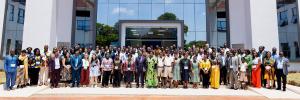
Participants at the launch of the Africa Regional Collaborative for Agriculture, Nutrition and Health (ANH-ARC) at the University of Ghana in Accra on 30 April 2026
SU key partner in new platform to strengthen food systems in Africa
- A new science-policy platform aims to bridge the gap between research and real-world food-systems action in Africa.
- Co-led by Stellenbosch University, the University of Ghana and Ethiopia’s Policy Studies Institute, the initiative brings together key players to strengthen evidence-based decision-making.
- The Africa Regional Collaborative for Agriculture, Nutrition and Health (ANH-ARC) aims to improve access to affordable, nutritious and sustainable diets across the continent.
Africa is not short of research on food systems, but translating that knowledge into effective interventions to improve diets, health and livelihoods across the continent remains a challenge.
That urgency was palpable in Accra last week, where a new Africa-led initiative – the Africa Regional Collaborative for Agriculture, Nutrition and Health (ANH-ARC) – was launched to tackle exactly this problem.
“The atmosphere is electric,” said Prof Kennedy Dzama, Dean of the Faculty of AgriSciences at Stellenbosch University (SU), describing the scene as researchers, policymakers and development partners gathered for the event.
“There is a real sense that this work has to move beyond discussion to action.”
Bridging the gap
ANH-ARC was officially launched at the University of Ghana on 30 April 2026. The initiative is co-led by Stellenbosch University (SU) in Southern Africa, the University of Ghana (UG) in West Africa, and Ethiopia’s Policy Studies Institute (PSI) in East Africa, working in collaboration with the global ANH Academy Science–Policy Platform.
The platform aims to strengthen the link between evidence, policy and implementation in African food systems to make them healthier, more equitable and climate-resilient.
“This is about ensuring that our research does not remain in journals, but actually influences policy and practice,” said Dzama, who serves as a principal investigator on the programme.
From knowledge to implementation
Food systems in Africa are under intensifying pressure. Undernutrition remains widespread, while obesity, micronutrient deficiencies and diet-related diseases are rising.
Climate change, inequality and changes in food environments are compounding these pressures.
Researchers, governments and regional bodies are expanding the evidence base and policy frameworks to overcome these challenges, yet translation into policy and practice remains uneven.
ANH-ARC is designed as an integrated, “end-to-end” programme linking evidence generation with financing, governance and implementation.
By building an African community of experts, the ANH-ARC aims to place rigorous, policy-ready evidence at the centre of decision-making – accelerating collaboration and action to improve access to affordable, nutritious and sustainable food across the continent.
UG’s Prof Amos Laar said the initiative seeks to address fragmentation across sectors: “Agriculture, nutrition, and health can no longer operate in silos – evidence must deliberately connect them to inform policy-relevant decisions.”
PSI’s Dr Alebel Weldesilassie emphasised the importance of alignment: “Effective food systems transformation requires not only robust evidence, but also coherent financing strategies and policy coordination across sectors.”
His colleague, Dr Tseday Mekasha, stressed that gender and equity considerations must be embedded in how food-systems evidence is generated, policies are designed, and decisions are made – or they risk failure.
African-led collaboration
ANH-ARC is explicitly designed to be African-led, while remaining globally connected.
“The partnership is designed to ensure that African voices are central in shaping the agenda,” Dzama said.
It forms part of the global ANH Academy, convened by the London School of Hygiene & Tropical Medicine (LSHTM), in collaboration with Tufts University in the United States and the University of Sheffield in the United Kingdom (UK). The initiative is funded with support from the UK Foreign, Commonwealth and Development Office (UK FCDO) and the Gates Foundation.
Speaking on behalf of the ANH Academy, LSHTM’s Prof Suneetha Kadiyala said: “Platforms such as ANH-ARC are important not only because they strengthen the translation of evidence into policy, but because they model a more equitable and regionally grounded way of producing knowledge itself.”
“Sustainable change depends not simply on better evidence, but on partnership structures that redistribute voice, leadership and agenda-setting closer to where decisions and impacts are felt.”
The funders echoed this emphasis on impact and collaboration.
“I’m proud of the UK’s investment in the ANH Academy and of what the ARC represents – a strong commitment to equitable, Africa-led research with real-world impact,” UK FCDO’s Prof Sir John Edmunds said.
Ana Maria Loboguerrero of the Gates Foundation added that the initiative comes at a critical moment: “Bringing together leading research and policy experts, the platform will improve access to safe, affordable and healthy diets by leveraging rigorous evidence rooted in local realities to inform climate-sensitive food and agriculture policies, leading to healthier, more equitable outcomes across the continent.”
Stellenbosch University’s role
At SU, the initiative is anchored in the Faculty of AgriSciences, which leads the programme’s governance component. The faculty is consistently ranked top in Africa for agricultural research and education, and has a strong international reputation in food systems science.
Its interdisciplinary nature – covering such areas as agricultural economics, agronomy, animal science, plant pathology and food-related disciplines – enables it to engage across the full food systems value chain, from production to nutrition and policy.
This capacity is further strengthened through its “Faculty of the Future” initiative, a major campus renewal programme aimed at advancing research, teaching and infrastructure to address emerging challenges in food systems, climate resilience and sustainable agriculture.
Dzama, who took up his role as Dean in January 2026, is an internationally recognised researcher in animal breeding, genetics and sustainable agriculture, with a strong focus on climate-resilient livestock systems.
He emphasised: “Strengthening governance systems and accountability mechanisms will be critical to translating knowledge into sustained impact at scale.”
Team effort
The SU contribution to ANH-ARC brings together a multidisciplinary team working across the programme’s core themes.
- Prof Dzama serves as the principal investigator
- Prof Scott Drimie is the co-principal investigator, leading work on living labs and multi-stakeholder engagement
- Prof Lisanne du Plessis and Dr Sandra Boatemaa contribute to research on governance diagnostics
- Dr Obvious Mapiye focuses on livestock transitions within food systems
- Julia Harper manages the project
Linking research and practice
A distinctive feature of ANH-ARC is its emphasis on applied, multi-stakeholder approaches. At SU, this builds on the work of the Southern Africa Food Lab (SAFL), known for its facilitation of Learning Labs and African Food Dialogues – structured processes that enable stakeholders to test ideas, build shared understanding and develop practical, context-specific interventions.
“We are bringing together different disciplines and actors to address food systems challenges in a coordinated way,” said Dzama, who also heads the SAFL.
These approaches – grounded in dialogue, experimentation and collaboration – are expected to inform how ANH-ARC works, helping to bridge the gap between knowledge and action.
Continental priorities
The initiative is aligned with key African Union frameworks, including Agenda 2063, the Comprehensive Africa Agriculture Development Programme (CAADP) 2026–2035 strategy, the Kampala Declaration on Agriculture and Food Security, and the African Continental Free Trade Area (AfCFTA).
By linking research to these policy processes, ANH-ARC aims to support more coherent and coordinated food-systems transformation across the continent.
Looking ahead
The real test of ANH-ARC will lie in whether it can strengthen the governance, coordination and accountability needed to translate evidence into sustained action at a continental level.
“We want this work to influence not only policy but also practice. That’s where the impact will be,” Dzama said.