
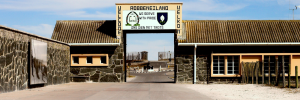
Political prisoners used sport to survive the harsh conditions on Robben Island.
Sport sustained hope for prisoners on Robben Island, PhD study shows
- Political prisoners organised different sports.
- Sport became a tool of resistance, discipline, and solidarity.
- Sport helped bridge political, intellectual and generational divides.
Robben Island is mostly associated with the suffering, brutality and isolation endured by political prisoners who fought against Apartheid. What is often overlooked is the role prisoners played in organising sport and how it became a tool of resistance, sustaining hope and preparing them for freedom and leadership.
“Political prisoners used sport not just for recreation, but to organise themselves, educate one another and create a sense of order in a harsh system built on control. Sport offered them physical release, emotional expression and relieved the psychological strain of isolation, monotony and hard labour,” says Dr Vanessa Mitchell, Museum and Heritage Education Coordinator at the Robben Island Museum.
Mitchell recently received her doctorate in Sport Science from Stellenbosch University for her research on how prisoners on the island actively shaped their environment by organising sport and recreation.
She says sport became a tool of resistance, discipline, and solidarity in an oppressive environment. “It became a way for prisoners to create something meaningful that allowed them to rise above their immediate harsh surroundings. The satisfaction they derived from organising sport lay in the simple act of surviving with dignity. Sport sustained hope.”
But sport was also about preparation – for freedom, for leadership, and for ethical life beyond prison. “Sport on Robben Island mirrored the kind of society prisoners envisioned beyond prison walls – one grounded in rules, fairness, accountability and collective responsibility, even though this was not initially a fully conscious political project.”
Using archival sources, oral testimonies and life histories, Mitchell examined how prisoners took the lead in organising sport, thereby fostering community and cultural life and shaping political development. Sports included chess, card games, table tennis, volleyball, athletics, kerrim (a game in which players use their hands or cue-like sticks to knock wooden or plastic discs into the corner pockets of a wooden board, like pool or billiards), ludo (a strategy-based board game), draughts, rugby, soccer, and lawn tennis.
“While these histories are essential, they sometimes portray prisoners only as victims of repression. By focusing on sport and everyday self-organisation, my research adds another layer to the story – one that highlights their agency, creativity and ability to build institutions even in incarceration,” Mitchell notes.
“My research shows how they actively shaped their environment. Through sport, they became organisers, administrators, referees, journalists and leaders, building their own systems of governance under extremely difficult conditions. Self-organised sport was a demonstration that prisoners could govern themselves ethically and collectively, even when subjected to an unjust system of rule.”
It also eased tensions among political prisoners by creating neutral spaces where they could interact. Teams fostered trust and mutual respect, strengthening the collective spirit behind their sustained resistance, Mitchell says.
Matches and administrative meetings were forums for debate, negotiation and exchange. “The organisation of leagues and clubs mirrored democratic practice – complete with elections, constitutions and mechanisms for dispute resolution. In this way, sport rehearsed the principles of accountability and participatory governance that many prisoners envisioned for a future South Africa.”
Sport and recreation also helped bridge political, intellectual and generational divides. “Clubs were formed irrespective of political allegiance, encouraging collaboration beyond political party lines and contributing to the development of broader political consciousness. Through shared goals and structured competition, prisoners learned to engage one another across ideological differences, Mitchell says.
What sets her study apart is that it also focuses on the experiences of lesser-known prisoners who were held in the general sections of the maximum-security prison. She says this shifts attention beyond iconic leaders to many prisoners whose contributions were foundational, but less visible.
To illustrate what sport meant to these prisoners, Mitchell shares the story of Sedick Isaacs, who was incarcerated from 1964–1977. “Isaacs admitted that he was never naturally inclined towards sport. Like some fellow prisoners, he initially questioned its necessity, yet he came to recognise that organised sport was essential for coping with prison conditions. For him, participation was less about competition and more about collective wellbeing and enjoyment.”
Mitchell relates that Isaacs introduced volleyball and athletics, helped establish formal organisational frameworks on Robben Island, and became instrumental in diversifying the sporting codes available to prisoners. Unfortunately, he couldn’t convince his fellow prisoners to play basketball, cricket or croquet. They viewed the former as too similar to netball and therefore a “girl’s game” and the latter as too passive and as “games for old men”.
Isaacs also served as secretary of the Island Rugby Board and the Robben Island Amateur Athletic Association Interim Committee. “Importantly, he broadened the prisoners’ understanding of sport beyond participation alone. He emphasised the role of spectatorship, reporting and record-keeping, reinforcing the idea that sport functioned as a complete social institution. Through his administrative leadership, sport on Robben Island became not only a recreational outlet, but a structured, self-governing system that reflected discipline, accountability and collective imagination.”
Mitchell hopes her research will deepen understanding of Robben Island not just as a site of suffering, but as a place where prisoners found moments of fun and camaraderie despite the harsh conditions.
Related stories

Media release
People with Down syndrome must be included in conversations about their healthcare
People with Down syndrome and their families consistently value healthcare that is relational, respectful, and person-centred, rather than focused solely on...
Media release
SU scientist receives R14 million grant to tackle West Nile virus
As climate and environmental change continue to reshape ecosystems across the world, scientists are warning that mosquito-borne diseases may spread into new...

Media release
Many factors drive changes in human-wildlife relationships
Human populations are expanding and encroaching further into wildlife habitats, leading to dynamic and evolving relationships between humans and wildlife. As...