

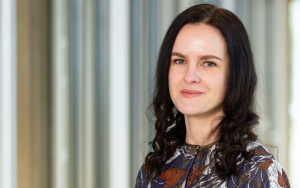
Amohetsoe Shale and her company, NAVU Mobility, will compete against 135 companies from 133 countries for the $1 million prize.
SU student takes African prosthetics innovation to global stage
- Biomedical engineering student to represent South Africa in the final rounds of a global student startup competition.
- Amohetsoe Shale and her company, NAVU Mobility, will compete against 135 companies from 133 countries for the $1 million prize.
- NAVU develops affordable prosthetic knee technology.
At just 23, Stellenbosch University (SU) master’s student and NAVU Mobility founder Amohetsoe Shale is preparing for the biggest sprint of her life: access to a global stage where she will be able to reach potential funders so that she can bridge the gap between innovation and affordable treatment for amputees who would otherwise be denied mobility because of cost and accessibility.
Her team will soon go up against entrants from more than 130 countries in the Hult Prize - widely regarded as the world’s largest student startup competition.
It challenges students to launch for-profit startups that support at least one of the United Nations’ Sustainable Development Goals (SDGs). NAVU aligns with at least three of the UN’s Sustainable Development Goals: SDG 3 (Good Health and Well-being) through restoring mobility; SDG 9 (Industry, Innovation and Infrastructure); and SDG 10 (Reduced Inequalities) by expanding access to affordable prosthetic care.
The winning team will receive $1 million seed funding to scale their business.
Closing the gap
But for Shale, the journey to this starting line began in the Eastern Cape, where she witnessed the physical and economic impact of disability on the small farming community where she grew up.
While studying orthotics and prosthetics at Walter Sisulu University, she was exposed to healthcare and rehabilitation in rural settings. What she encountered left a lasting impression.
“I was dissatisfied with the quality of access, the quality of care and the components being given to people,” she says.
In her fourth year, a two-week literature review assignment prompted deeper reflection on her clinical experiences working with amputees in Mthatha. One insight stood out: While there were a few research papers proposing innovative prosthetic knee designs, none translated into practical, commercially available products.
“I realised there was a gap,” she says. “And I knew I wanted to change that.”
That moment sparked an ambition to design a prosthetic knee that people could afford and actually use in their daily lives.
Translating ideas into products
Determined not to let her work gather dust on the shelf as an academic thesis, Shale began focusing on how to turn her research into a real-world solution. “Entrepreneurship and commercialisation are the vehicles that make that possible,” she explains.
She chose to pursue her master’s degree in biomedical engineering at SU in part for its global opportunities. Even before arriving on campus, she had secured an internship in Norway – an experience she describes as “eye-opening”.
Coming from the small farming village of Kei Road, the exposure helped shape her sense of possibility. It was also where she began developing the entrepreneurial mindset that now underpins her work.
Back at SU, Shale focused her research on developing a low-cost, passive polycentric prosthetic knee. The prosthetic knee is designed to mimic a natural walking motion using a four-bar linkage system, while repurposing everyday components to improve how it performs. The design aims to improve functionality and affordability. Under the supervision of Prof Kristiaan Schreve, Director of the Institute of Biomedical Engineering (IBE), this work makes up Shale’s structured master’s course.
Winning ways
To take the innovation beyond the lab, she founded NAVU Mobility. The prototype is undergoing laboratory validation, supported by collaboration with a Cape Town-based company and software analysis. Early results are promising, but real-world testing remains critical to assess durability, comfort, and cost-effectiveness.
This is where platforms such as the Entrepreneurship Development in Higher Education (EDHE) Intervarsity Competition and the Hult Prize play a crucial role.
Encouraged by SU’s LaunchLab and Innovus Technology Transfer Office, Shale entered the EDHE competition in the Research Commercialisation category. In March this year, she went on to win the Hult Prize South Africa National Finals.
NAVU Mobility is now one of 135 startups from 133 countries competing for the global prize which will be announced after the final stage in London.
Her team of three is preparing “like an athlete training for a sprint”, she says.
Yet for Shale, the real value lies beyond the competition itself.
“The journey is the point,” she says. “It puts your company under pressure in a way that forces you to build.”
Advancing in the competition would be significant, but equally important are the opportunities to secure partnerships, attract investment and gain international exposure.
“If we make it to London, we’ll be able to connect with potential customers and collaborators,” she says. “That’s the biggest win.”
Anita Nel, SU’s Chief Director: Innovation and Commercialisation, says: “Amo demonstrates yet again the high quality of entrepreneurs on the SU campus and the relevant research being done at our institution which is set to make the world a better place for all. We are excited to be part of the NAVU journey and are providing excellent support to the spinout company.”
Innovation with impact
As one of seven children, raised by parents with doctoral degrees in business development and language, Shale is no stranger to discipline and ambition. Now, she is channelling that drive into building what she describes as an African solution to African challenges.
She is also determined to challenge perceptions about innovation on the continent. The idea that products developed in Africa can’t be commercially viable is simply not true, she says.
For Shale, what sets a startup apart is not just the technology, but its connection to the community it serves. “Don’t be afraid to stand in your background and your truth,” she advises. “We’re one of the only companies building prosthetics on the continent, and that’s exactly what makes us different.”
Her message to aspiring innovators is simple: think big. “We should never shy away from building solutions for ourselves.”
Related stories

Media release
People with Down syndrome must be included in conversations about their healthcare
People with Down syndrome and their families consistently value healthcare that is relational, respectful, and person-centred, rather than focused solely on...
Media release
SU scientist receives R14 million grant to tackle West Nile virus
As climate and environmental change continue to reshape ecosystems across the world, scientists are warning that mosquito-borne diseases may spread into new...
Media release
Many factors drive changes in human-wildlife relationships
Human populations are expanding and encroaching further into wildlife habitats, leading to dynamic and evolving relationships between humans and wildlife. As...