
Researchers urged to keep human judgement at the centre of AI-driven science
- SU launched its 2026 Library Research Week under the theme “Score Big! Elevate your research”.
- Speakers highlighted the growing importance of AI literacy, research infrastructure and ethical scholarship in a changing academic landscape.
- Prof Francesco Petruccione warned that AI could accelerate discovery, but also “scale up” mediocrity if used uncritically.
As artificial intelligence (AI) rapidly reshapes universities and research institutions across the world, Stellenbosch University’s (SU) annual Library Research Week opened with a challenge to researchers: embrace new technologies, but do not surrender scientific judgement to machines.
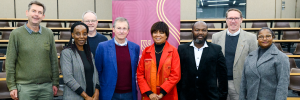
Addressing academics, postgraduate students and researchers at the launch of Library Research Week in the SU Library auditorium this week, Prof Francesco Petruccione said the scientific community was entering what he described as a “new scientific method” in which human intelligence and machine systems increasingly work together in the research process.
“The danger is not that AI will make us completely redundant,” said Petruccione, professor of quantum computing and Pro Vice-Chancellor: Artificial Intelligence and Quantum Technologies at SU. “The danger is that mediocrity in science will scale up exponentially.”
His keynote lecture, “The New Scientific Method: Navigating Research in the Age of AI and Quantum Technologies”, formed part of the launch of the University’s 14th annual Library Research Week.
Libraries at the centre of change
Opening the event, Ellen Tise, Senior Director of Library and Information Services, described the week as a reflection of the University’s “enduring commitment to supporting and advancing research excellence”.
“This year’s theme, ‘Score Big! Elevate your research’, was inspired by the excitement and spirit of the upcoming FIFA World Cup,” she said. “Just as world-class athletes prepare, adapt, innovate and perform at the highest level, researchers too are challenged to sharpen their skills, embrace new technologies and strive for excellence.”
Prof Sibusiso Moyo, Deputy Vice-Chancellor: Research, Innovation and Postgraduate Studies, said libraries sit at the heart of the University’s research ecosystem.
“Libraries are more than repositories of books and journals,” Moyo said. “They are dynamic spaces of digital scholarship, innovation, collaboration and knowledge creation.” She pointed to the University’s recent research output growth, noting that SU recorded more than 5 300 articles in 2025, the highest number in more than a decade.
Moyo also highlighted the recent launch of SU’s Immersive Technology Laboratory in the Library as an example of how academic spaces are evolving to support new forms of research and teaching. “This is not technology for technology’s sake,” she said. “It’s about enhancing understanding, encouraging collaboration, and creating new opportunities for innovation and impact.”
Beyond the machine
In his address Petruccione argued that AI is no longer simply a computational tool used to process information. Instead, it is beginning to participate in multiple stages of scientific work – from literature reviews and hypothesis generation to coding, peer review and data analysis.
“We are witnessing a phase transition,” he said. “The computational sphere is not just a machine that crunches numbers. It’s really participating actively in what we do.”
Drawing on examples from chemistry, mathematics and molecular biology, he showed how AI systems are already being used to predict protein structures, identify new materials and generate algorithms capable of solving previously intractable mathematical problems.
Yet he repeatedly stressed that the role of researchers remains indispensable. “We still need to use our brain and our critical thinking,” he said. “We shouldn’t use AI to outsource our science.”
Petruccione described future scientific workflows as fundamentally “hybrid”, combining human reasoning with AI tools, high-performance computing and, eventually, quantum technologies. He likened the future scientist to an architect or orchestra conductor – someone who orchestrates multiple systems rather than working alone in isolation. “The picture of the scientist alone in a dark room is a very romantic picture that will probably never come back,” he remarked.
A global inequality challenge
One of the strongest themes running through Petruccione’s address was the growing inequality in global AI infrastructure. He warned that African universities risk being left behind as major technology companies invest billions of dollars into AI systems and computing infrastructure.
Petruccione argued that collaboration, open science and shared infrastructure would become increasingly important if African institutions hoped to remain globally competitive. “The only chance that we have to survive is to collaborate and network,” he said.
He also called for universities to rethink teaching and assessment practices in response to generative AI tools. “Assigning essays or things like that, those times are gone,” he said, suggesting that oral examinations and stronger AI literacy training may become increasingly necessary.
Towards the end of the address, Petruccione returned to what he saw as the central challenge facing academia in the AI era: preserving intellectual rigour while embracing technological acceleration. “At the core we should still include a little bit of natural intelligence,” he said.
During the discussion session, Tise noted that demand for AI-assisted literature reviews had increased sharply in recent years, prompting the Library to acquire specialised AI tools to support researchers.
- Library Research Week continued throughout the week with sessions on ethical AI use, academic writing, research data management, digital tools and researcher wellbeing.
Related stories

Institutional news
Celebrating a partnership that invests in Africa's future
As the Gerda Henkel Foundation celebrates its 50th anniversary this year, Stellenbosch University (SU) reflects on the impact of its own decade-long partnership...
Institutional news
Connecting the dots: Prof Liezl van Dyk’s vision as new DVC: Academic
Stellenbosch University’s (SU) new Deputy Vice-Chancellor: Academic, Prof Liezl van Dyk, sees patterns everywhere: in 14-year chapters, prime numbers and the...

Events
Prof Mesias Alfeus’s vision brings global finance congress to Africa
The announcement that Stellenbosch University (SU) will host the 14th World Congress of the Bachelier Finance Society (BFS) in 2028 – the first time the...