
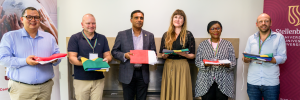
A people’s meeting across continents: SU and Danish delegation rethink how democracy is taught
- Three-day visit deepens South Africa-Denmark Democracy Learning Partnership.
- Dialogue spans welfare states, inequality, youth disengagement and experiential learning.
- Collaboration enters consolidation phase with plans for mobility, joint projects and research.
When a Danish delegation recently arrived at Stellenbosch University (SU) to partake in the inaugural Globus LIV² People’s Meeting: South Africa-Denmark Democracy Learning Partnership, the conversation moved swiftly from friendly exchanges to complex issues such as poverty, youth disengagement, welfare systems and the difficult question at the heart of the visit: How does one actually teach democracy?
The three-day programme was hosted by SU’s Centre for Social Justice and Unit for Experiential Learning in the Centre for Student Life and Learning at SU.
The Globus LIV Project was initiated in 2023 and strengthened in 2024 through the LIV Cohort 1 and Cohort 2 student exchanges, led by the Unit for Experiential Learning. This latest engagement marked a consolidation phase, shifting from intercultural learning to include cultivating democratic citizenry with plans for joint initiatives, mobility pathways and research-informed democratic learning.
The Danish delegation represented Campus Bornholm and VUC Storstrøm, both embedded in Denmark’s civic education tradition and folk high school for adult learning culture. They participated in formal leadership engagements, structured dialogue sessions on democracy and community-based experiences that tested theory against lived reality.
Democracy beyond the textbook
On the first day, discussions at the Centre for Social Justice explored how democracy is understood, enabled and constrained in different national contexts. By the second day, at the Stellenbosch Institute for Advanced Study (STIAS), the dialogue had broadened to include senior SU leaders.
Prof Deresh Ramjugernath, Rector and Vice-Chancellor, outlined SU’s vision as a research-intensive institution “in Africa, with Africa, for Africa”, committed to humanising pedagogy and social justice. Prof Sibusiso Moyo, Deputy Vice-Chancellor for Research, Innovation and Internationalisation, and Dr Leslie van Rooi, acting Dean of Students, situated the Learning Partnership within SU’s everyday work: supporting first-generation students, fostering inclusion and preparing graduates whose impact matters beyond rankings.
In one of the sessions, Danish participants unpacked the concept of Bildung – an education of the whole person that cultivates critical awareness and civic agency rather than simply transmitting information. They described a fully state-funded system that supports lifelong learning, with digital and hybrid models designed to widen participation.
South African academics and students responded candidly, reflecting on the gap between progressive policy frameworks and classroom realities shaped by inequality, uneven schooling and financial exclusion. The exchange was probing rather than deferential. Participants pressed one another on issues like representation, bias and the risks of teaching history through a single lens.
In a culminating session, both delegations wrestled with youth disengagement. Danish educators spoke of young people who appear detached despite generous welfare systems. South Africans described politically aware youth who feel excluded from economic opportunity. Around the table, the question lingered: What kind of education equips citizens not only to understand democracy, but to co-create it?
Common ground across difference
Prof Thuli Madonsela, Director of the Centre for Social Justice, found the initiative very meaningful. “The visit by our colleagues from Denmark was both enjoyable and insightful,” she remarked. “Enjoyable in that we found common ground and that there was rapport between us – you would have sworn we had known each other forever. The insightful part was learning that young people’s concerns about democracy are a global challenge.”
She noted that while Danish colleagues worry about apathy in a context of material security, South African youth often feel that democracy has not yet delivered on the constitutional promises of dignity and opportunity, but added a hopeful sentiment: “If we communicate with young people in ways that meet them where they are and speak to their fears and dreams, we can draw them into conversations about co-creating public governance systems that work for everyone and are just and democratic.”
Rasmus Kristiansen, Vice Director and Head of Education, Business and Development at VUC Storstrøm, reflected on the depth of the exchange. “I was impressed by the thoughtfulness, passion and diversity of perspectives that inform the continued building of democracy in a country where it cannot be taken for granted in the same way as in Denmark,” he said. “The shared reflections on historical legacies and their lasting impact on contemporary society made a profound impression on the Danish group. We look forward to continuing this collaborative learning exchange and to welcoming our South African colleagues to Denmark, where you will experience Danish democracy in action at Folkemøde Bornholm.”
Dr Ruth Andrews, Head of the Unit for Experiential Learning and the organiser, said the engagement with Campus Bornholm, VUC Storstrøm and the Centre for Social Justice “created a rare space for sustained reflection on ethical leadership, reconciliation and the responsibility of institutions to safeguard democratic values in complex contemporary societies”.
The visit to the Desmond and Leah Tutu Legacy Foundation, she added, reinforced the notion that democracy “is not self-sustaining – it requires moral courage, historical consciousness and intentional educational design”.
Learning in place
The programme extended beyond seminar rooms. On the third day, the delegations walked through the Kayamandi township and engaged with representatives of the Thuma Foundation, founded by Madonsela to promote democracy, accountability and civic education. The group also met Janet Jobson, Chief Executive Officer of the Desmond and Leah Tutu Legacy Foundation, who has agreed to collaborate further within the Globus People’s Meet project.
These engagements highlighted a central theme of the visit: democracy as lived practice rather than abstract principle. Experiential methods, including immersive simulations and community-based projects, were discussed as ways to translate constitutional ideals and the United Nation’s Sustainable Development Goals for 2030 into tangible outcomes.
For students, the impact was lasting. Ayabonga Hlumkeza, a third-year accounting student who participated in the dialogue, described the initiative as transformative. “I am still in awe. It was a rare and inspiring exchange where all parties spoke openly about their country’s processes, strengths and challenges, each willing to learn from the other,” he remarked.
He was struck by the deliberate inclusion of young voices in the discussions. “It was encouraging to witness that nations like Denmark are eager to learn from us as well,” he said. “This experience reassured me of the strength of our democracy and renewed my hope for and pride in our country.”
From dialogue to design
As the delegation concluded its visit with a tour of Babylonstoren in the Franschhoek valley, the tone was reflective. Conversations had moved from comparisons to ideas to adapt the People’s Meeting model to different contexts. Plans are now being mapped for expanded student mobility, joint policy briefs, comparative research and co-created projects, starting with educator-led online engagements to begin shaping experiential learning initiatives. The curriculum design and academic collaboration will be led by educators from the respective institutions.
For SU, the Learning Partnership aligns with its Vision 2040 and the commitment to transformative student experiences and global engagement rooted in African realities. For the Danish institutions, it offers a deeper encounter with democracy shaped by constitutional promise and historical redress.
Across contexts marked by different resources and histories, one insight appeared to resonate: Democracy cannot be assumed, outsourced or reduced to procedure. It must be learned, practised and continually renewed.
Related stories

Institutional news
Celebrating a partnership that invests in Africa's future
As the Gerda Henkel Foundation celebrates its 50th anniversary this year, Stellenbosch University (SU) reflects on the impact of its own decade-long partnership...
Institutional news
Connecting the dots: Prof Liezl van Dyk’s vision as new DVC: Academic
Stellenbosch University’s (SU) new Deputy Vice-Chancellor: Academic, Prof Liezl van Dyk, sees patterns everywhere: in 14-year chapters, prime numbers and the...

Events
Prof Mesias Alfeus’s vision brings global finance congress to Africa
The announcement that Stellenbosch University (SU) will host the 14th World Congress of the Bachelier Finance Society (BFS) in 2028 – the first time the...