
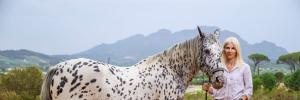
Prof Sandra Swart with Aztec, the Appaloosa mare teaching SU staff and students leadership skills.
Learning leadership from horses at SU
- In the paddocks of Stellenbosch University, two Appaloosa mares quietly guide students and staff on a unique leadership path.
- A structured, research-informed programme known as HERD (Human Embodiment, Relationality & Dynamics) reimagines leadership as an embodied, relational practice.
- For many participants, particularly women students or those who feel like outsiders in traditional leadership spaces, the experience offers a powerful alternative to conventional leadership training.
Leadership lessons at Stellenbosch University (SU) sometimes happen beyond lecture halls and meeting rooms.
Instead, they unfold in the university’s paddocks, surrounded by trees and mountains, where two Appaloosa mares quietly guide students and staff along a different leadership path.
While many associate Maties Equestrian with horse riding, the club has offered sessions in body language and leadership since 2017, explains Prof Sandra Swart from the African Anthropocenes Research Centre and the History Department. Through equine-assisted learning, the programme has helped participants develop confidence, assertiveness and self-awareness.
This work has now been formally consolidated into a structured, research-informed programme known as HERD (Human Embodiment, Relationality & Dynamics). “HERD reimagines leadership as an embodied, relational practice rather than a hostile or hierarchical one,” explains Swart. “In South Africa’s context of institutional and social complexity, the project helps explore what ethical, non-coercive leadership looks like when it is grounded in self-regulation and relational responsibility."
SU as a pioneer
Swart says SU is currently the only university in the country with facilities that make this kind of programme possible, placing it in a unique position to drive research and innovation in this field. “HERD positions Maties Equestrian not only as a recreational offering, but as an innovative platform for student development within the University’s broader transformative student experience.”
She explains that the programme also offers a counter to many of the modern-day pressures. “The world is often overstimulated, high-tech and disconnected. The HERD programme is designed to oppose all of these negative forces in our lives.” Drawing on research into nervous system regulation, non-verbal communication, group dynamics, ethology and human–animal interaction, HERD offers experiential sessions where participants learn through interaction rather than instruction.
In ground-based exercises, students work alongside horses as their teachers. “The lessons are simple and striking,” says Swart. “Horses do not respond to words. They respond to coherence. They notice tension, distraction, uncertainty and calm. Their reactions make visible how our presence, intention and regulation shape trust and group dynamics in real time.”
Rethinking leadership
For many participants, particularly women students or those who feel like outsiders in traditional leadership spaces, the experience offers a powerful alternative to conventional leadership training. “We don’t want to replicate dominance, hierarchy or patriarchal ideas of leadership,” says Swart. “What we want to explore are other ways of asserting yourself: leadership without dominance, confidence without aggression and boundaries without force.”
At its most basic level, the programme also creates space for students to step away from digital environments and spend time outdoors with the horses, Aztec and her daughter, Voodo, who was born at the university’s stables 12 years ago.
There is no cost involved in interacting with the horses, and students can contact Swart to arrange a time to visit the horses. Swart notes that the impacts of these interactions can be surprisingly profound. She refers to what researchers call “skin hunger” – the growing sense of bodily deprivation people experience when they lack meaningful physical touch. For students living far from home, often separated from family or even the comfort of a family pet, time with the horses can provide a sense of calm and grounding.
Learning through the body
Beyond these informal moments of connection, the programme also offers structured equine-assisted learning sessions where participants work in small groups. In these interactions, the horses become teachers.
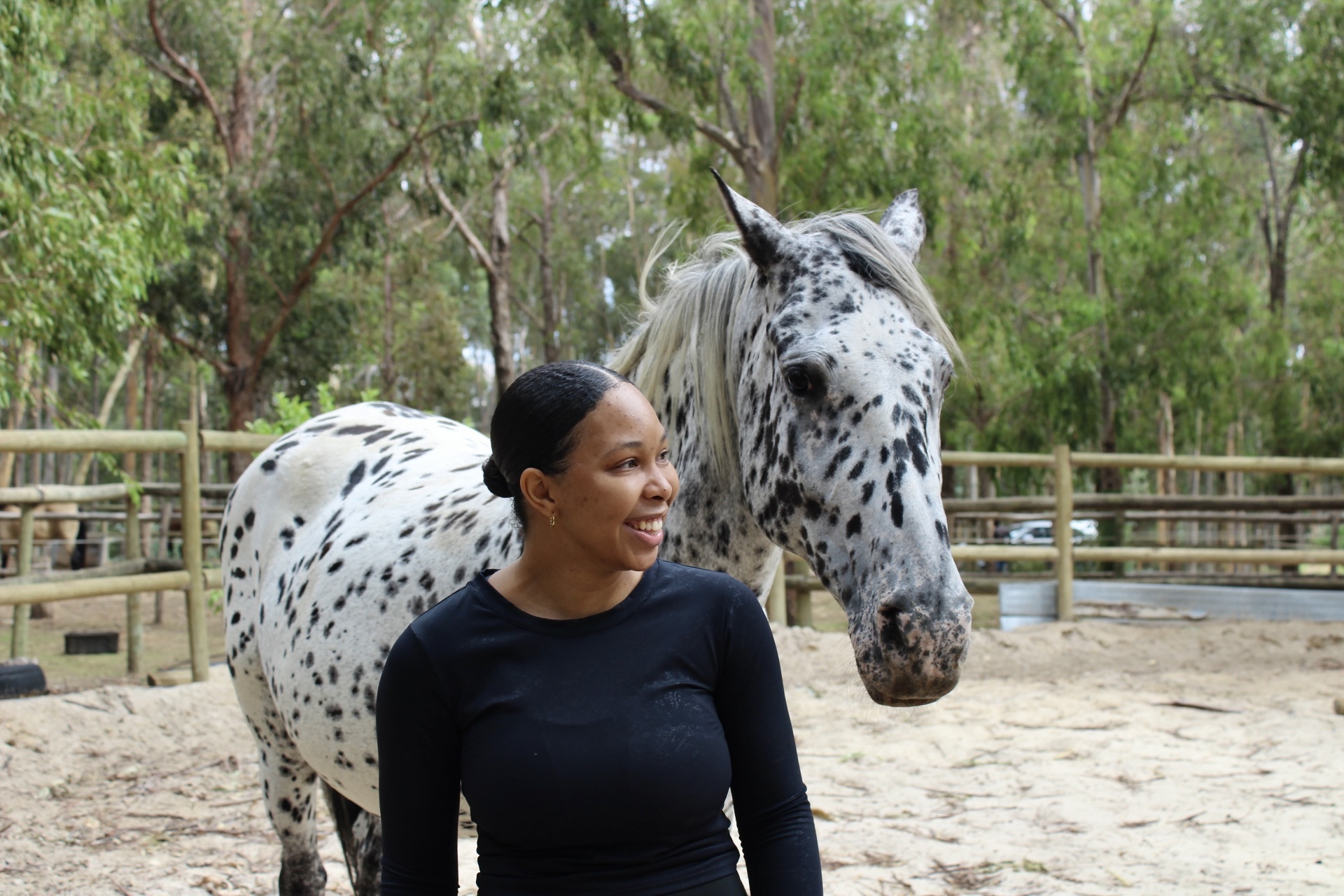
Dr Anell Daries, a lecturer at SU’s Centre for the Study of the Afterlife of Violence and the Reparative Quest (AVReQ), joined the programme as both facilitator and participant. She says the experience highlights how leadership is communicated through the body as much as through words. Much of her research focuses on the body and how certain notions of race, gender, class and other social strata have been imprinted onto the body and then internalised by individuals.
Working with horses presents different ways of knowing through sight, touch and hearing, she adds. “You have to physically change your body, your stance and how you appear.” She notes that the experience was unexpectedly emotional. “There’s an intensity that goes beyond just the person doing the exercise. It affects the whole group watching the exercise.”
The horse does not respect boundaries or hierarchies, forcing participants to rethink their definition of leadership, she explains. Daries also notes that traditional leadership training is often linear, with tools that work well in “ideal” situations. It rarely suggests ways to navigate the tensions that leaders often encounter.
A powerful personal moment
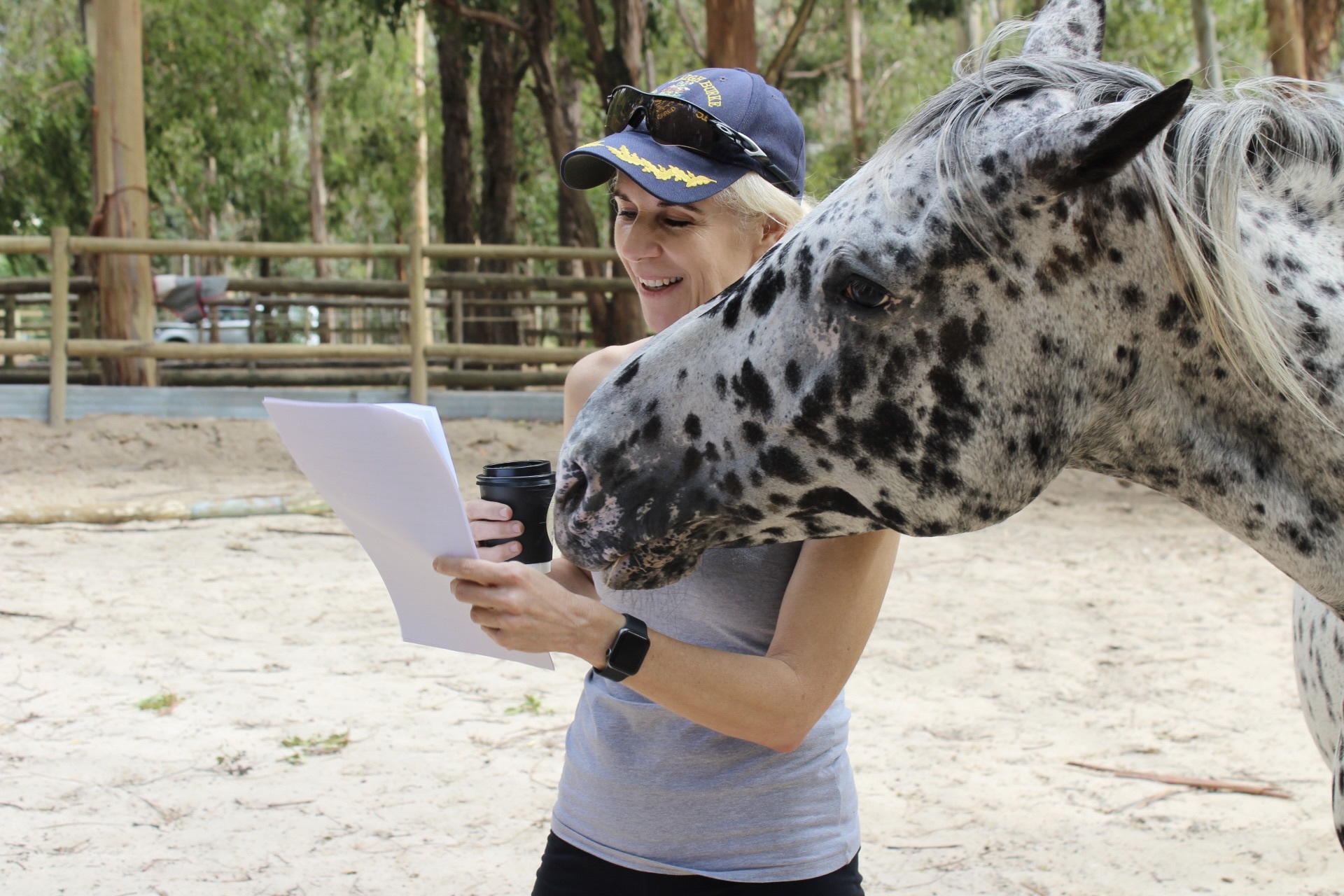
For student participant Cleo Saal, the experience marked her first interaction with a horse. She arrived at the paddocks unsure of what to expect but was quickly put at ease when Swart explained that the space was free of titles or hierarchy. “We were all just human beings,” Saal recalls.
Saal interacted with Aztec, who, as Swart quips, receives the most positive evaluations from participants. During the exercise, Swart asked Saal to reflect on two contrasting memories. One was deeply painful and the other evoked gratitude and hope. Saal says she did not realise the impact the exercise would have on her. As she relived the painful memory, she touched Aztec. “I did not have to say anything; she felt it immediately.” The horse tensed slightly before walking away.
The moment was powerful not only for Saal but also for the group observing the exercise. “There was a shift in the atmosphere,” she recalls. “Everyone could feel the intensity of that moment. I immediately broke down and cried.” Later, when Saal shifted her focus to a memory of gratitude and hope, the interaction changed. Aztec approached her again and allowed her to touch and stroke her. “I immediately felt that instant connection between the two of us,” Saal says. “I felt so seen and heard.”
Connection at the centre
Although the programme is not intended to be therapeutic, Swart acknowledges that working with horses can evoke strong emotions. A psychiatrist is connected to the programme and can assist if participants require support.
For Swart, the key outcome of the HERD programme can be summarised in one word: connection. “This is how we defeat ChatGPT – by giving students and staff an authentic experience,” she emphasises. “Horses cannot be gamified. We live in a noisy world. Horses don’t like noise, so they compel us to be quiet.” It is within that quiet space that participants often discover something fundamental: leadership begins not with authority, but with awareness and connection.
Notes:
• The programme is free and open to all students and staff.
• A once-off two-hour session is hosted by Prof Swart at Maties Equestrian.
• Contact: Prof Sandra Swart – [email protected].

Related stories

Media release
People with Down syndrome must be included in conversations about their healthcare
People with Down syndrome and their families consistently value healthcare that is relational, respectful, and person-centred, rather than focused solely on...

Media release
SU scientist receives R14 million grant to tackle West Nile virus
As climate and environmental change continue to reshape ecosystems across the world, scientists are warning that mosquito-borne diseases may spread into new...
Media release
Many factors drive changes in human-wildlife relationships
Human populations are expanding and encroaching further into wildlife habitats, leading to dynamic and evolving relationships between humans and wildlife. As...