

Anneline Arries
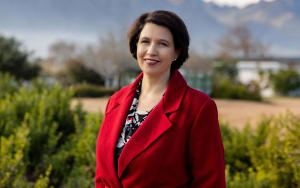
Anneline: Using language to open worlds for young learners
- Her academic background in language, translation, and education shapes her work in the classroom.
- Anneline is a published poet, with several poems featured in the Afrikaans anthology Penseel.
- She is passionate about helping learners grow.
For Stellenbosch University (SU) alumna Anneline Arries, language has always been more than a subject. It is a way to connect, to understand different cultures, and to give young people a voice.
Anneline, an Afrikaans teacher at Apex Education in Stellenbosch, holds a BA in Language and Culture, a BA Honours in Translation, and a Postgraduate Certificate in Education from SU.
“I have always loved languages and knew I wanted to do something with languages, but I wasn’t 100% sure what that would be at the time,” she says.
In 2021, she enrolled for an Honours degree in Translation.
“I realised that even though I enjoyed writing texts, I also found pleasure in editing and translating them.”
During her Honours year, her interpreting module lecturer, Dr Harold Lesch, was so impressed with her interpreting skills that he recommended that she apply for an English-Afrikaans interpreting opportunity to assist a community organisation with community hearing sessions by the South African Parliament. Anneline applied and was hired for the weeklong, all-expenses-paid assignment, which took her to various communities across the Western Cape.
“That surely was one of my greatest achievements, especially because I was so young. It also allowed me to connect with interpreters from all over the country.”
That same year, Anneline felt increasingly drawn to teaching after experiencing a vision of herself standing in front of a classroom of young people.
“When I did my school observations at Hoërskool Stellenbosch and my practicals at Stellenzicht Secondary in 2022, it became even clearer that I wanted to pursue a career in education.”
Today, her language and translation studies shape how she teaches Afrikaans to additional-language learners. She uses approaches such as “code switching, visual aids, language enrichment, and repetition of important Afrikaans terminology” to make Afrikaans more accessible and meaningful for second-language speakers.
“I had an amazing Afrikaans teacher in high school who supported me and made me fall in love with Afrikaans. At university, my love for Afrikaans expanded even more. I see teaching as a way of cultivating excitement and pride in Afrikaans amongst my learners.”
After graduating in 2022, Anneline started teaching at Stellenzicht Secondary School in Jamestown while also doing freelance editing and translation work. She has since paused her freelance work to focus on teaching and joined Apex Education this year.
One of the most meaningful aspects of her teaching journey has been helping to foster a reading culture through the school libraries at Stellenzicht and Apex, where books have created spaces of calm, curiosity, and belonging for learners.
“It always brings me peace and joy to see a learner find a book they have been looking for, or to see them peacefully reading in the library,” she says.
While at Stellenzicht, she was also involved in WOW — Woorde Open Wêrelde — an SU initiative. Through WOW, she helped learners prepare for spelling bees, restarted the school newspaper to give “learners a voice”, and exposed them to opportunities to meet authors during events such as the annual Afrikaans arts festival, Woordfees.
Besides being a teacher, writer, translator, interpreter, and editor, Anneline is also a poet. In 2018, 2020 and 2022, several of her poems were published in the Afrikaans anthology, Penseel.
Looking back on her time at Maties, she particularly remembers the people, cultures and languages she encountered.
“There was so much novelty at university. I've picked up phrases from different languages, learnt how different cultures work, and learnt to look at the world through new lenses.”
She is also grateful to lecturers such as Prof Rufus Gouws and Dr Lesch, who shaped her confidence and academic growth, and inspired her.
Her leadership roles as a church cell leader and mentor at Serruria, together with lunch-hour workshops presented by the Centre for Student Counselling and Development and StudyTrust, also helped shape her into the leader she is today. These experiences equipped her with conflict management, financial planning, communication, listening, and leadership skills.
As a young educator, she hopes to honour the legacy of the youth of 1976 by identifying learners’ interests and guiding them towards opportunities that can help them grow in confidence – whether through participation in language olympiads, featuring on the schools’ slot of the university’s MFM radio station, or gaining exposure to other meaningful platforms.
Her advice to current students and recent graduates is simple: “Know that you can make a difference, even in the smallest things you do. Be authentic, be YOU in the classroom, and remember that language is one of those wonderful tools that helps us connect.”
Related stories

Institutional news
Celebrating a partnership that invests in Africa's future
As the Gerda Henkel Foundation celebrates its 50th anniversary this year, Stellenbosch University (SU) reflects on the impact of its own decade-long partnership...
Institutional news
Connecting the dots: Prof Liezl van Dyk’s vision as new DVC: Academic
Stellenbosch University’s (SU) new Deputy Vice-Chancellor: Academic, Prof Liezl van Dyk, sees patterns everywhere: in 14-year chapters, prime numbers and the...

Media release
Cape Winelands Airport and SU forge strategic partnership for smart and sustainable development
Cape Winelands Airport and Stellenbosch University (SU) have entered into a cooperation agreement aimed at advancing innovation under the shared themes of...