
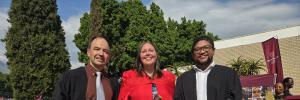
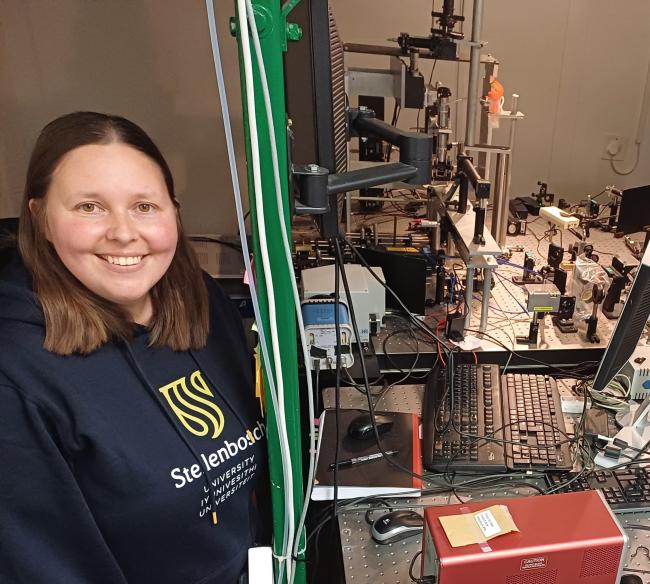
Dr Anneke Erasmus, an alumnus of Brackenfell High School, was one of six female scientists to earn their doctoral degrees in Physics during Stellenbosch University’s March graduation ceremony. Here she is with her study leader, Prof. Pieter Neethling, and co-supervisor, Dr Gurthwin Bosman, from the Department of Physics.
Curiosity with light leads to PhD in physics
- Dr Anneke Erasmus is one of 6 women scientists to graduate with a PhD in Physics during Stellenbosch University’s March graduation ceremony this week.
- She had to overcome several setbacks, including loadshedding and a burst water pipe, while experimenting with optical trapping – a technique that uses lasers to hold microscopically small particles in place.
As an undergraduate science student, Dr Anneke Erasmus’ curiosity about lasers made her stay behind after physics classes to ask lecturers about their research and to get a peek at experimental setups in one of the many research labs in the Merensky building, home to the Department of Physics at Stellenbosch University (SU).
Since then, she has visited the labs of some of the world’s leading researchers in the field of laser physics and photonics –including Dr Andy Ward’s lab at the Rutherford Appleton Laboratory in the United Kingdom , Prof Thomas Feurer’s at the University of Bern in Switzerland, and Prof Robert Pal’s lab at Durham University in the United Kingdom.
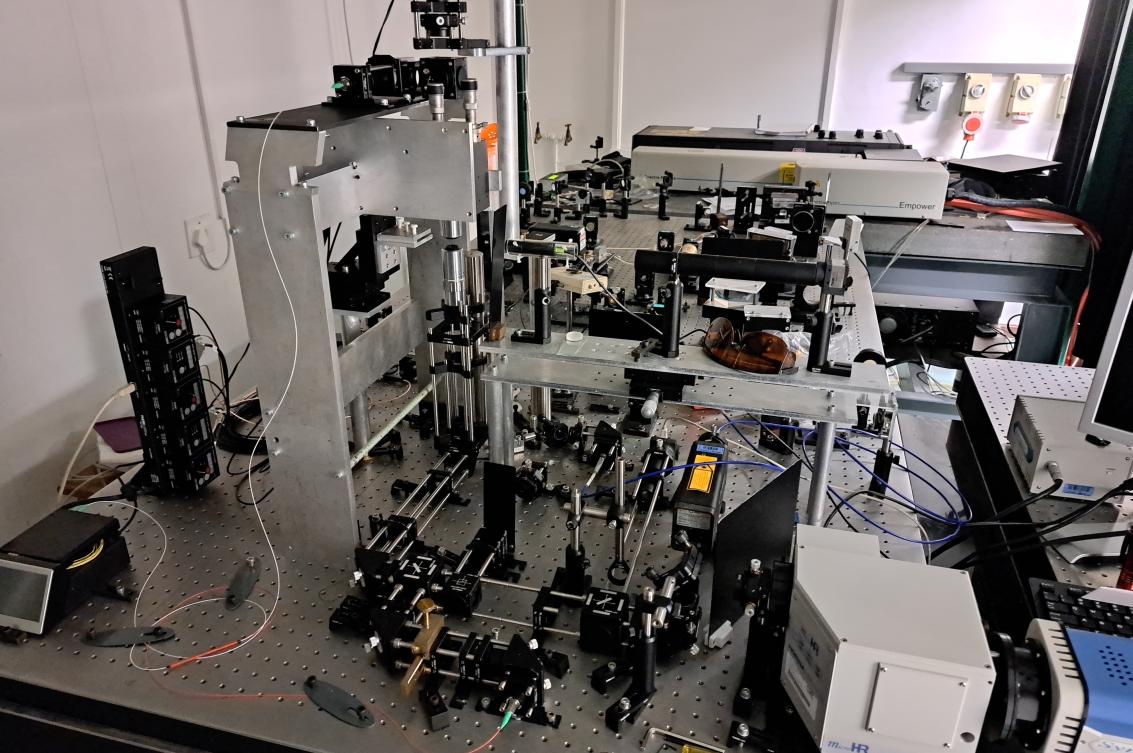
At these labs, she was exposed to different experimental setups including optical trapping – a technique that uses lasers to hold microscopically small particles in place.
This type of fundamental research is important to address pressing questions in aerosol physics. Uncertainties in our understanding and measurement of aerosol dynamics affect the accuracy of global climate models and hence our ability to predict future climate.
For Anneke, the challenge was to find out whether light can be used to more accurately measure the physical properties of individual droplets.
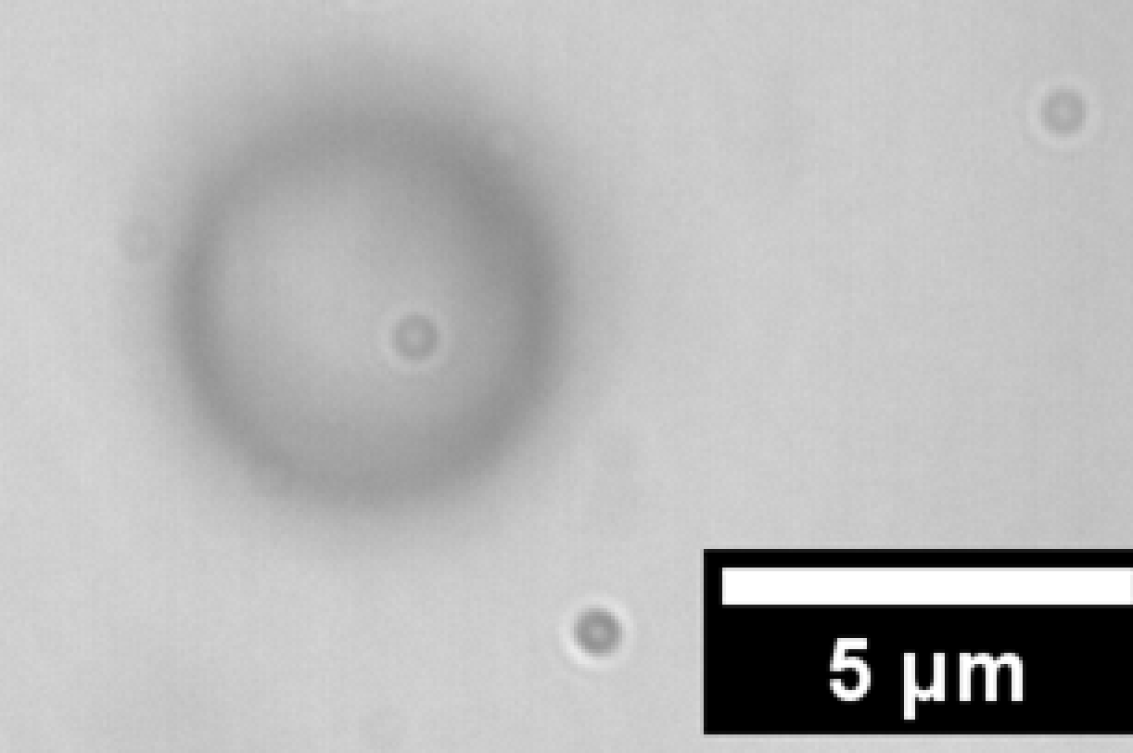
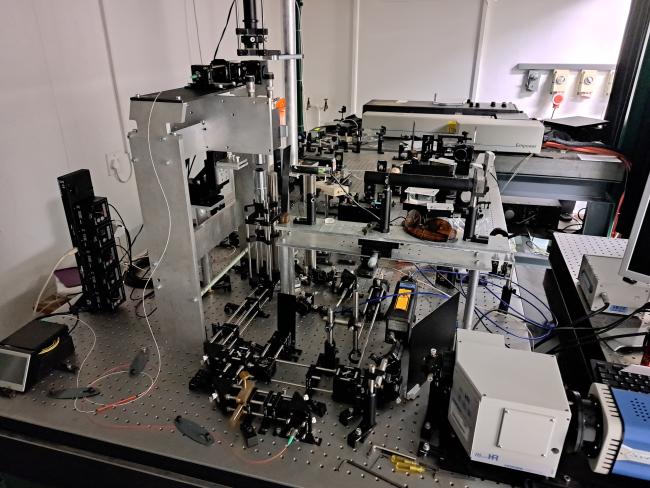
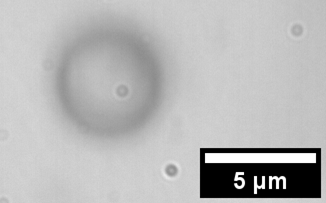
Back in the Merensky building, she succeeded in building an optical trapping setup that uses two lasers pointing at each – called a counter propagating optical trap – to trap an individual saltwater droplet and keep it suspended in midair for up to five hours.
She then induced evaporation and condensation cycles in the trapped droplet by small changes in laser power. These changes were measured indirectly by shining a broad-spectrum light source at the droplet and analysing the pattern of light it scatters – a method known as Mie scattering.
The size of the droplet (on the order of micrometers) was measured with an uncertainty of a few nanometers, three orders of magnitude better than the optical resolution using a camera, she explains.
Because the trapping of aerosol droplets is a dynamic and unpredictable system, with so many random variables, the measurements often extended to over an hour at a time.
Prof. Pieter Neethling, head of the Stellenbosch Photonics Institute in the Department of Physics and her study leader, says to the best of their knowledge, this is the first time that such minute (nanoscale) changes in the size of a droplet have been tracked in real time as it underwent changes in temperature.
“Measuring these dynamics in a controlled laboratory environment contributes to our understanding of droplet formation in the atmosphere and intricate interplay between atmospheric temperature and droplet size, which has great significance in our understanding of cloud formation, and hence the climate,” he adds.
Because of the sensitivity of the experimental setup, however, it also meant that a myriad of things could – and did – go wrong. While loadshedding was enemy number one, in 2021 her research was set back with several months after a burst waterpipe on the second floor of the Merensky building left the instruments soaking wet.
“The water was streaming down from the ceiling and walls of our lab,” Anneke remembers. She had to break down the setup, clean and inspect each of the individual instruments for possible damage, and start again from scratch.
During 2024 vibrations from renovation work in the building interfered to such an extent with the measurements that she had to conduct her experiments after hours.
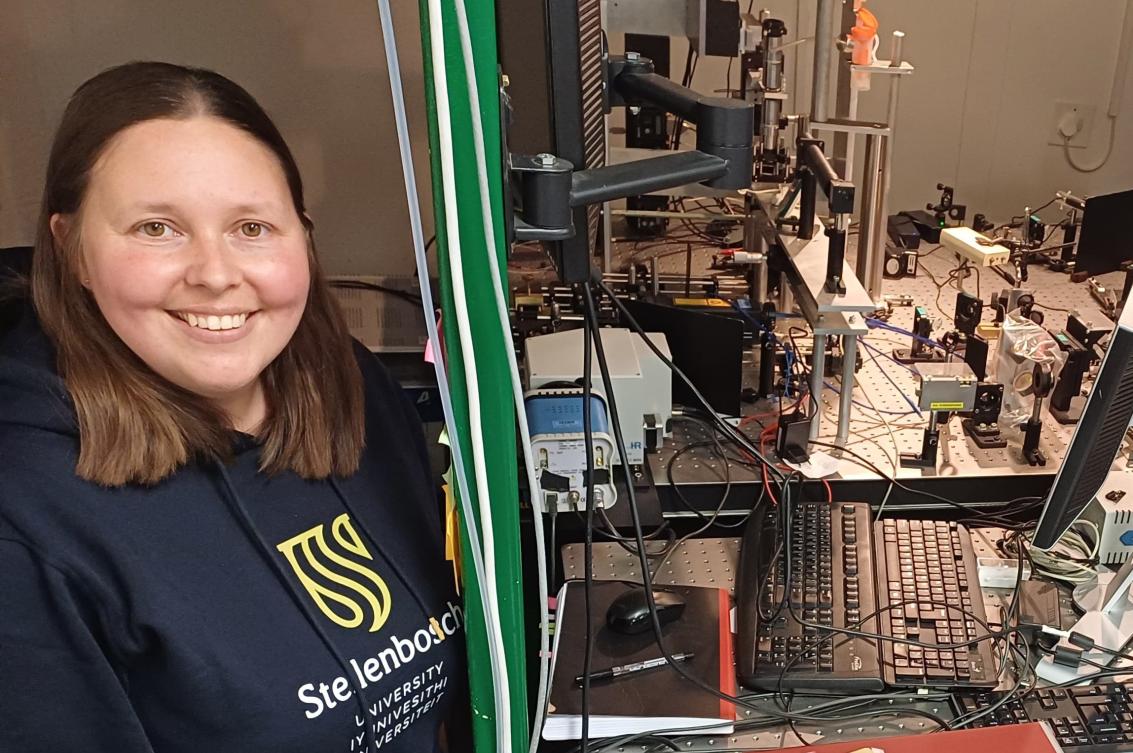
Despite these setbacks, this alumnus from Brackenfell High School thoroughly enjoyed designing and building the entire setup on her own: “I was the only postgraduate student on this project. Together with my supervisors, we were a small team tackling this question – how to use light to more accurately measure the physical properties of individual droplets.”
More about the 2025 graduation statistics for the Faculty of Science
The Faculty of Science produced 1 142 graduates in 2025, up from 1 013 in 2024 — the biggest single-year increase in 9 years. This is also a significant leap from the 868 graduates recorded in 2017, representing almost 32% growth over eight years.
On postgraduate level, the Faculty of Science produced a record number of doctoral graduates – 72 PhDs in 2025 compared to 47 in 2024, a 51% increase. Even more impressive is the fact that, of these, 55.6% are women, graduating with PhDs in the fundamental sciences such as Physics (6 PhDs), Chemistry and Polymer Science (5 PhDs), Mathematics (2 PhDs) and Computer Science (1 PhD).
Prof. Bertie Fielding, Dean of the Faculty of Science, says the 2025 graduation numbers reflect the strength and momentum of students and staff: “Producing 72 PhD graduates, with more than half of them women, is very encouraging, especially in disciplines where women have historically been underrepresented.”
Related stories
Media release
Gut health: why food alone won’t fix childhood stunting
Prof. Thulani Makhalanyane, holder of the NRF-SU research chair in African Microbiome Innovation in the Department of Microbiology, and Prof. Ronelle Burger...
Media release
African microbiomes – from humans to ecosystems – will be focus of new research chair at SU
Africa’s unparalleled biodiversity and environmental variations present an extraordinary opportunity to explore novel microbial species and their functions. Yet...
Media release
Geoscience for everyone: word bank of geological terms in all South Africa’s eleven spoken languages
The Mineralogical Association of South Africa (MinSA) is proud to announce the successful completion of a pioneering lexicography exercise that has collated...