
Logistics and Supply Chain Systems (LSCS)
There is a need for logistics and supply chain skills development in the African economy. These aspects are required as an enabler to establish sustained economic development and job creation via national trade growth in our export markets.
The logistics and supply chain systems programme focuses on enabling students to develop forward-thinking strategies to enhance the global competitiveness of supply chains, making significant contributions to logistical frameworks and ensuring these systems are resilient and future ready.
Invest in your career
This Structured Masters degree in Logistics and Supply Chain Systems is designed to equip students with in-demand expertise across critical areas such as supply chain risk and resilience, sustainable logistics systems, logistics resource engineering, and strategic supply chain engineering. Through a blend of theory, applied learning, and industry-aligned modules, students gain the tools to design smarter, more resilient, and sustainable supply chains. Ideal for aspiring professionals and graduates, this two-year full-time or three-year, part-time programme develops the strategic and technical capabilities needed to thrive in a rapidly evolving global landscape.
Study while you work
The hybrid online delivery mode is ideal for part-time students worldwide. Whether you work in retail, fruit and wine exports, fast moving consumer goods or any industry related to the logistics and supply chain field, this programme is designed to help you build a learning community that supports you in applying your newly developed skills. The language of instruction is English.
Elevate your skillset
This programme is designed to equip students with the technical, analytical, and soft skills needed to excel in a career within the field of logistics and supply chain systems.
Application Process
What is the application process and application deadlines for intake 2027?
- Applications closing date is 31 October 2026
You will need to apply on the SU portal How to Apply | Postgraduate | Stellenbosch University
When you apply, select:
MEng(Industrial Engineering) Struct: Logistics and Supply Chain Systems
Admission requirements
What are the admission requirements?
The degree will be offered to students with a prior NQF level 8 qualification or international equivalent. Typical previous programmes that would be admitted are:
- A four-year BEng degree (any discipline), OR
- A four-year BSc degree (any discipline), OR
- Any four-year degree (or three-year and honours degree) with either computer science, mathematics, applied mathematics or similar analytical modules as a major will be reviewed on a case by case basis.
Programme Structure
The 180-credit programme consists of 8 X 15-credit core and elective modules, a 1-credit professional communication module and a 60-credit research assignment module.
Are there options for full-time and part-time studies?
The programme is offered as a full-time and a part-time option.
Part-time studies provide a student with a longer period to complete the programme, i.e. three years for MEng PT instead of two years for MEng FT. The part-time students choose fewer modules per year.
However, part-time and full-time students still have to adhere to the same modules/lecture times/deadlines.
Students who work whilst completing their studies are generally advised to choose the part-time option. If you are unsure, please contact [email protected]
Changing from full-time to part-time or vice versa is only possible within the registration period of your first-year registration.
How are the modules presented? Is there an online option?
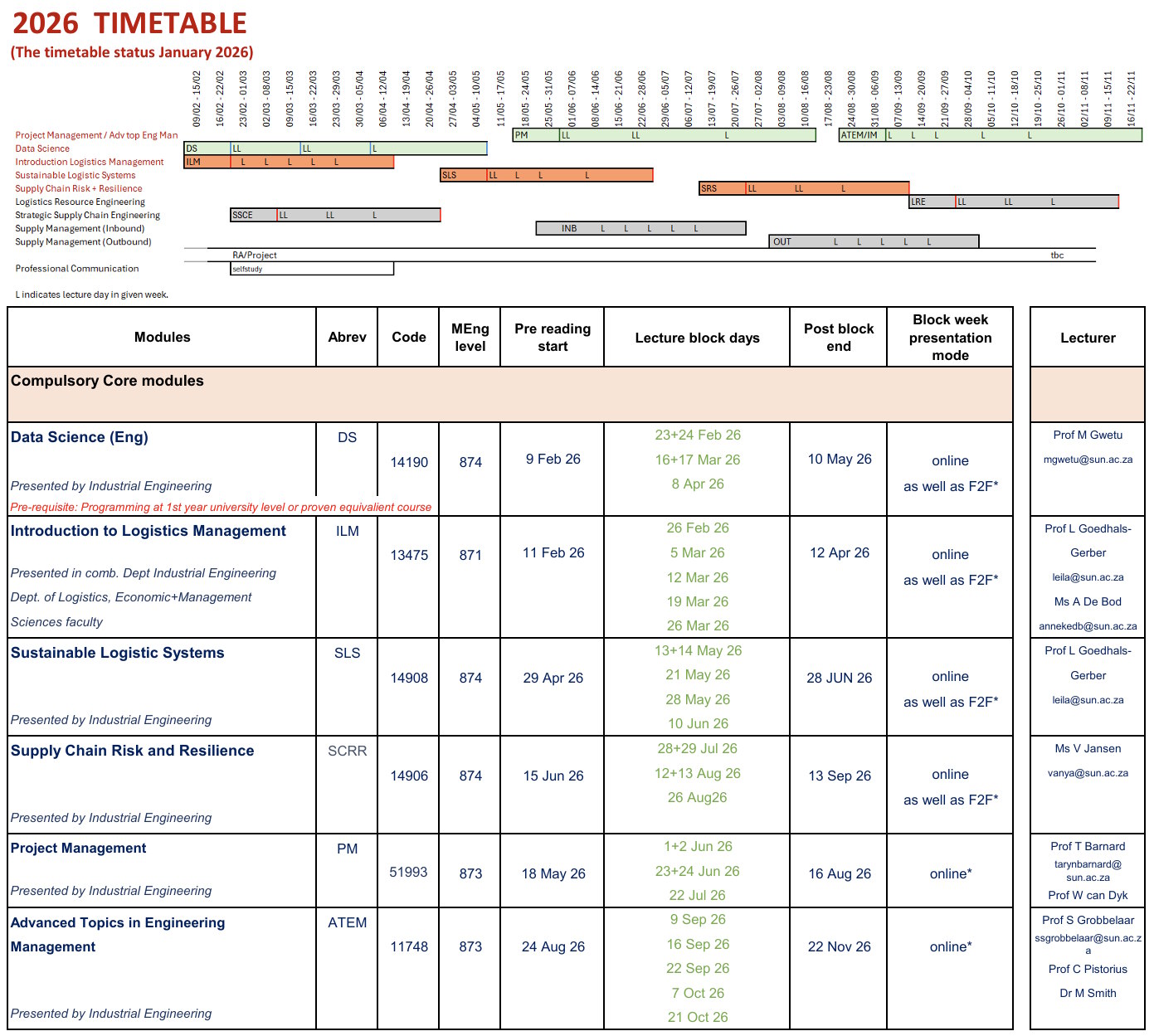
While the pre-reading and post-blocks do not require contact time, the lecture days must be attended during the full working day. Students have the option to attend in person on campus or online via MSTeams.
How is the programme assessed?
The modules are assessed continuously during the pre-reading, the lecture block and the post-block assignments. There is no additional exam period.
How are the modules presented?
The modules offered by the Industrial Engineering department have the following structure:
- 2 weeks pre-reading
- 5 days of lectures (synchronous, week or shorter 1-2 day blocks)
- 6 weeks post block assignments
Pre-reading and post-blocks take place asynchronously at your own time.
The lecture days of the different modules can be presented in one week or shorter blocks of one or two days. The lecture days must be attended for the full day for both in person and online students. The modules can entail significant group work and assessments, which require your availability during the full working days.
Note: Some modules are presented by other departments/faculties, and their structure can deviate. The department presenting the modules is listed in the section ‘Modules’.
Core Modules | Year | Co-requisites |
| (modules are compulsory) | ||
| Adv Topics in Engineering Management 873 | Year 1 | – |
| Project Management 873 | Year 1 | – |
| Introduction to Logistics Management 875 * | Year 1 | – |
| (*dependent on previous qualifications and/or experience) | ||
| Sustainable Logistics Systems 874 | Year 1 | Introduction to Logistics Management, other undergraduate logistics and supply chain module or relevant industry experience |
| Supply Chain Risk and Resilience 874 | Year 1 | Introduction to Logistics Management, other undergraduate logistics and supply chain module or relevant industry experience |
| Data Sciences (Eng) 874 | Year 2 | Programming experience 1st year level |
Elective Modules | Year | Co-requisites |
| (choose 2 or 3 depending on modules selected above) | ||
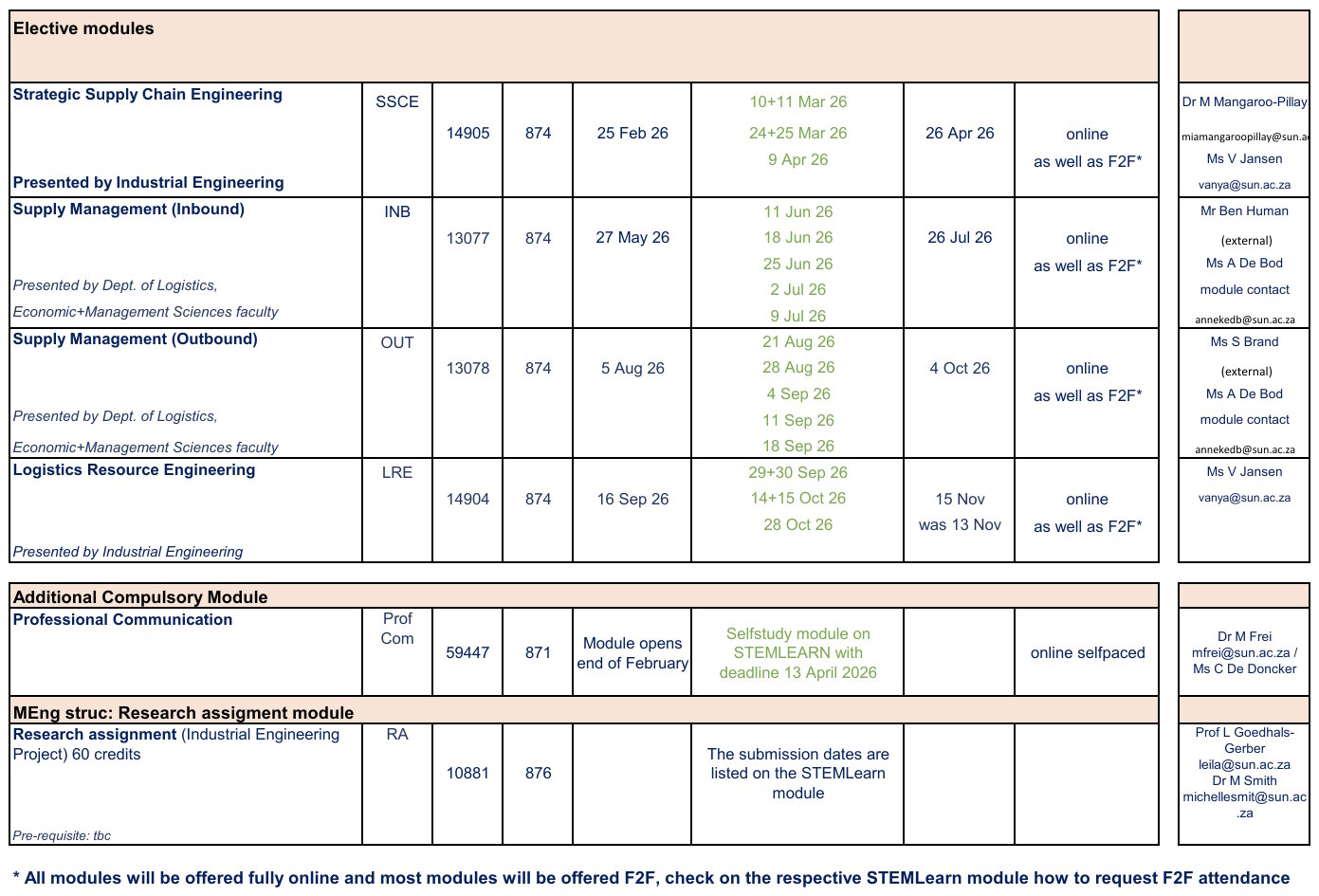
| Logistics Resource Engineering 874 | Year 1 | Introduction to Logistics Management, other undergraduate logistics and supply chain module or relevant industry experience |
| Strategic Supply Chain Engineering 874 | Year 2 | Introduction to Logistics Management, other undergraduate logistics and supply chain module or relevant industry experience |
| Supply Management (Inbound) | tbc | Introduction to Logistics Management, other undergraduate logistics and supply chain module or relevant industry experience |
| Supply Management (Outbound) | tbc | Introduction to Logistics Management, other undergraduate logistics and supply chain module or relevant industry experience |
Additional Module | Year | Co-requisites |
| Professional Communication 871 | Year 1 |
Research assignment module | Year | Co-requisites |
| Research assignment in industry relevant topics 876 | Year 2 for full-time students / year 3 for part-time students |
Compulsory Core Modules
| Advanced Topics in Engineering Management 873 (15 Credits) – Prof S Grobbelaar, Prof C Pretorius, Dr Smit (Dept. Industrial Engineering) |
| The purpose of the module is to present principles of general management within the context of technical disciplines. The course themes include the business environment and strategic management on a firm level, touching on the role of innovation and technology for competitiveness on a systems level from international and national perspectives. |
| Project Management 873 (15 Credits) – Prof T Barnard (Dept. Industrial Engineering) |
| This course is designed to enhance your existing project management expertise by reemphasising best practices and accentuating the role of project management, along with the project manager’s position, within the context of project-based organisations. In addition, the course will delve into the role of the project leader within such settings, with the aim of not only facilitating successful projects, but also promoting the overall success of organisations through the proper application of project management principles and the successful delivery of projects. |
| Sustainable Logistics Systems 874 (15 Credits) – Prof L Goedhals-Gerber (Dept. Industrial Engineering) |
| This module explores the concept of sustainable logistics systems. It takes an interdisciplinary perspective on the subject, incorporating elements of logistics, economics, engineering, systems thinking, and climate science. The module delves into how businesses are subject to increasingly stringent environmental, economic, and societal pressures, their ongoing response to this, and the role of innovation to tackle these concerns. The module aims to make students aware of the seriousness of the often-conflicting sustainability challenges faced by companies, governments, and society. It will particularly focus on informing students of logistics’ contribution to environmental problems and reveal what companies and governments can do to reduce logistics’ environmental impact while remaining profitable. Students will also gain insight into how businesses are interacting with the Triple Bottom Line approach and working towards the UN Sustainable Development Goals. |
| Supply Chain Risk and Resilience 874 (15 Credits) – Ms V Jansen (Dept. Industrial Engineering) |
| In an increasingly unpredictable global landscape, professionals must develop the skills to navigate business supply chains through disruptive events. This module equips students with the knowledge and strategies necessary to support their organisations in not only withstanding challenges, but thriving in a volatile, uncertain, complex, and ambiguous (VUCA) environment. Grounded in both theoretical frameworks and industry best practices, this course explores how organisations can build resilience across supply chains, minimising disruption impact, reducing response time, and accelerating recovery beyond pre-shock operational levels. Students will gain a comprehensive understanding of supply chain risk and resilience, learn to evaluate and manage key stakeholders and develop a structured approach to fostering a resilient business environment. By the end of this module, participants will be equipped to implement risk-mitigation strategies, ensure business continuity, and contribute to a sustainable future in an ever-evolving global economy. |
| Data Science (Eng) 874 (15 Credits) – Prof M Gwetu (Dept. Industrial Engineering) |
Data science is the application of computational, statistical, and machine-learning techniques to gain insight into real-world problems. The focus of this module is on the data science project life cycle, specifically to gain a clear understanding of the five steps in the data science process, namely obtain, scrub/wrangling, explore, model, and interpret.
Pre-requisites: Proof of knowledge of an appropriate coding language (e.g. Python) at first year university level. In addition, an Introduction to Logistics Managment module is compulsory for all students who have not completed undergraduate logistics and supply chain module or relevant industry experience. |
| Introduction to Logistics Management (15 Credits) – Prof L Goedhals-Gerber, Ms A De Bod (Dept. Industrial Engineering) |
The student should be able to describe the basic functioning of a logistics channel. It is important to identify, illustrate and appreciate the contribution of all the major activities involved in logistics. The student should be able to articulate the major differences between the inbound and outbound logistics systems.
In addition, the ‘Introduction to Logistics Management’ module is compulsory for all students who have not completed undergraduate logistics and supply chain modules or have relevant industry experience. |
Elective modules
Students choose 2 to 3 modules depending on if they enroll for the Introduction to Logistics Management module
| Logistic Resource Engineering 874 (15 Credits) – Ms V Jansen (Dept. Industrial Engineering) |
| In today’s interconnected global economy, supply chains and logistics systems rely on the seamless integration of shipping, warehousing, and transportation. Effective management of these components, alongside stakeholder relationships, infrastructure, technology, information, and financial resources, is essential for achieving operational efficiency, cost reduction, and long-term resilience. This module takes an interdisciplinary approach to logistics resource engineering, exploring how organisations can optimise procurement, processes, systems, and workforce structures to enhance supply chain performance. Through the study of shipping networks, warehousing strategies, and transportation logistics, students will gain insights into improving reliability, mitigating risks, and maintaining a competitive edge in the global marketplace. By the end of this module, participants will be equipped with the strategic knowledge and practical tools to design and manage resilient, efficient, and adaptive supply chain systems. |
| Strategic Supply Chain Engineering 874 (15 Credits) – Prof L Goedhals-Gerber (Dept. Industrial Engineering) |
| This module explores the concept of strategic thinking and development of strategic decision-making skills in the engineering environment. It explains the link with strategic supply chain engineering and provides a comprehensive understanding and critical appreciation of concepts and issues linked to supply chains, strategies and processes in a global context. This address both strategy at product, company and macro infrastructure level. The module addresses the supply chain within a global logistics system which includes critical processes to be managed such as materials, services and information. In so doing, the module develops a student’s understanding of interrelationships and integration of different stakeholders and owners in a supply chain. In this module, students will learn the iterative process that is followed in the design and development of supply chain strategies that is aligned to business strategies and fit with the requirements of various competitive environments. It also investigates barriers to integrating supply chains, including behavioural issues (e.g., misaligned incentives and change management) and operational execution problems. The module focuses on the tools students will need to participate effectively in strategic and tactical business decisions about supply chain operational choice and execution within a global economy. |
| Supply Management Inbound (15 Credits) – tbc (Dept. Logistics, Economic & Management Sciences faculty) |
Students will learn the language of the subject matter and be equipped with the relevant procurement, supply and inventory management practices typically found in inbound segments of a manufacturing organization’s supply chain (Source and Make). This module is designed to explore the procurement cycle within the context of supply chain management from acquisition to disposal of goods (and services). The major phases of supply management will be covered, i.e., generation of requirements, sourcing, pricing, agreement development, and post award activities including evaluation processes. Students will also be sensitized to the procurement decision interfaces with the other major business functions, including marketing, finance-accounting, operations, logistics, and research and development. The major operational/execution processes of the inbound supply chain will also be covered. It is based on several existing supply chain conceptual models that highlight these as core/functional skill areas.Source – The processes associated with ordering, delivery, receipt and transfer of raw material items, subassemblies, products and/or services.
Make – The process of adding value to products through, e.g., mixing, separating, forming, machining, and chemical processes. |
| Supply Management Outbound (15 Credits) – tbc (Dept. Logistics, Economic & Management Sciences faculty) |
| Students will learn the language of the subject matter and be equipped with the relevant practices typically found in outbound segments of an organization’s supply chain (Deliver and Return). The Deliver section of the module will map out the major types of outbound supply chain configuration. It will consider process integration requirements and map out ideal process flows; conduct business process analysis and streamlining, and cover process control and quality management. The Deliver section covers essential elements needed to manage warehousing, packaging and materials handling activities (facilities management) as well as coordinate product deliveries (transport service providers). An overview of the use of relevant documentation to manage deliveries effectively is provided. Core aspects of maritime logistics are also covered. In the Return section of the module, practices to minimise the logistics environmental impact and waste are considered and product returns management and reverse logistics practices are explained. |
Professional Communication
| Professional Communication 871 – Engineering Faculty |
| All students must complete the self-study Professional Communication module. |
Research Assignment
| Research Assignment 876 (60 Credits) |
The Research Assignment provides the student with the opportunity to undertake a research project which addresses a specific issue or problem in logistics or supply chain systems under the supervision of lecturer in the Faculty of Engineering, elsewhere in the University (or the industry). This includes the formal structuring of the problem to be addressed and learning how to conduct a research project using scientific methodology which leads to practical conclusions and recommendations. Students are encouraged to select a topic that will allow them to publish their findings in a recognised journal and present these at a conference.
A student will typically select a topic and conduct the bulk of the structuring of the problem to be addressed in the semester preceding the research itself. During this time, the student will also be designated a supervisor who has an interest in the topic.
|
Module Framework
Here, we discuss aspects about only the core modules presented by the Department of Industrial Engineering.
Note: Modules offered by other departments can have a different structure. The presenting department is listed in the section ‘Modules’.
The module framework for each module will be made available to students before the start of the module on the learning platform SUNLearn/STEMLearn.
These contain all important information about the module content, structure, deadlines and prescribed literature etc.
Assessment
Here, we discuss aspects about only the core modules presented by the Department of Industrial Engineering.
Note: Modules offered by other departments can have a different structure. The presenting department is listed in the section ‘Modules’.
The assessment structure for the logistics and supply chain systems modules offered by the Industrial Engineering department is listed below.
The logistics and supply chain systems modules will consist of five formal assessment opportunities – a pre-block assignment, a formative assessment opportunity during the lecture block week, and three post-block assignments. Each of these assessment opportunities will account for 20% of the student’s final mark. The formative assessment may consist of one or more smaller assessments which will take place during the contact session. In order to successfully pass the module, a student needs to achieve a final mark of 50% or above.
The pre-block assignment will be made available to students two weeks before the scheduled module lectures block days. The due dates of the post-block assignments will be set to allow for 1-2 weeks per assignment.
Take note that each of the core logistics and supply chain systems modules has one pre-block assignment which will require 20-30 hours of work. The lecture block week/days requires your full attention for the entire week/days. This is followed by three post-block assignments which will require around 30 hours of work each.
Fees
Information on postgraduate fees is available on the University’s postgraduate website: Section Student Fees where you find information in the Yearbook ‘Study fees’.
Use the information in the Yearbook ‘Study fees’ in combination with the provisional quotations form on the postgraduate website.
Fees are adjusted annually. Fees differ for South African and International students as well as part time and full time students. It is recommended that you acquaint yourself with the fee structure, especially the yearly registration fees as well as the module fees.
For South African students fees enquiries must be directed to student accounts .
For International students enquiries fees enquiries must be directed to SUIFINANCE .
There may be limited bursaries available depending on funding availability. For information on available bursaries, please contact Prof Leila Goedhals-Gerber at [email protected]. For information on other postgraduate funding and support, visit the SU Postgraduate Office Funding Support website.
As part of the MEng (Structured) programme with focus on Logistics and Supply Chain systems our students are required to complete a final 60 credit research project where they are required to apply and consolidate the logistics and supply chain systems knowledge gained throughout the programme. For this purpose, students will solve a real-world logistics and supply chain systems project, providing solutions for industry challenges and opportunities and document it in a research assignment.
For these projects, we collaborate with industry and academic partners who are willing to propose a topic, to provide the necessary data (if not publicly available) as well as to act as domain mentors. The data set needs to be complete.
If you are interested in partnering with us for such a project, please contact [email protected] for further information about a short project proposal and deadlines.
Project proposals reviewed by end of term 3 of a given year will be assigned to students for the following year.

Prof Leila Goedhals-Gerber
Email: [email protected]
Prof Leila Goedhals-Gerber is a supply chain specialist with focus areas including cold chain logistics, sustainable logistics, driver behaviour and issues relevant to the maritime industry. She...
read more
obtained her PhD from Stellenbosch University based on research that developed a model that can determine the efficiency of the individual links or nodes in a supply chain as well as determine the efficiency of the entire supply chain. The model also identifies the bottlenecks in a supply chain and therefore makes it easier to determine the steps needed to improve the levels of efficiency in the supply chain under investigation.
Leila is the academic coordinator of the focal area in Logistics and Supply Chain Systems. She is rated as an established researcher by the National Research Foundation (NRF) of South Africa and has been involved in research projects in the South African fruit industry, the port sector, assessing driver behaviour in the South African road freight industry as well as projects that investigate further logistical efficiencies.

Ms Vanya Jansen
Email: [email protected]
Vanya is a Human Capital and Certified Supply Chain Professional (CSCP). With over 20 years of working experience across the financial, manufacturing, logistics, and retail sectors, Vanya has...
read more
acquired in-depth knowledge and skills in problem solving, analytical reasoning, conceptual thinking, project management, collaboration, leadership, and negotiating.
Committed to driving both excellence and service delivery, she strives to deliver outcomes that exceed expectations and thrives in environments where there’s a need to optimise people, processes and systems in order to achieve high levels of organisational effectiveness.
Vanya has a keen love for continuous learning and is a Certified Supply Chain Professional (CSCP) and holds qualifications in Project Management (USB), Business Management (PGDip), Human Resource Management (BTech), and Industrial Psychology (Mcom).

Ms Anneke De Bod
Email: [email protected]
Anneke is a lecturer at Stellenbosch University’s Department of Logistics, with years of experience in rail management, rail market and market opportunity research in South Africa and other...
read more
African countries. As a researcher, she has been involved in work for Transtrade (a subsidiary of Transnet), freight flow modelling in South Africa and similar projects in Zambia and Botswana.
In addition to consulting for various companies, Anneke’s work as lecturer is focused on supply chain strategy, change management and transformation and logistics customer service interface – specifically macrologistics change management and policy implementation.

Prof Mandlenkosi Victor Gwetu
Email: [email protected]
Mandla Gwetu has an extensive career in tertiary education which spans multiple institutions, where he has gained experience in curriculum development, community engagement, scientific research and...
read more
academic leadership. He holds a PhD in Computer Science from the University of KwaZulu-Natal and is an alumni of the Heidelberg Laureate Forum and the USB-ED Senior Management Development Program. His areas of expertise include both theoretical and application aspects of Machine Learning, Artificial Intelligence and Computer Vision. He is actively seeking for self funded PhD candidates and research collaborations in Computational Data Science.
Mandla Gwetu is currently involved in the delivery of Data Science, Data Engineering and Data Analytics modules in the Faculty of Engineering. Visual Paradigm software is used as a design tool in the Data Engineering module.