
Data Science related programmes
Data science is the scientific investigation that employs innovative approaches and algorithms, most notably machine learning algorithms, for processing and analysing data. Data Science technologies can be applied to both small and big data, of various types such as relational, images, video, audio, and text. Big data constitutes extremely large data sets that may be analysed computationally to reveal patterns, trends and associations, especially relating to human behaviour and interactions.
The data science programmes focus on enabling students to develop innovative optimisation and machine learning techniques to produce novel, efficient and robust data science technologies, for use in Industrial Engineering, Engineering Management and related applications. Examples include forecasting, customer segmentation and targeted marketing, production quality control, supply chair performance prediction and process monitoring.
The Department of Industrial Engineering is hosting two data science related programmes, namely the MEng (Structured) and the Postgraduate Diploma.
The 180 credit MEng (structured) programme encompasses five core data science modules, two elective modules, one specialization module, a module in professional communication, as well as a final 60-credit research assignment.
The 120 credit postgraduate diploma, on the other hand, requires students to complete six core data science modules, two generic modules and a professional communication module.
The modules are spread throughout the year (see timetable). The module duration is typically nine or thirteen weeks and starts with a pre-block. Five lecture days will be presented from the 3rd week onwards. Students must attend all five lecture days full time. The lecture days take place online. In addition to the online presentation, limited modules may also be delivered in person. Beyond the lecture week no further contact time will be required.
Modules offered by other departments for the programme can have a different format/presentation mode.
Study time, Full time and part time option
A student may choose to enroll for the programme as a fulltime or a part-time student, where the main difference is the length of time allowed to enroll. Both student groups attend the same modules/teaching schedule/deadlines.
It is expected of a fulltime student to complete the postgraduate diploma in one year or the MEng programme in two years. A part-time student, on the other hand, is expected to complete the postgraduate diploma in two years and the MEng programme in three years. If necessary, students may apply for extension of study time with good motivation.
Once you commence your studies, a change from full time to part time is not possible.
Remember the co-requisite requirements for MEng and PGDip when you register for your modules. Be aware that there is overlap between the modules.
Students from SU Engineering postgraduate programmes who wish to take the Data Sciences 774 / 874 modules as an elective module must be aware of the pre-requisite: programming knowledge.
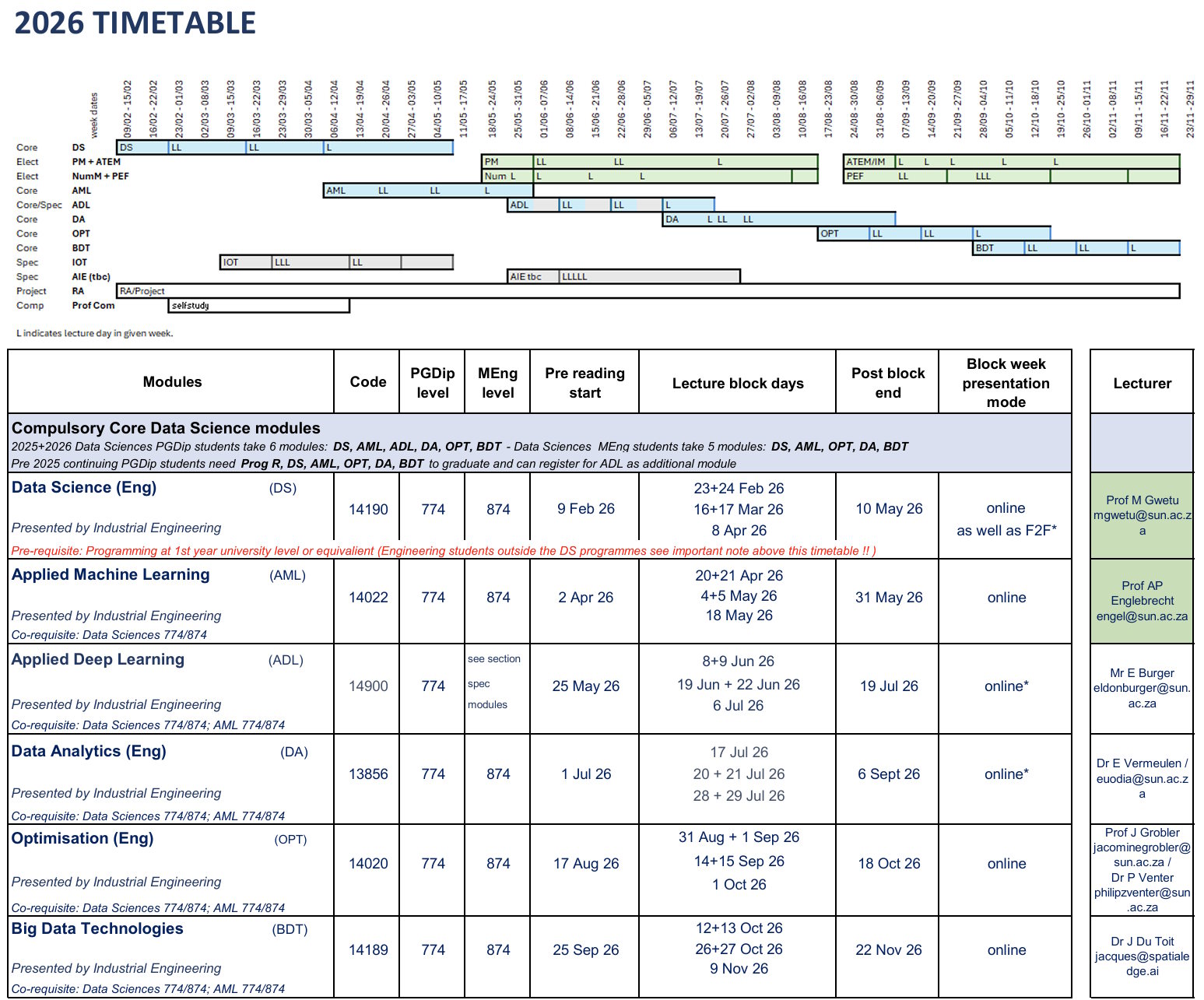
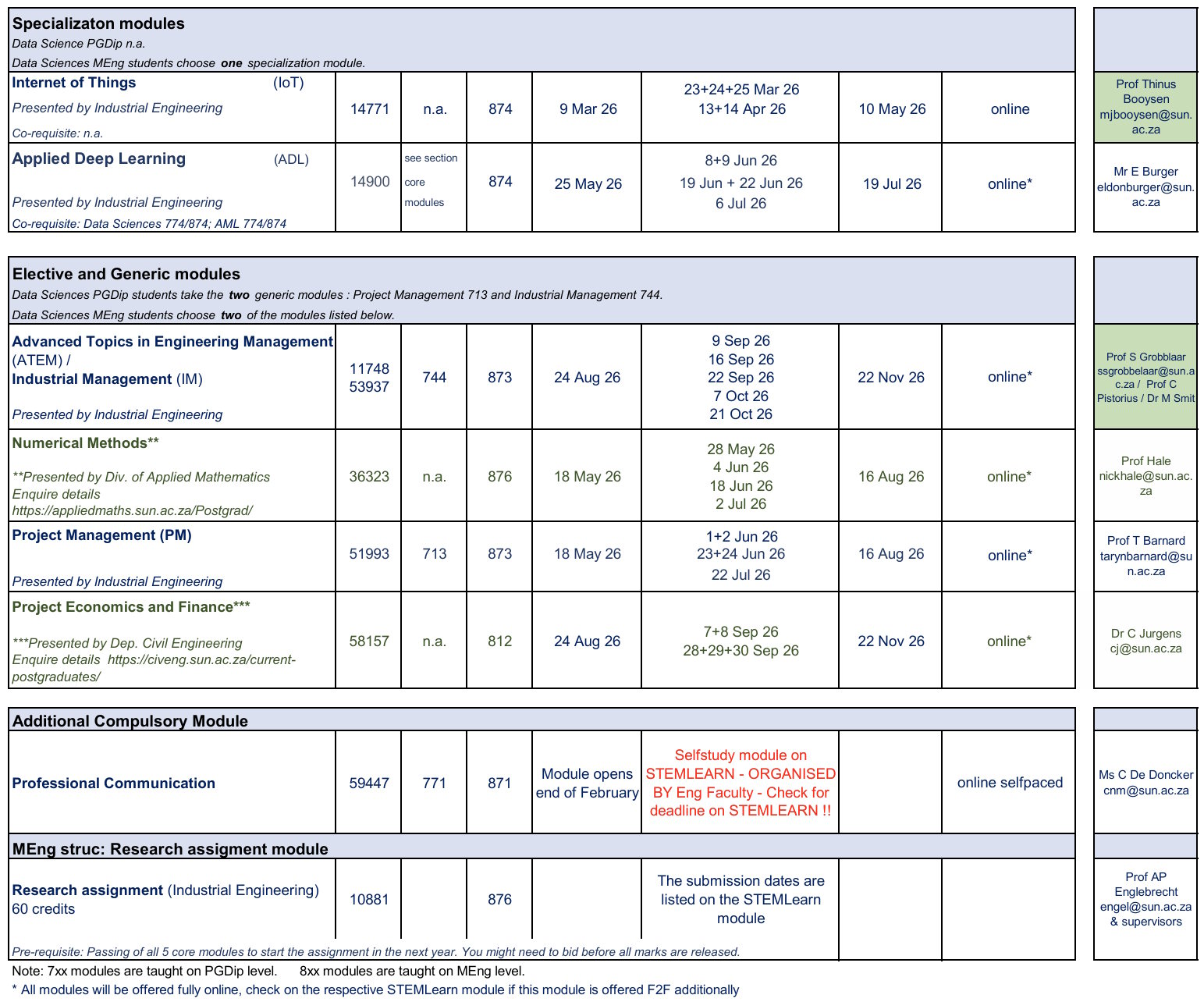
Last updated: 12 Feb 2026
Applications for the next year intake year commences in April of the current year.
Applications must be submitted via the University’s postgraduate website.
Current students should apply after their 1st semester marks reflect on the transcripts.
When you apply, select:
MEng(Industrial Engineering) Struct: Data Science for the master’s program
PGDip(Eng)(Industrial Eng) for the postgraduate diploma programme.
Applications for MEng IE structured close
- 31 October 2026 for South African candidates, and
- 31 October 2026 for international candidates.
Applications for the PGDip Ind Eng programme close
- 31 October 2026 for South African candidates, and
- 31 October 2026 for international candidates.
Important before submitting your application:
Admission requirements for MEng IE (struc) are listed here.
Admission requirements for Pg Dip IE are listed here.
Please note that the programmes are quota-managed and have a limited number of places available for students.
Note:
The complete set of documents must be uploaded on the application portal before submitting the application. Documents cannot be added later. The complete application must be submitted on the application portal before the closing date.
Information on postgraduate fees is available on the University’s postgraduate website: Section Student Fees where you find information in the Yearbook ‘Study fees’.
Use the information in the Yearbook ‘Study fees’ in combination with the provisional quotations on the postgraduate website.
Fees are adjusted annually. Fees differ for South African and International students as well as part time and full time students. It is recommended that you acquaint yourself with the fee structure, especially the yearly registration fees as well as the module fees.
For South African students fees enquiries must be directed to student accounts.
For International students enquiries fees enquiries must be directed to SUI Finance.
Note: There are no scholarships from the Industrial Engineering department available for these programmes. For information on postgraduate funding and support, visit the Postgraduate office website.
Module Framework
Here, we discuss aspects about only the core Data Science modules presented by the Department of Industrial Engineering.
The module frameworks for each module will be made available to students before the start of the module on the learning platform SUNLearn->STEMLearn
These contain all important information about the module content, structure, deadlines and prescribed literature etc.
Assessment
The assessment structure for the data science modules offered by the Industrial Engineering department is listed below. Note: Modules offered by other departments can have a different structure. The departments which offer modules are listed in the timetable.
The data science modules will consist of five formal assessment opportunities – a pre-block assignment, a formative assessment opportunity during the lecture block week, and three post-block assignments. Each of these assessment opportunities will account for 20% of the student’s final mark. The formative assessment may consist of one or more smaller assessments which will take place during the contact session. In order to successfully pass the module, a student need to achieve a final mark of 50% or above.
The pre-block assignment will be made available to students at least two weeks before the scheduled module lectures block week. The due dates of the post-block assignments will be set to allow for 1-2 weeks per assignment.
Take note that each of the core data science modules has one pre-block assignment which will require 20-30 hours of work. The 5 lecture days require your full attention for the entire week/2 day/2 day/1 day blocks. This is followed by three post-block assignments which will require around 30 hours of work each. Students will have about six weeks to complete these post-block assignments

Prof Andries Engelbrecht
Email: [email protected]
Prof Andries Engelbrecht is an A-rated researcher as rated by the National Research Foundation. This rating acknowledges that he is a leading international researcher in his field. His fields of...
read more
expertise are computational intelligence, swarm intelligence, evolutionary computation, neural networks, optimisation, machine learning, and data analytics. Prof Engelbrecht is the first incumbent of the new Voigt Chair in Data Science in the Department of Industrial Engineering.
As a first-year Matie student in 1988 he opted for BSc with Computer Science and Mathematics. He obtained his honours cum laude in 1992, followed by a master’s cum laude (1994) and a PhD in 1999. During his postgraduate studies he taught Computer Studies and Mathematics on a temporary basis at a few schools. His introduction to academia came with his appointment as a lecturer in Computer Science at UNISA in 1996 where he stayed for two years.
His academic career gained momentum in 1998 when he joined the University of Pretoria as a lecturer in Computer Science. Over the two decades that followed, he rapidly progressed through the ranks, his last two positions being Head of Department (2009 to 2017) and Director: Institute for Big Data and Data Science (2017 to 2018). After 21 years at the University of Pretoria, the opportunity arose to return to his alma mater. His appointment at Stellenbosch University comprises two aspects: 50% is allocated to his role as Chair in Data Science in the Faculty of Engineering and 50% as an academic in the Computer Science Division in the Faculty of Science.
He presents the Applied Machine Learning and Data Analytics modules of the Data Science postgraduate programmes. In the Computer Science Division, he presents two honours modules, Computational Intelligence and Machine Learning. He serves on the management committee of the Department of Industrial Engineering, and academic coordinatore of the M.Eng (Structured)(Industrial Engineering) and PGDip (Industrial Engineering) programmes. He is also th epostgraduate manager for the Computer Science division.
He leads a large research group of fourth year project students, masters students, and PhD students from both the Industrial Engineering department and the Computer Science division. In addition, he also supervises 8 external masters students and 2 external PhD students. He has graduated 52 masters students, 18 doctoral students, and 96 fourth year project students.
Prof Engelbrecht is currently the most cited Computer Scientist in South Africa, with a current Google Scholar h-index of 60. He has published over 370 research papers, and has written two books:
Fundamentals of Computational Swarm Intelligence, Wiley & Sons, December 2005 (also translated into Chinese)
Computational Intelligence: An Introduction, Wiley & Sons, Second Edition, December 2007.
Prof Jan van Vuuren
Email: [email protected]
The research interests of Prof Jan H van Vuuren are combinatorial optimisation and decision support within the wider area of operations research. He heads the Stellenbosch Unit for Operations...
read more
Research in Engineering (SUnORE) within the Department of Industrial Engineering. He obtained his bachelor’s degree in science cum laude from Stellenbosch University in 1989, majoring in mathematics and applied mathematics. He followed this up with an honours degree cum laude in 1990 and a master’s degree cum laude in 1992, both in applied mathematics and both from Stellenbosch University.
He obtained his doctorate in mathematics from the University of Oxford, United Kingdom in 1995. He has been a member of staff at Stellenbosch University since 1996, first in the Department of Applied Mathematics (until 2007) and then at the Department of Logistics (until 2013). He is currently professor of operations research within the Department of Industrial Engineering, a position he has held since 2014. In all of these departments he has taught subjects related to optimisation, at both undergraduate and postgraduate levels.
He leads a large research group of fourth year project students, masters students, and PhD students from both the Industrial Engineering department and other engineering departments. In addition, he has supervised 80 fourth-year project students, 85 masters students, and 55 doctoral students to the successful completion of their studies.
Prof van Vuuren is the author of more than a hundred and twenty journal publications has co-edited/written two books: Kruger HA & Van Vuuren JH (Eds), 2019. Operations research in South Africa: The first 50 years, African SunMedia, Stellenbosch; and Henning MA & Van Vuuren JH, 2022. Graph and network theory: An applied approach using Mathematica, Springer, Cham.

Prof Jacomine Grobler
Email: [email protected]
Prof Jacomine Grobler joined the Department of Industrial Engineering at Stellenbosch in February 2019 as Associate Professor. Her areas of expertise are the development of optimisation algorithms...
read more
and the application of data science within the field of industrial engineering. With this background she joined the newly-established Data Science research group. Prof Grobler was born and raised in Pretoria. She decided to study engineering as the work is creative and requires good problem-solving skills.
She opted for Industrial Engineering in particular, because it is people oriented and there are vast opportunities in industry for industrial engineers. She obtained all her industrial engineering degrees at the University of Pretoria: BEng 2006, HonsBEng 2007, MEng 2009 and PhD 2015.
During her study career, she received 12 awards. These include the Department of Industrial and System Engineering prize for the best final-year project; Medal from the South African Institute of Industrial Engineering for the best final-year Industrial Engineering student; Winner of the SAS Operations Research National Student Competition best honours project; South African Association for the Advancement of Science Bronze medal for the best dissertation at master’s level at the University of Pretoria; and the 2017 South African Institute for Industrial Engineering Award for Outstanding Young Industrial Engineering Researcher. From August 2008 to March 2014 she was employed by Denel Dynamics Pty Ltd. Thereafter she joined the CSIR as research group leader: Transport and Freight Logistics. In October 2015 she returned to academia, this time as lecturer in supply chain management at UP.
Prof Thinus Booysen
Email: [email protected]
Prof MJ (Thinus) Booysen is Professor and Chair in the Internet of Things at the Faculty of Engineering at Stellenbosch University. He has been with Stellenbosch University from 2009 and his...
read more
research is on the Internet of Things, with a focus on Smart Energy, Water and Vehicles (specifically its application to paratransit in Sub-Saharan Africa). He is also a founder of Bridg-iot (Bridge-to-the-Internet-of-Things), founder of Green X Engineering , and co-creator of Geasy and Count Dropula. He is the Director of the MTN Mobile Intelligence Lab and partner in the Stellenbosch Smart Mobility Lab.
He is a Senior Member of the IEEE, Member of the Institution of Engineering Technology (MIET), a Chartered Engineer (CEng) at the Engineering Council (UK), and a Professional Engineer (PrEng) with the Engineering Council (SA). He has over ten years’ international industry experience in the aerospace and automotive industries with companies that include SunSpace, Rolls-Royce, Boeing, BMW, and Jaguar Land Rover.
Prof Mandla Gwetu
Email: [email protected]
Mandla Gwetu has an extensive career in tertiary education which spans multiple institutions, where he has gained experience in curriculum development, community engagement, scientific research and...
read more
academic leadership. He holds a PhD in Computer Science from the University of KwaZulu-Natal and is an alumni of the Heidelberg Laureate Forum and the USB-ED Senior Management Development Program. His areas of expertise include both theoretical and application aspects of Machine Learning, Artificial Intelligence and Computer Vision. He is actively seeking for self funded PhD candidates and research collaborations in Computational Data Science.
Mandla Gwetu is currently involved in the delivery of Data Science, Data Engineering and Data Analytics modules in the Faculty of Engineering. Visual Paradigm software is used as a design tool in the Data Engineering module.
As an academic partner of Visual Paradigm, Visual Paradigm is providing Stellenbosch University with their online UML software, and database design software for educational use.
Dr Jacques du Toit
Email: [email protected]
Dr Jacques du Toit obtained his bachelor’s degree in physical and mathematical analysis (PMA) from Stellenbosch University (SU) in 2003, majoring in mathematics and computer science. He went on to...
read more
complete his Honours degree in PMA, and received his master’s degree cum laude in Applied Mathematics in 2009, also from SU. He then followed master’s courses in Artificial Intelligence at the University of Amsterdam (UVA) and received his PhD in Operations Research in 2014 from SU.
He is currently working at a big data analytics company where his responsibilities include industry training in big data methodologies and realising value from data using the latest technologies. He has worked on various data science, machine learning and big data problems in industry, as well as big data science projects like the SKA.

Dr Philip Venter
Email: [email protected]
Dr. Philip Venter received his B.Sc. and B.Sc. Hons. in Actuarial science, B.Sc. Hons. Mathematics, B.Eng. and M.Eng. (Mechanical) and Ph.D. in Applied Mathematics from the North-West University (NWU)...
read more
in Potchefstroom. He is professionally registered at ECSA (Mechanical) with industry, consulting, and academia experience. In academia he held positions at both the Mechanical and Industrial Engineering the NWU, before joining the SUNoRE research group at SUN’s Department of Industrial Engineering.
The combination of qualifications allows Dr. Venter to incorporate his research into providing, scientific fundamentally based, data-driven solutions for process optimisation and decision support. As a specialist in thermal fluid science modelling, emphasis is placed on modelling that assesses both the in-time working efficiency of chemical processes, as well as plant equipment’s operational health.
As an optimisation specialist his research focuses on decision support, by solving for best system outcomes through either advanced planning, in-time interactions, or a combination thereof.

Mr Eldon Burger
Email: [email protected]
Eldon Burger graduated with a bachelor’s in Electrical and Electronic Engineering from North-West University in 2012 upon which he received the South African Institute of Electrical Engineers (SAIIE)...
read more
award for the best fourth year student. Thereafter, he joined Eskom where he worked on various analytical projects. In 2015, while working at Eskom, he obtained his degree in Industrial Engineering from the University of South Africa. In 2020, Eldon graduated from the University of Debrecen in Hungary with a master’s in Computer Science and he was awarded the distinguished Dean’s List award.
Eldon joined Stellenbosch University in 2021 as a lecturer in data science. He is currently pursuing his PhD in Industrial Engineering. His research focuses on addressing the major barriers associated with adopting artificial intelligence in essential industries. He serves in the management committee of the Industrial Engineering department.
Dr Euodia Vermeulen
Email: [email protected]
Euodia Vermeulen is a lecturer at the Stellenbosch University’s Department of Industrial Engineering. She has earned PhD (Industrial Engineering) in 2021, MEng in Industrial in 2018 and BEng...
read more
Industrial in 2015. Earlier in life she has obtained a degree in Physiotherapy (BPhysT) at the University of Pretoria in 2010 and completed the community service year in Waterval Boven, South Africa in 2011. Her research interests are in systems thinking, data science, networks, and simulation, especially in the life sciences domains concerning sports, health, and sustainability.
For general enquiries about the programme, applications and registration, please contact the programme manager, Dr M Frei.
Fee enquiries and requests for quotes must be directed to student accounts (SA students) /SUIfinance
For enquiries on the technical aspects of the online application process please contact [email protected]