
Post-graduates
Honours
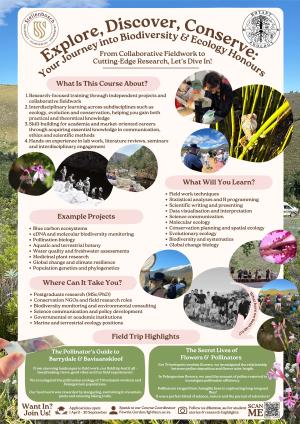
The Honours course runs over one year and through a combination of independent research, skills development and theoretical training, aims to develop an enhanced understanding of scientific theory and practice. Students should emerge with a broad theoretical grasp of diverse topics in ecology and evolution. It is also expected that successful students will be better placed to develop and conduct rigorous scientific research. Successful completion of the Honours course will allow students the opportunity to study further for an academic degree (MSc and PhD).
Students are required to each conduct an independent research project. Many research topics are available in the department, but students are also encouraged to develop their own research questions. Early in the course students should speak to the relevant academics in order to decide on a research topic. The research project accounts for 50 % of the total course mark and as such is the most critical part of the Honours year. Although the final written project report (written as a scientific paper) forms the bulk of the mark, students are also required to submit a written project proposal, present their proposed research verbally to the department and present their results at the department research meeting at the end of the academic year.
STATISTICS: Experimental design and data analysis are arguably the most important skills required by any scientist and thus this forms the bulk of the generic module requirements for the Honours course. An intensive introductory statistics course will run for the first 4 weeks (four hour sessions on Mondays and Wednesdays) of term presented by Dr. Grea Groenewald (GR).
Assessment: An exam and class assignments are associated with this component of the generic module.
ETHICS & PERMITS:
General lecture will be presented by:
Dr Victor Rambau (Research Ethics Committee: Animal Care and Use: Member).
Mr Winston Beukes (Research Ethics Committee: Animal Care and Use: Secretariat)
COMMUNICATION IN SCIENCE: During the course of the Honours year students will be required to read many scientific papers and to distinguish good from weak ones. Students will receive a library tour and guidance on effective reading, searching and evaluating literature. Students will also receive training in scientific writing and presentation skills.
PHILOSOPHY: Students will receive three lectures and a series of discussion sessions around a selected philosophy of science book presented by Dr Jurie van den Heever (JvdH).
Assessment: 1 Assignment
BOOKS: Two books will be assigned which students will be required to read during the course of the year. There will be a group discussion session around each of the books.
Assessment: Questions on all books will be asked in the General Written Examination.
PAELONTOLOGY FIELDTRIP: A day trip to the West Coat Fossil park followed by an overnight stay in Ceres will be done under the supervision of Dr Jurie van der Heever (JvdH). This will take students through diverse Cape landscapes in search of fossils and all array of extant biota
Members of the academic staff present focused, integrated, interactive modules in their fields of expertise designed to provide in-depth exposure to theory and/or relevant techniques in the Biodiversity Sciences. Students choose 3 of the 4 broad subject areas listed below. The range of material covered under each topic will provide students with the requisite breadth of exposure to key concepts in ecology and evolution.
The module choices are listed below:
(1) Biodiversity and Systematics
The Biodiversity and Systematics module essentially covers four areas: chromosomal speciation (mammals), phylogenetics and phylogeography. The fourth aspect that is discussed is an overview (with case studies) of Cape floral diversity. The aim of the module is to provide the basis of the evolutionary processes that give rise to extant biodiversity which is estimated at approximately 8 million species. Some recent indications are that 86% terrestrial and 91% marine species have yet to be discovered and described. Modern species descriptions (documentation of biodiversity) take into account evolutionary history and in this module, we focus on such a systematic approach. The content of this module partly builds on the foundations laid in the third-year module, Evolutionary Principles and Processes. Although this module is presented by different lecturers, there is overlap in topics that are covered and therefore it is expected that some of the study material will reflect this.
(2) Evolutionary Ecology of Plants and Animals
How do everyday events create the wonderful diversity of species, form and behaviour that we see around us today? Can we, through observing the lives of animals and plants around us, make sense of the long tails of sugarbirds, the scent of flowers, and the asexuality of the worker bee. The answers often come by studying natural selection acting on the trait of interest – this is how ecology translates into evolutionary change, or even speciation.
The module may cover the following three areas: pollination networks – a geographic perspective, study natural selection in the wild and the importance of honeybees as pollinators in natural habitats.
A fieldtrip is included where students will see where one plant species varies in morphology across different sites. Data will be collected on pollinators at the different sites and a geographically variable pollinator networks will be built.
(3) Plants and Animals in Extreme Environments
Plant and animal adaptations to environmental extremes involve a suite of form and functional changes which range from anatomy, physiology, biochemical and genetic alterations. The plant portion of this module will cover stresses from the cell to organismal level and integrate this with the larger biome. These stresses include biotic and abiotic factors, to which the plant can respond in a variety of mechanisms. Terrestrial animals occurring in extreme environments exhibit various life history strategies, which are constrained by phylogeny, but many parallelisms are apparent. In this module, we will cover similar adaptations that evolved because of parallel environmental stresses in all of the vertebrate classes.
This module focuses on the ecological and evolutionary responses of plants and animals to extreme environmental conditions, with emphasis on functional trait diversity. Adaptations to environmental extremes involve a suite of form and functional changes which range from anatomical, physiological, biochemical and genetic alterations. The plant portion of this module will cover stresses from the cell to organismal level, and integrate this with the larger biome. These stresses include biotic and abiotic factors, to which the plant can respond in a variety of mechanisms. Terrestrial animals occurring in extreme environments exhibit various life history strategies, which are constrained by phylogeny, but many parallelisms are apparent. In this module, we will cover similar adaptations that evolved because of parallel environmental stresses in all of the vertebrate classes.
(4) Global Change Biology
The term "Global Change" has come to represent a multi-facetted set of pressures on the socio-ecological system that supports all human life. The interactions of these pressures with biodiversity, ecosystem services and the attendant impacts on people make for both a fascinating and highly applicable subject area for understanding future scenarios for ecosystems and human wellbeing, and how risks can be managed. This module will focus on a few key drivers of global change - mainly invasive aliens, climate change, and habitat transformation - and explore them in interactive ways which will include formal background lectures and class engagement in informal discussion, debate and mini-assignments that will assess global change risks in the context of the Greater Cape Floristic Region
This module explores the complex interactions between climate change and biodiversity within the broader context of 'Global Change' - a multi-faceted set of pressures on the socio-ecological system that supports all human life. By examining the impacts of these pressures on biodiversity, ecosystem services, and human wellbeing, we explore into a fascinating and highly applicable subject area crucial for understanding future scenarios and managing risks. The course focuses on the patterns and processes of biodiversity change in response to global change, employing interactive teaching methods including formal lectures, class discussions, student-led lectures, debates, and a group assignment. We will also involve well recognised national experts in the field as guest lecturers on occasion.
Honours Technical Co-ordinator

Postgrad Information
Postgrad Liaison