
Theoretical Physics
Introducing the theoretical physics environment
Our history
The theoretical physics environment in the Department of Physics was known as the Institute of Theoretical Physics (and before that as the Institute of Theoretical Nuclear Physics) and was founded in 1984 with the support of the Nuclear Development Corporation of South Africa.
The fundamental objectives of the group are to undertake research projects in theoretical physics, to assist in the education of graduate students and to provide a center for the development and co-ordination of activities in theoretical physics in the Physics Department and elsewhere.
There are degree programmes in theoretical physics at all levels in the Department of Physics at Stellenbosch University. If you are interested in a theoretical physics degree, please explore this and the rest of the Department’s website. You are invited to contact staff members with queries about potential research projects.
Our connections
Theoretical Physics is part of the Department of Physics where there are experimental and also other theoretical physics activities.
Members of the environment have numerous contacts to other groups and Departments in Stellenbosch and beyond.
The activities of the Theory Group are often closely linked to those of the Stellenbosch-based hub of the National Institute for Theoretical and Computational Sciences.
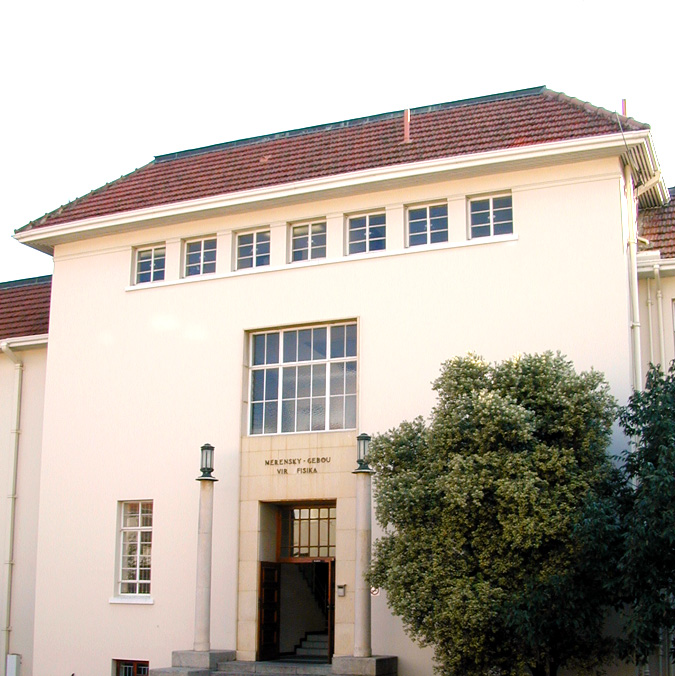
Merensky Building for Physics
Our research
Configurations with localized energy-densities (solitons) emerge in almost any non-linear field theory. Solitons have particle properties. So we use solitons, for example, to study baryon properties that (so far) evade direct computation from QCD. Also, solitons can induce sizable corrections to energies on the quantum level. We compute these corrections in field theories like the standard model. In particular we ask whether these energy corrections can stabilize solitons that would be unstable classically.
Prof. Herbert Weigel
We specialise in understanding polymer and filament networks, active systems and physics of structures at cellular and sub-cellular length-scales. A variety of analytical and computational tools are used, and close relationships exist with other experimental groups.
Prof. Kristian Müller-Nedebock
We focus on theoretical aspects of gravitational physics which span the range from Newtonian gravity to Einstein’s theory of general relativity and modifications thereof. Gravity may be the weakest of the four fundamental forces, but it is the only interaction that is both long-range and universal. Consequently it is the dominant force on the largest length and mass scales and indispensable to any successful understanding of astrophysical phenomena. Our research is concentrated on black holes, dark matter, relativistic hydrodynamics, gravitational waves, and cosmology.
Dr Anslyn John
We focus on theoretical aspects of gravitational physics which span the range from Newtonian gravity to Einstein’s theory of general relativity and modifications thereof. Gravity may be the weakest of the four fundamental forces, but it is the only interaction that is both long-range and universal. Consequently it is the dominant force on the largest length and mass scales and indispensable to any successful understanding of astrophysical phenomena. Our research is concentrated on black holes, dark matter, relativistic hydrodynamics, gravitational waves, and cosmology.
Dr Hannes Kriel
Current academic staff

Postdoctoral fellows

Postgraduate students
Current postgraduate students
- Dean Brand
- Keegan Davids
- Cornel de Villiers
- Nadine du Toit
- Nicholas Folscher
- Abbas Hassafar
- Riyaadh Jamodien
- Matthys Lourens
- Chanelle Manfouo
- Shane McFarthing
- Graham Mitchell
- Nicholas Moschides
- Topollo Naketsana
- Ian Pittaway
- Damian Petersen
- Damian Robson
- Amy Rouillard
- Donovan Slabbert
Former postgraduate students
- Dr Jaymie van der Merwe (2025)
- Dr Langa Horoto (2025)
- Luan van Loggenberg
- Gerhard Woithe
Associates & emeritus members
Associates
Stellenbosch theoretical physicists who are members of the National Institute for Theoretical and Computational Sciences and the School for Data Science and Computational Thinking.
Prof. Francesco Petruccione (Director of NITheCS and a member of the School for Data Science and Computational Thinking and the Department of Physics)
Emeritus members
- Prof. Frederick Scholtz
- Prof. Hans Eggers
- Prof. Hendrik Geyer
- Prof. Dieter Heiss