Monitoring & Evaluation Research & Learning (MERL)

The Theory of Change (TOC)
Experiential learning stands as a cornerstone of modern educational practice, emphasizing the transformative power of learning through direct experience, reflection, and application. Complementing Kolb’s theoretical foundation, George Kuh’s extensive research on student engagement underscores the profound impact of experiential learning on student development and success. Kuh asserts that what students experience outside the traditional classroom, in experiential learning initiatives, internships, service learning, and community-based projects contributes to the valued outcomes of higher education.
By integrating a robust theory of change with ongoing monitoring and evaluation, institutions can not only measure the tangible and intangible impacts of experiential learning but also ensure that students’ voices are central to understanding and improving these educational practices. This approach supports continuous improvement and ensures that experiential learning remains a transformative force for both individual development and broader societal benefit.
To maximize the societal and personal impact of experiential learning, it is essential to articulate a clear theory of change. The theory of change provides a roadmap that links experiential learning activities to desired outcomes, such as increased social responsibility, enhanced problem-solving skills, and greater civic engagement. It makes explicit the assumptions about how and why change is expected to happen because of students’ participation in these initiatives. For example, the theory of change might posit that by engaging in hands-on projects and reflective practice, students will not only acquire new knowledge but also develop the attitudes and behaviours needed to become active, responsible citizens.
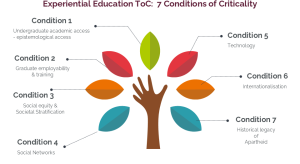
Condition 1: Undergraduate Academic Success – Epistemological Access
Access to university must go beyond admission, ensuring students can meaningfully engage with disciplinary knowledge, develop critical thinking, and participate confidently in academic learning.
Condition 2: Graduate Employability
Graduate employability focuses on equipping students with the skills, experiences and professional competencies needed to navigate the transition from university to meaningful and sustainable careers.
Condition 3: Social Equity and Societal Stratification
Recognising unequal social and economic starting points, higher education must create opportunities that support equitable participation and enable all students to succeed.
Condition 4: Social Networks and Industry Partnerships
Partnerships with industry and organisations expand students’ professional networks and create pathways for mentorship, experiential learning and career development.
Condition 5: Technology and Responsible Digital Access
Equitable access to technology, connectivity and responsible use of digital tools, including artificial intelligence, is essential for enabling inclusive participation in modern learning environments.
Condition 6: Internationalisation and Intercultural Engagement
International and intercultural engagement enriches learning by exposing students to diverse perspectives, preparing them to collaborate and lead in an interconnected world.
Condition 7: Historical Context and Institutional Legacy
South African universities continue to engage with the legacy of apartheid, working towards transformation, inclusion and more equitable institutional cultures.
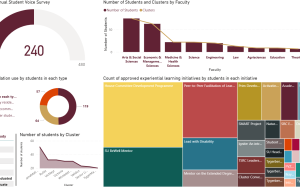
2025 Annual Student Voice Survey